TL;DR
We help working guards determine whether a self-paced security guard course counts for their exact state, role, and license stage. Online coursework may be accepted, but a certificate can still leave fingerprints, an application, firearms qualification, first aid, employer requirements, or an in-person assessment unfinished.
Illinois gives a useful example of why delivery format matters: its law allows qualifying 20-hour guard training through internet-based learning, with completion required within 30 days of employment under Illinois law.
A self-paced security guard course counts only when your regulator permits online delivery for that exact license stage and recognizes the course, provider, and instructor. Even then, fingerprints, a background check, an application, employer paperwork, an in-person scenario, a firearms range qualification, or first aid may still be required before you can work.
We map the state rules, course formats, shift-work checks, and approval records that separate convenient study from a credential you can actually use.
Can Guard Training Be Fully Online?
Sometimes the coursework can be online, but “fully online” is usually too broad a promise for a guard-card path. The question is not whether a provider has lessons on a phone. It is whether the state accepts that delivery method for your unarmed or armed role, at your stage of licensing, from that provider.
California shows the distinction clearly. The state requires at least half of its newer Power to Arrest and Use of Force training in person, and it will not accept split certificates from multiple trainers for that requirement. Read the current BSIS guidance before treating an online course certificate as a complete California registration step.
Fully Online Instruction
Fully online instruction means the required lessons and the required assessment are both accepted remotely. That still does not automatically include fingerprints, a regulator application, a background check, or card issuance.
Self-Paced Study
Self-paced study means you can start, pause, and resume without joining a scheduled class. A state may permit online training without specifically promising that its approved option is asynchronous.
Live Online and Hybrid Courses
Live online classes happen at set times, often with identity and attendance checks. They are not self-paced. Hybrid courses move theory online but retain an in-person exam, scenario, first-aid session, or firearms range requirement.
Online Theory with In-Person Requirements
This is the most common working-guard arrangement. It can be practical, but only if you schedule the required offline component before your employment or renewal deadline.
What Does Your State Allow?
We treat a state’s silence as a reason to verify, not as permission. The matrix below distinguishes explicit online authorization from a conditional status, where the regulator requires an approved course or provider but does not publicly establish self-paced delivery for every component.
| State | Initial Unarmed Training Online? | Renewal Training Online? | Exam Online? | Firearms Online? | First Aid Online? | Official Check |
|---|---|---|---|---|---|---|
| Illinois | Yes, online delivery is expressly permitted | May be online when the applicable statutory training allows it | No separate statewide online-exam rule stated | Do not assume so | Not a general initial requirement | Illinois law |
| California | Hybrid only | Confirm the specific approved course | Required course test, delivery depends on compliant provider | Not fully online | Not a statewide initial-card condition | BSIS guidance |
| Georgia | No, the rule requires classroom instruction | Conditional, with licensed facilitation and records | Completion exam requires 75% | No, range qualification is required | Not a stated basic-course requirement | Georgia rule |
| Florida | Confirm delivery with a licensed Class DS school | No general Class D renewal course stated | Confirm with the licensed school | Hybrid only | Not a stated Class D component | Florida rules |
| Minnesota | Conditional, check the current certified-course record | Conditional, check the course type | Confirm with provider and Board record | Do not assume fully online | Required in armed annual training | MN training |
| New York | Approved school required, delivery mode must be confirmed | Approved school required | Confirm with the approved school | Do not assume online | Not a stated statewide guard-card component | NY training |
| Texas | Conditional, authorized course and instructor required | Employer and DPS rules apply | Level II test required | No fully online course-of-fire path | Not a stated general Level II component | Texas guidance |
| Vermont | Conditional, check the exact OPR-approved course record | Confirm the current record | State examination may apply by role | Confirm the exact role and course | CPR required before application and renewal | Vermont rules |
Every row above should be treated as checked September 8, 2026, not as permanent permission. For example, Georgia’s rule requires 24 classroom hours for private-security employees, an exam with a minimum 75% score, and eight hours of continuing education before renewal. Our Georgia requirements guide helps separate those requirements from a general online certificate.
How Do Course Formats Differ?
Course labels can sound interchangeable when you are balancing night shifts, family obligations, and a hiring deadline. They are not interchangeable for compliance. We recommend matching the course format to the regulator’s language before comparing price, reviews, or lesson count.
Self-Paced Courses
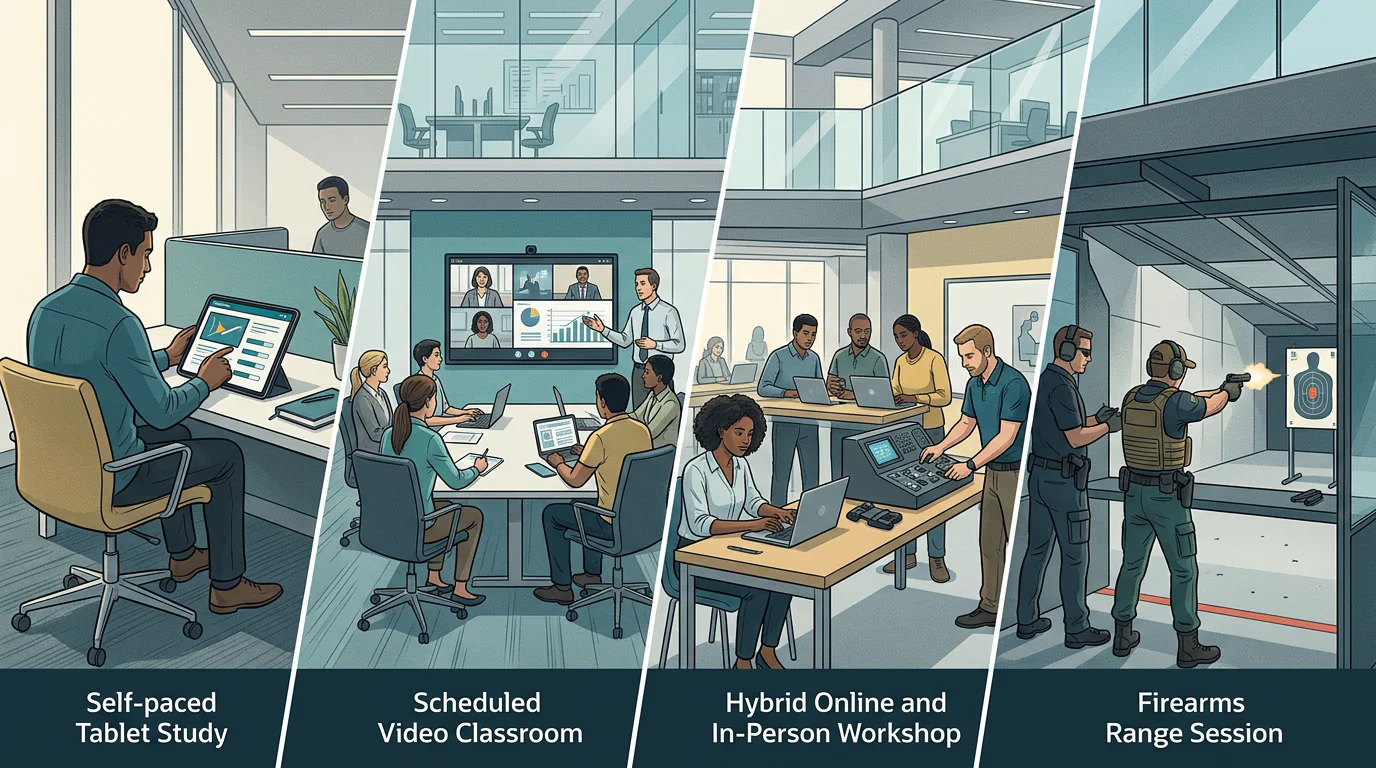
A self-paced course is the best format for unpredictable shifts only when saved progress, access length, assessment rules, and certificate timing fit your deadline. Ask whether the system records time, requires a final assessment, or blocks progress after an absence.
Scheduled Webinars
Scheduled webinars are remote, but they are not self-paced. They can be a valid option where an instructor must verify identity and real-time attendance, especially for courses with live discussion or supervised testing.
Hybrid Courses
Hybrid courses combine online theory with an in-person element. Florida’s Class G route illustrates the point: its classroom material can be delivered live online under identity and attendance controls, while the range portion remains in person.
General Certificates
A broad security certificate may teach useful observation, reporting, ethics, or de-escalation skills. It does not satisfy a guard-card rule unless the authority accepts its course type, hours, provider, instructor, and delivery format. Compare those boundaries with our online guard training guidance before enrolling.
Which Course Fits Shift Work?
The best fit is not simply the fastest course. It is the option that lets you study around interruptions without missing a required live session, range date, certificate deadline, or employer submission window. We publish what we know about our terms and flag what you should still confirm.
| Comparison Point | Our Georgia Basic Security Officer Course | Employer-Supplied Program | Other Approved Candidate |
|---|---|---|---|
| Published price | $65 tuition | Ask employer | Verify current checkout total |
| State-fit warning | Do not assume online delivery satisfies Georgia’s classroom rule | Confirm role and employer acceptance | Verify exact course, provider, and instructor |
| Mobile access | Online access is published, device compatibility is not | Ask employer | Ask provider |
| Pause And Resume | Confirm before purchase | Ask employer | Ask provider |
| Access period | Rolling access, no published day count | Ask employer | Ask provider |
| Assessments | 70% final standard, retakes described | Ask employer | Ask provider |
| Tutor support | Phone and email support published | Ask employer | Ask provider |
| Certificate timing | Emailed after completion, no guaranteed delivery time published | Ask employer | Ask provider |
Our published $65 tuition, rolling-access label, assessment standard, and certificate terms are explained in our course cost detail. That price is tuition, not a promise that every licensing or employer cost is included.
Use this shift-work test before paying:
- Interruption Test: Can you leave mid-lesson and return without losing work?
- Deadline Test: Does the access period extend beyond your hiring, renewal, or application deadline?
- Appointment Test: Can you book any exam, fingerprinting, first-aid, or range component now?
- Submission Test: Will your certificate arrive before your employer or regulator needs it?
- Evidence Test: Can you save the receipt, approval record, and completion certificate in one place?
What Happens After Training?
Finishing lessons is often the midpoint, not the finish line. Your next steps depend on whether you are seeking an unarmed job, an armed assignment, a first registration, or a renewal. For a broader sequence that starts with the format question, use our self-paced course guide before setting your schedule.
| Step | What To Complete | Why It Matters |
|---|---|---|
| 1 | Pass the required course assessment | A completion certificate may depend on it |
| 2 | Finish any live, proctored, first-aid, or range component | Online theory may not cover the whole requirement |
| 3 | Complete fingerprints and background screening | Regulators commonly require a criminal-history review |
| 4 | Submit the correct application and training record | A certificate alone does not issue a card |
| 5 | Meet employer or site-specific requirements | The employer may need extra records or training |
| 6 | Receive active card, registration, or license | Do not perform regulated duties before authorization |
New York, for instance, requires an eight-hour pre-assignment course before application, a 16-hour on-the-job course within 90 days of initial employment, and annual in-service training. Armed applicants also face a separate 47-hour firearms course. The practical lesson is simple: choose your job path first, then select training. Our unarmed versus armed guide can help you keep those paths separate.
How Do You Verify Approval for a Self-Paced Security Guard Course?
Approval is a record-checking task, not a marketing claim. Before you enroll, find the regulator’s approved school, provider, instructor, or course listing and compare it against the course you are considering.
Verify the Provider Number
Ask for the provider, school, facility, or instructor number that applies to your state. Search the regulator’s own lookup, then check whether the authorization is active and matches the course format.
Verify the Exact Course
Match the course title, license stage, required hours, assessment, and delivery method. “Security training” is too broad when you need a specific unarmed, armed, renewal, employee, or independent-guard requirement.
Verify Your Records
Save screenshots of the official listing, course description, checkout receipt, certificate, and any email confirming acceptance. In Georgia, retain the instructor and certificate details that the Board may require. Our course distinction guide explains why a generic certificate cannot be treated as automatic guard-card credit.
Use this three-step enrollment checklist:
- Identify the exact license stage, state, and job type.
- Verify every required component, including offline requirements.
- Save approval and completion records before submitting anything.
If the state language is unclear, call or email the regulator before purchase. Match the regulator’s answer to the exact course title and save the response with your enrollment records.
Train with Learningshopusa
At Learning Shop USA, we want convenience to be the result of a correct choice, not a reason to skip the regulator check. Our catalog helps working guards compare course format, published tuition, access terms, assessments, and certificate details before they commit time around shifts. We also draw a firm line between course completion and a card, registration, firearms authorization, employer assignment, or state approval. If your role is in Georgia, start by matching the job to the Board’s classroom, instructor, recordkeeping, and armed-training rules. If it is elsewhere, use the state matrix, call the regulator when delivery language is unclear, and keep screenshots of every approval record. Bring us the exact course title, state, and license stage before enrolling, so we can help you ask sharper questions and protect your schedule. This preparation lets you plan your next move with confidence. Explore our Learning Shop USA.
FAQs on Self-paced Security Guard Course
Can Security Guard Training Be Completed Fully Online?
Online coursework may count, but complete online licensing is uncommon. Confirm fingerprinting, applications, employer steps, first aid, firearms, and practical assessments before you begin regulated work.
Which Security Guard Certification Course Offers Self-Paced Study?
Select self-paced study only after your regulator confirms online delivery for the exact license stage, provider, instructor, hours, assessment method, and certificate requirements for work.
Which Online Security Guard Course Fits a Working Guard?
Choose a course that saves progress, provides enough access time, meets every deadline, and leaves time for fingerprinting, assessments, paperwork, and range qualification when required.
Which Guard Card Training Is Approved for Online Study?
Approved online study depends on your state, role, course type, provider, and instructor. Check the regulator’s active course or school record before enrolling or paying.
Do Online Guard Courses Require an In-Person Exam?
Some courses require an in-person exam. Others require scenarios, identity checks, fingerprinting, firearms qualification, or employer training. Review every component before paying tuition for training.