Georgia Unarmed vs Armed Guard Training
Compare Georgia unarmed vs armed guard training, 24-hour basics, 15-hour handgun training, range scores, registration, and renewals.

Choosing the right path affects both your training schedule and when you can legally begin work. Georgia requires a 24-hour minimum of basic security instruction for private security employees.
Georgia Unarmed vs Armed Guard Training starts with the same 24-hour basic course from a Board-licensed instructor. Armed officers then need 15 additional handgun-training hours, 80% on written and range tests, and employer-sponsored registration. A basic-course certificate proves training, but it does not independently permit armed work or firearm carrying.
We will compare the two paths, clarify online and in-person limits, and map the steps from first class through ongoing armed compliance.
How Does Georgia Unarmed vs Armed Guard Training Differ?
The simplest distinction is this: unarmed work requires the basic course, while armed work adds firearm instruction, live qualification, and employer-tied Board authorization. We recommend treating the armed route as a separate compliance path, not as a quick add-on to a certificate.
| Requirement | Unarmed Guard | Armed Guard |
|---|---|---|
| Basic training | At least 24 hours | At least 24 hours |
| Added handgun training | Not required | At least 15 additional hours |
| Instructor credential | Board-licensed classroom instructor | Board-licensed firearms instructor for handgun training and range work |
| Delivery constraints | Classroom instruction, confirm provider delivery and attendance controls | Range qualification requires physical attendance |
| Examination | Course assessment practices vary by instructor | Written exam, minimum 80% |
| Range work | None in the basic curriculum | Minimum 80% range score |
| Certificate | Documents completed training | Documents firearm training and qualification |
| Registration | No individual unarmed registration required | Employee registration and weapons approval tied to employer |
| Ongoing obligation | Employer retains training records | Annual firearm requalification plus registration renewal requirements |
A basic-training certificate can still be valuable before a job offer because the Board says a person may attend approved training before being hired. For a closer look at why a course must match Georgia’s mandated curriculum, review our basic-course comparison.
What Does the Shared 24-Hour Course Cover, and Can It Be Online?
The shared course is not simply an introduction to standing post. It covers the everyday judgment calls that shape a security officer’s work, including crime awareness, legal limits, patrol, reporting, emergencies, security technology, customer service, and first aid.
Required Basic Curriculum
Georgia’s curriculum includes the role of private security, legal aspects of the profession, patrol and observation, incident response, security resources, customer service issues, and a first-aid overview. Legal coverage includes arrest and proper use of force, liability, and courtroom testimony, while incident response includes active-assailant response, hazardous materials, bomb threats, evacuation, and mental-health awareness.
That breadth is why we encourage new applicants to compare course descriptions against the state requirements, not only against a course title. Our Georgia guard requirements guide can help you frame that comparison before enrollment.
Online Coursework Requires Careful Verification
The rule uses the term “classroom instruction,” but it does not publish a universal guarantee that every basic course can be completed entirely online. Before paying, ask how the instructor verifies attendance, how any exam is administered, and whether the certificate contains all required details.
The Board requires instructors to give successful students a certificate showing the course dates, topics, actual hours, instructor signature, and full license number. Its instructor standards also require training records to be retained for five years.
The Certificate Is Evidence, Not a Guard Card
A compliant certificate is proof that you completed training. It is not an individual unarmed license, a promise of employment, or permission to carry a firearm. Keep your own copy, and provide it to the licensed security company that hires you.
For students comparing delivery methods, our course comparison explains why instructor credentials and course documentation matter more than a generic completion badge.
What Additional Training, Testing, and Range Work Do Armed Guards Need?
Armed work adds a regulated firearm curriculum to the shared basic course. The added training cannot be reduced to watching firearm lessons because the state requires testing and live range qualification supervised by a Board-licensed firearms instructor.
The Additional 15 Hours
The handgun curriculum assigns one hour to use-of-deadly-force instruction, two hours to liability, one hour to ballistics, three hours to handgun types and safe handling, and eight hours to range qualifications. It covers storage, loading and unloading, holster selection, weapon retention, range safety, drawing, grip, sight alignment, and trigger control.
Written and Live-Range Scores
An armed applicant must score at least 80% on a written examination and at least 80% on the firing range. The range requirement uses two 48-round strings, with the higher score used for qualification, and the listed course of fire includes distances of 3, 7, and 15 yards under the handgun rule.
In-Person Range Work Is Not Optional
The range portion requires a real range, a real firearm, and a Board-licensed firearms instructor who proctors the qualification. We would not describe any armed route as fully online unless every requirement, including physical range work and proctoring, is separately satisfied.
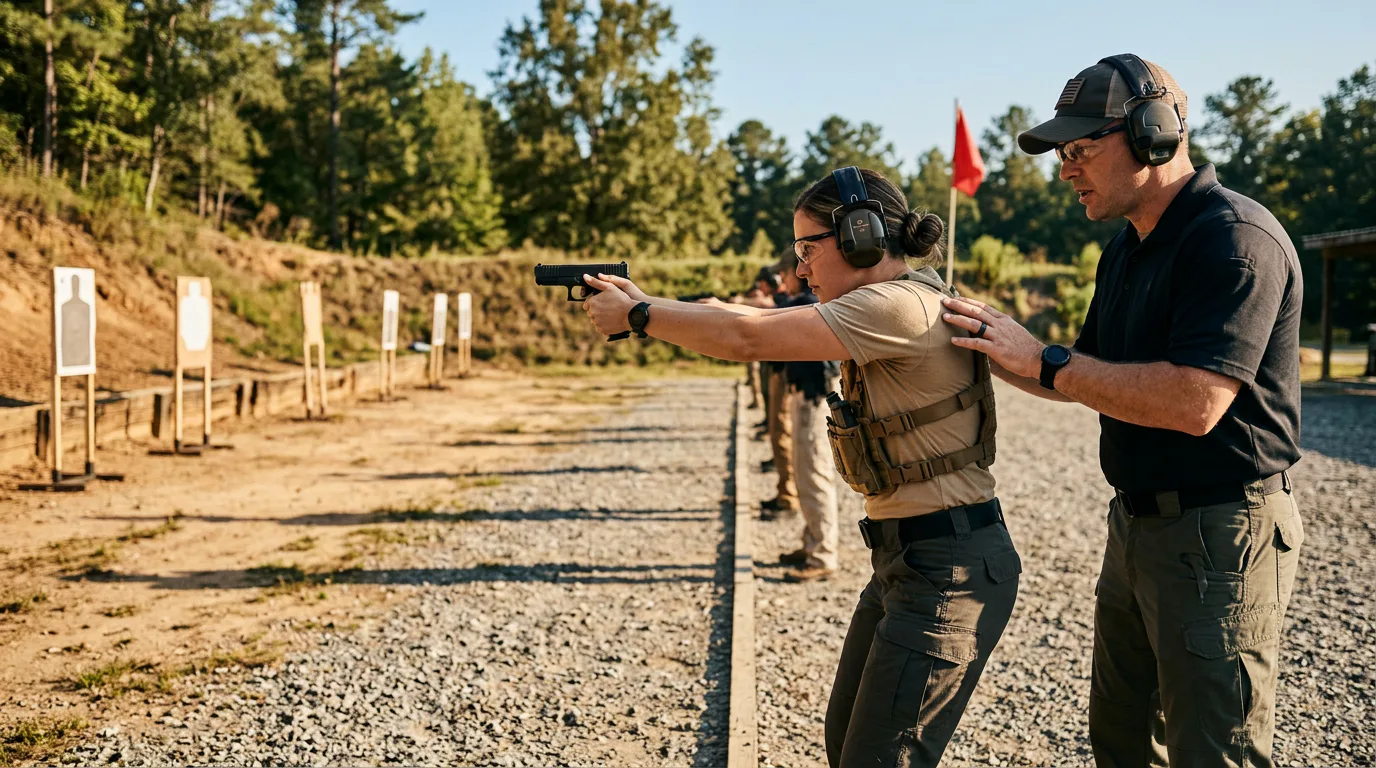
If you plan to add armed qualifications after basic training, start with our security training overview and confirm the firearms instructor’s current Board status before scheduling the range session.
Does a Certificate Make You Eligible to Work or Carry a Firearm?
Training, employment, and armed authorization are three separate milestones. Keeping them separate prevents the most costly mistake in this field, assuming that course completion alone gives someone authority to work armed.
| Status | What It Shows | What It Does Not Do |
|---|---|---|
| Basic-training certificate | Required 24-hour training was completed | Create an armed registration or authorize firearm carrying |
| Employment with a licensed company | The company can assign security work within its compliance process | Transfer an armed registration from another company |
| Armed registration and weapon approval | The Board has approved the employee for armed work with that employer | Authorize work for a different company |
The hiring company is responsible for training through a Board-approved instructor, and an armed employee license is tied to a specific employer. If an armed employee changes companies, a new application is required before working for the new employer, according to the Board FAQ.
What the Employer Submits
For armed employee registration, the Board’s checklist includes the application and fee, weapons-permit form, proof of training, range scores, affidavit of employment, and background-check materials. We do not promise a universal approval timeframe because the Board does not publish one that applies to every applicant.
How to Verify an Instructor
Use the Board’s GOALS Licensee Search, then confirm that the instructor’s status is active and that the license type fits the training. A classroom instructor may teach the basic security course, while firearm curriculum and range qualification require the appropriate firearms credential.
Match the instructor’s full license number against the number printed on your certificate, then confirm the future employer is actively licensed. Our Georgia licensing guide walks through the questions worth asking before you accept a training provider’s claim.
What Are the Fastest Legitimate Paths for Unarmed and Armed Work?
Speed depends on the class schedule, the instructor’s documentation process, a prospective employer’s hiring steps, and, for armed work, range availability and Board processing. A person with two weeks available may finish scheduled training, but no provider can honestly guarantee employer hiring or armed approval by a fixed date.
Five Steps for Unarmed Work
- Identify a licensed security employer or confirm the basic course you plan to take is taught by an active Board-licensed classroom instructor.
- Complete the 24-hour curriculum before providing security services.
- Review your certificate for the training dates, actual hours, course topics, signature, and instructor license number.
- Give the certificate to your employer and retain your own copy.
- Follow the employer’s onboarding and recordkeeping process before reporting for duty.
Training completed after January 1, 2022 must be retained in the employee file for five years, and the employee must receive a copy of the certificate. That recordkeeping rule is one reason we advise workers to protect their paperwork from the first day.
Seven Steps for Armed Work
- Confirm that you meet the armed path’s age and employer requirements.
- Complete the shared 24-hour basic course.
- Verify a Board-licensed firearms instructor and reserve a physical range session.
- Complete the 15-hour handgun curriculum.
- Pass the proctored written exam and live range qualification at 80% or higher.
- Work with the employer on the employee-registration, background-check, training, range-score, and weapons-permit documents.
- Wait for approval before working armed, then complete annual weapon qualification and required renewal education.

For a broader pre-enrollment checklist, see our security coursework guide. It can help you organize the documents and practical questions that come before an employer submits an armed application.
Choose Your Next Step with Learningshopusa
At Learningshopusa, we built our Georgia guard training information for people who need a clear decision before spending time on a course. We help you separate the shared basic-training requirement from the added armed path, then prepare the questions to ask an instructor and prospective employer. That matters when you work full-time and need to plan around class access, a proctored assessment, range availability, fingerprinting, and the employer’s submission process. We will never present a course certificate as an armed credential or promise an approval date that only the Board and employer control. Start by confirming the instructor’s active license category, ask whether the course records attendance and supplies a compliant certificate, and reserve a range session before you choose the armed route. When you are ready to compare the next practical steps with confidence, begin today with Learning Shop USA
FAQs on Georgia Unarmed vs Armed Guard Training
These answers address the points most likely to affect a new applicant’s training choice, work timing, and required documentation.
Do Georgia Armed Guards Need the 24-Hour Course?
Yes. Georgia requires all private security employees to complete at least 24 hours of basic classroom instruction. Armed applicants complete that requirement before the additional handgun curriculum.
Can the Basic Course Be Completed Online?
The rule uses classroom instruction and requires a Board-licensed instructor, but it does not establish a universal online-delivery guarantee. Confirm delivery, attendance, testing, and certificate practices before enrolling.
Does a 24-Hour Certificate Let Me Carry a Firearm?
No. A basic certificate documents training. Armed work also requires firearm coursework, passing scores, employer-supported registration, and Board weapons authorization. Do not carry a firearm until that approval is issued.
What Score Is Required for Armed Range Qualification?
Georgia requires an 80% written score and an 80% range score, each proctored by a Board-licensed firearms instructor. The higher result from two 48-round strings is used.
Do Unarmed Guards Need Individual Board Registration?
No individual registration is required for unarmed guards, but required training still applies. The licensed company oversees compliance and retains the mandated training record, while armed registrations are employer-specific.
How Do I Verify a Georgia Security Instructor?
Use the Board’s licensee search, select the applicable instructor category, and verify active status. Then match the instructor’s full license number with the number printed on your certificate.