Vermont Security Guard License: Registered or Licensed, 8 or 40 Hours
A Vermont security guard license comes in two forms: registration after 8 hours of approved training for agency employees, or a full license after 40 hours, an exam and two years' experience.
By Sharon DeCet, Founder · Updated 14 Oct 2026

Key takeaways
If a licensed Vermont agency is hiring you, you need registration as a registered security employee: age 18, 8 hours of approved training and a character review (Vermont administrative rules, Rule 4-2). The full license is for guards who work independently, and it needs 40 hours, an exam and two years' experience.
A first-time guard starts as a registered employee, because the licensed credential requires two or more years of security experience under 26 V.S.A. (Vermont Statutes Annotated) § 3174.
- As of October 2026, the starting cost of the unarmed route is $200 for registration and $350 for the license. That is our course price plus the state application fee, before cardiopulmonary resuscitation (CPR) certification and fingerprinting.
- Carrying a firearm on duty adds a firearms specialty: 12 classroom hours, 4 more on your specific weapon, and range qualification.
In this article
- 1Which Vermont security guard license do you need: registered or licensed?
- 2Who can guard property in Vermont without a security guard license?
- 3Why do applicants lose time getting a Vermont guard card?
- 4How do you register as a Vermont security employee, step by step?
- 5How do you get a licensed security guard license in Vermont?
- 6What does a Vermont security guard license cost in 2026?
- 7What does the armed specialty add for Vermont security guards?
- 8How do you check that a Vermont guard course is OPR-approved before you pay?
- 9Frequently asked questions
The same Vermont job ad that asks for a guard card can mean an 8-hour registration or a 40-hour license that also demands two years of security experience. The phrase guard card covers both, so the wrong guess costs you a course you did not need or a shift you were not allowed to work.
The Vermont Office of Professional Regulation (OPR) handles both credentials. Its February 2026 application instructions ask applicants to allow 3 to 5 business days for processing. The same document states that beginning employment before a valid registration has been issued is a criminal offense in Vermont.
So the order of your steps decides how this goes: which credential, which course, and when you start work.
This page sorts you into the right credential first. Then it gives the steps, the costs and the checks that keep an application from stalling.
Which Vermont security guard license do you need: registered or licensed?
If an agency is hiring you as an employee, you need registration, not the full license. Vermont's rules define a registered security employee as someone who works for a licensed agency under a licensed guard's supervision. The licensed security guard credential is for guards who work as sole proprietors or carry an agency's regulatory responsibility.
Three terms, used the same way for the rest of this page:
- Registered security employee: the 8-hour credential for agency employees (Rule 4-2).
- Licensed security guard: the 40-hour credential (Rule 4-1).
- Guard card: the everyday name employers use. The state's own documents call the credential a registration or a license, so use those words when you contact OPR.
Under Rule 1-3, an agency employee is engaged directly by the agency and paid through its regular W-2 payroll. An independent contractor, a subcontractor or an employee of another corporate entity is not an agency employee. A 1099 contractor therefore cannot register under an agency.
| Your situation | Credential | Approved training | Other requirements | Application fee (as of October 2026) |
|---|---|---|---|---|
| Employed by a licensed Vermont agency, unarmed | Registered security employee | 8 hours | Age 18, character review, CPR certification | $70 |
| Same job, carrying a firearm | Registered, plus firearms specialty | 8 hours, plus firearms training | FBI background check | $140 |
| Working for yourself, or the agency's responsible guard | Licensed security guard | 40 hours | State exam, 2 or more years of security experience, 2 character references, FBI check | $175 (armed: $230) |
| Guarding only your own employer's premises | May be exempt | None | See the next section | None |
Fees come from 3 V.S.A. § 125(b). Age, hours and experience come from the administrative rules, and the references, exam and FBI check from the application instructions.
Who can guard property in Vermont without a security guard license?
Three groups are exempt under 26 V.S.A. § 3151a: certified law enforcement officers on approved, assigned security work, unarmed property managers doing damage inspections, and employees who provide security exclusively for one employer's own affairs.
The third group is the one that confuses people. A guard employed directly by the business they protect fits it. A guard placed at a client's building by a security company works for the company, which is a regulated agency, so the agency registers that guard. That is our reading of the statute's wording, not an OPR ruling.
If you are unsure whether you are employed directly or placed by a security company, call OPR at 802-828-1505 (the number on its application instructions) before your first shift. It is far cheaper to ask than to practice without a credential.
Why do applicants lose time getting a Vermont guard card?
Four mistakes cost applicants time: submitting an incomplete application, training for the wrong credential, mistiming the CPR certificate, and letting a registration go inactive.
- Incomplete applications. OPR does not process incomplete applications (Rule 3-1(a)): every question, attestation, document and fee must be in.
- Wrong course. An agency employee needs 8 hours. The 40-hour course is for the licensed credential. Confirm which one your employer files before you buy.
- CPR timing. OPR's FAQ requires an approved CPR certification within two years before you apply and before renewal. The rules (Rule 6-3) give agency personnel three months from hire. Holding a current certificate from the American Red Cross, the American Heart Association or an equivalent OPR-approved source before you apply satisfies both in our reading.
- Inactive registrations. A registered employee who is not employed and supervised by an agency holds a license that is "active but inoperative," and working in that state counts as unauthorized practice (Rule 4-2(b)). The employing agency must have a licensed security guard on staff who supervises its registered employees (Rule 4-5(c)). Agencies must notify OPR within 72 hours when they end a licensed employee's employment (Rule 7-5). For any arrangement beyond this, such as working for more than one agency, ask OPR at 802-828-1505.
How do you register as a Vermont security employee, step by step?
Registration takes five steps, and each has a check you can run before moving on.

- Confirm your employer is a licensed Vermont agency.
Pass: the agency will complete the supervisor authorization for you. OPR's forms page lists a Supervisor Authorization Form and an Employment History Form for registrants. Fail: no agency will supervise you, which leaves your registration inoperative.
- Complete 8 hours of approved training.Rule 9-3 sets the minimums at 2 hours on the role of the agency guard, 3 on ethics and conduct, and 3 on legal powers and limitations. Pass: you hold a completion certificate from a program OPR has approved.
- Get CPR certified.Pass: a certificate dated within two years before the day you apply. Fail: an expired card, or a course that is not from the American Red Cross, the American Heart Association or an OPR-approved equivalent.
- Submit the online application and pay the $70 fee($140 if you will be armed). Pass: no blank answers, all attestations made, documents uploaded, fee paid.
- Wait for the registration to be issued.
OPR runs an internal Vermont Crime Information Center (VCIC) background check on every application. Pass: you appear with an active status in OPR's license lookup, which Rule 6-1 treats as primary-source verification. Do not work a shift until you do, because beginning employment without an issued registration is a criminal offense.
Our Vermont Registered Security Employee Course covers step 2. It is 8 hours, self-paced, with 70 lessons, 6 assessments totaling 74 questions and a final exam, and you receive a certificate of completion when you pass. The course is approved by Vermont's Office of Professional Regulation, Private Investigative and Security Services.
How do you get a licensed security guard license in Vermont?
A licensed security guard application requires seven items, all listed in the OPR application instructions:
- The online application and non-refundable fee.
- A completion certificate from an approved 40-hour course.
- At least two completed character references, plus verification of your experience.
- The Vermont State Jurisprudence Examination, with your answer sheet uploaded. It covers Vermont statutes, administrative rules, the Fair Credit Reporting Act and public records laws.
- An official license verification sent directly to OPR from your first and most recent licensing states, if you have held a license elsewhere.
- The VCIC background check, which OPR runs.
- An FBI release form and fingerprinting.
The experience requirement is the one that stops new guards. Section 3174 allows that experience to be time licensed in another state, regular employment with a licensed agency, or service as a sworn law enforcement officer. A first-time guard builds it as a registered employee.
If you already hold a guard license in another state, OPR's instructions describe a separate Fast Track Endorsement route. It consists of the application and fee, the jurisprudence exam, and official license verification from your first and most recent states.
Rule 9-2 sets minimum hours for eleven topics in the 40-hour course: role of the security guard 2, ethics and conduct 4, legal powers and limitations 4, communication and public relations 4, patrolling and investigation 4, emergency response 4, observation and note taking 4, statements 2, evidence 2, access control 2, and report writing 4. By our addition those minimums total 36 hours, so a 40-hour course has 4 hours beyond them.
Our Vermont Licensed Security Guard Course is 40 hours, self-paced, with 83 lessons, 6 assessments totaling 81 questions and a final exam. It is approved by the same OPR office. For the report-writing hours specifically, our guide on security guard report writing shows the field note to finished report method.
What does a Vermont security guard license cost in 2026?
A Vermont security guard credential costs the state application fee plus an approved training course, and you add CPR certification and fingerprinting.
| Credential | Our course | State application fee | Total | State renewal, every two years |
|---|---|---|---|---|
| Registered security employee, unarmed | $130 | $70 | $200 | $95 |
| Licensed security guard, unarmed | $175 | $175 | $350 | $140 |
This is our calculation: our course prices as of October 2026 plus the application fees in 3 V.S.A. § 125(b). The licensed route costs $150 more up front ($350 minus $200).
Armed credentials carry higher state fees: $140 to apply and $150 to renew as a registrant, and $230 to apply and $205 to renew as a licensee. The firearms course comes on top. CPR certification and fingerprinting prices depend on the providers you choose. Ask your hiring agency what it arranges or pays for before you spend your own money.
What does the armed specialty add for Vermont security guards?
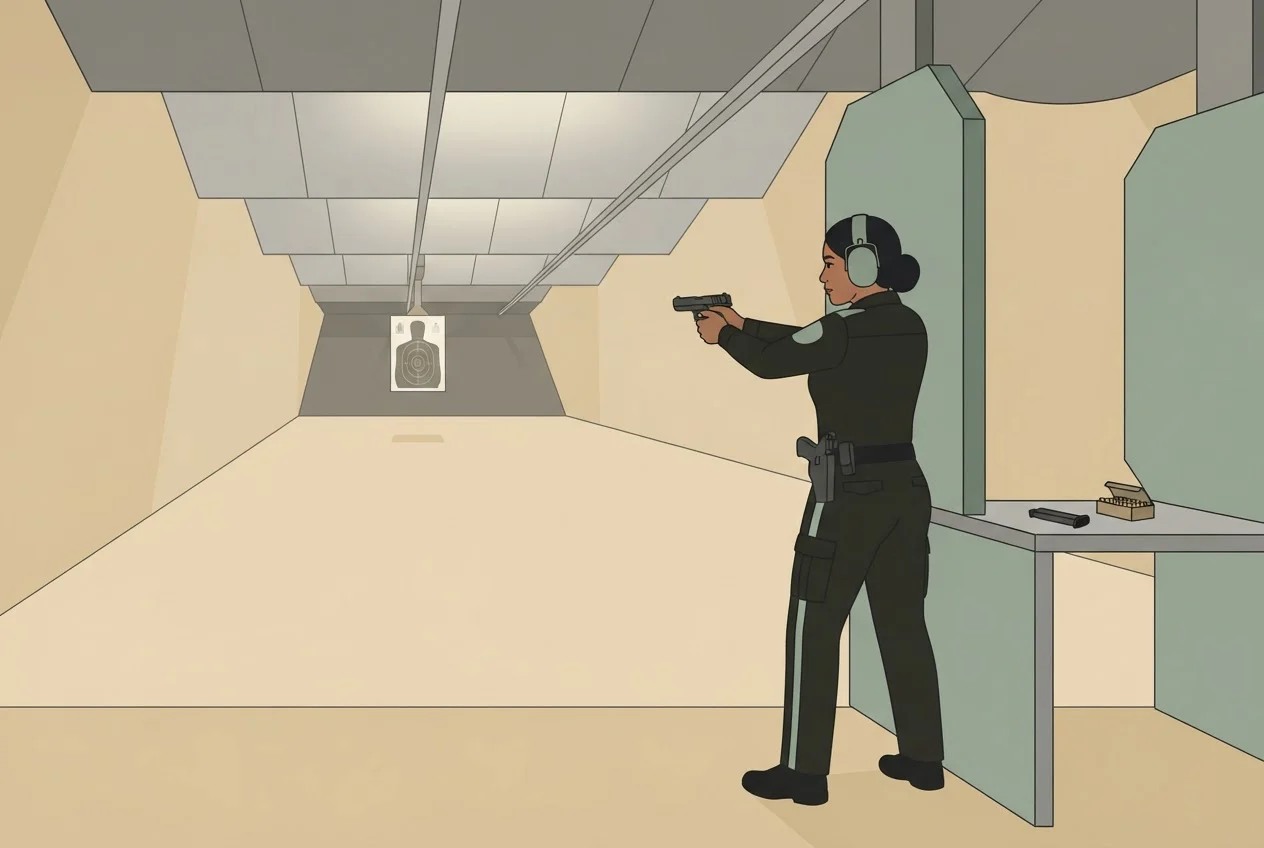
The armed specialty adds 12 classroom hours, 4 more on your specific weapon, and range qualification. You cannot carry a firearm on duty without the designation, and the rules treat that strictly.
Rule 5-3 requires approved classroom instruction of at least 12 hours in safe handling, proper use and legal responsibility for improper or negligent use. It also requires at least 4 hours on the weapon you will carry, and range qualification appropriate to that weapon. Renewal needs a valid firearms recertification certificate.
Rule 5-1 applies even when the gun is never fired: possessing or controlling a firearm while working as a licensee requires an active designation, regardless of intent. The training must come from an instructor registered with OPR (Rule 4-7). The instructor completes a Verification of Firearms Status form for your application, and OPR's online services system lists approved instructors. Armed applicants also need an FBI background check.
How do you check that a Vermont guard course is OPR-approved before you pay?
Ask OPR or your hiring agency to confirm the course is approved before you pay. The rules (Rule 9-1) credit only programs that OPR has approved, and approval is granted to a specific program and its instructors. OPR can also revisit it. A completion certificate from a program OPR has not approved does not count toward your credential.
Our guides on which online guard training meets state rules and on why course completion is not a guard license explain the same check for any state.
For the 8-hour registered credential, start with the Vermont Registered Security Employee Course at $130. For the 40-hour licensed credential, take the Vermont Licensed Security Guard Course at $175. Not sure which one your employer files? Call us at (832) 922-1215 or (706) 268-2221, Monday to Friday, 9:00 AM to 6:00 PM EST.
Pick the right Vermont guard course
Frequently asked questions
No. You can apply for jobs and finish training first, but your registration must be issued before your first shift. OPR's February 2026 instructions ask applicants to allow 3 to 5 business days for processing, and incomplete applications are not processed at all.
Sources
- 1.OPR, Licensed Private Investigator or Security Guard Application Instructions, February 2026
- 2.Vermont Administrative Rules for Private Investigators and Security Guards (Rules 1-3, 3-1, 4-1, 4-2, 4-5, 4-7, 5-1, 5-3, 6-1, 6-3, 7-5, 9-1 to 9-3)
- 3.OPR, Private Investigative & Security Services FAQs
- 4.OPR, Forms and Instructions for Private Investigative and Security Services
- 5.26 V.S.A. § 3174, Security guard licenses
- 6.26 V.S.A. § 3151a, Exemptions
- 7.3 V.S.A. § 125, Fees
- 8.Vermont Statutes Online, Title 26, Chapter 59
- 9.Learningshopusa, 205. Vermont Registered Security Employee Course
- 10.Learningshopusa, 208. Vermont Licensed Security Guard Course