Criminal Defense Investigator: Is a PI License Required?
A criminal defense investigator does not need a private investigator license for public defender jobs: none of eight reviewed postings required one. Private defense work depends on state law, so check yours.
By Sharon DeCet, Founder · Updated 10 Oct 2026
Key takeaways
- 01A criminal defense investigator can be hired by a public defender office without a private investigator (PI) license: none of eight reviewed postings required one. State law decides private defense work.
- 02Entry takes a degree, investigative experience, or both. Six of the eight accept a route without a bachelor's degree, but two of those (Contra Costa, Santa Cruz) still require college coursework, so only San Francisco, San Bernardino and Colorado are open with no college at all.
- 03Starting pay in seven posted defender roles (2023 to 2026, several now closed) ran from $39,000 to $115,544, median $64,792 (our figure from a small sample). The Bureau of Labor Statistics (BLS) reports a May 2025 median of $51,220 for all private detectives and investigators.
- 04The Certified Legal Investigator (CLI) credential needs 5 years as a legal investigator, and the Certified Criminal Defense Investigator (CCDI) credential needs 2 years as a criminal defense investigator. Both follow the job, so build interviewing, writing and evidence skills first.
In this article
- 1What does a criminal defense investigator do, and who hires one?
- 2Do you need a private investigator license to work as a criminal defense investigator?
- 3When does a PI license matter for private defense investigation work?
- 4What does a defense investigator earn?
- 5How do you read a defense investigator posting and decide where to apply?
- 6Are the Certified Legal Investigator and Certified Criminal Defense Investigator credentials required?
- 7Which training builds the skills a defense investigator needs?
- 8Frequently asked questions
Several defender offices accept documented investigative work in place of a four-year degree, so the credentials people chase first, such as a private investigator (PI) license or a professional certification, often decide less than a record of real casework. A new investigator who knows that can spend the first months building casework instead of collecting credentials.
Pay depends on the employer more than on credentials. San Francisco's Public Defender's Investigator class starts at $115,544 a year as of July 1, 2026, the highest start among the offices compared below. Other offices start far lower, so the same job title covers very different incomes.
The sections below set out what a set of real defender postings requires, what they pay and when a license does matter. A checklist then shows how to read any posting, followed by the two professional certifications and a training path for the skills the postings name, so you spend money in the right order.
What does a criminal defense investigator do, and who hires one?
A criminal defense investigator finds and documents facts for the defense in a criminal case. The work is locating and interviewing witnesses, checking police reports and evidence, writing up findings and testifying about them. Public defender offices, which represent defendants who cannot afford a lawyer, hire them directly. Private defense law firms retain them too.
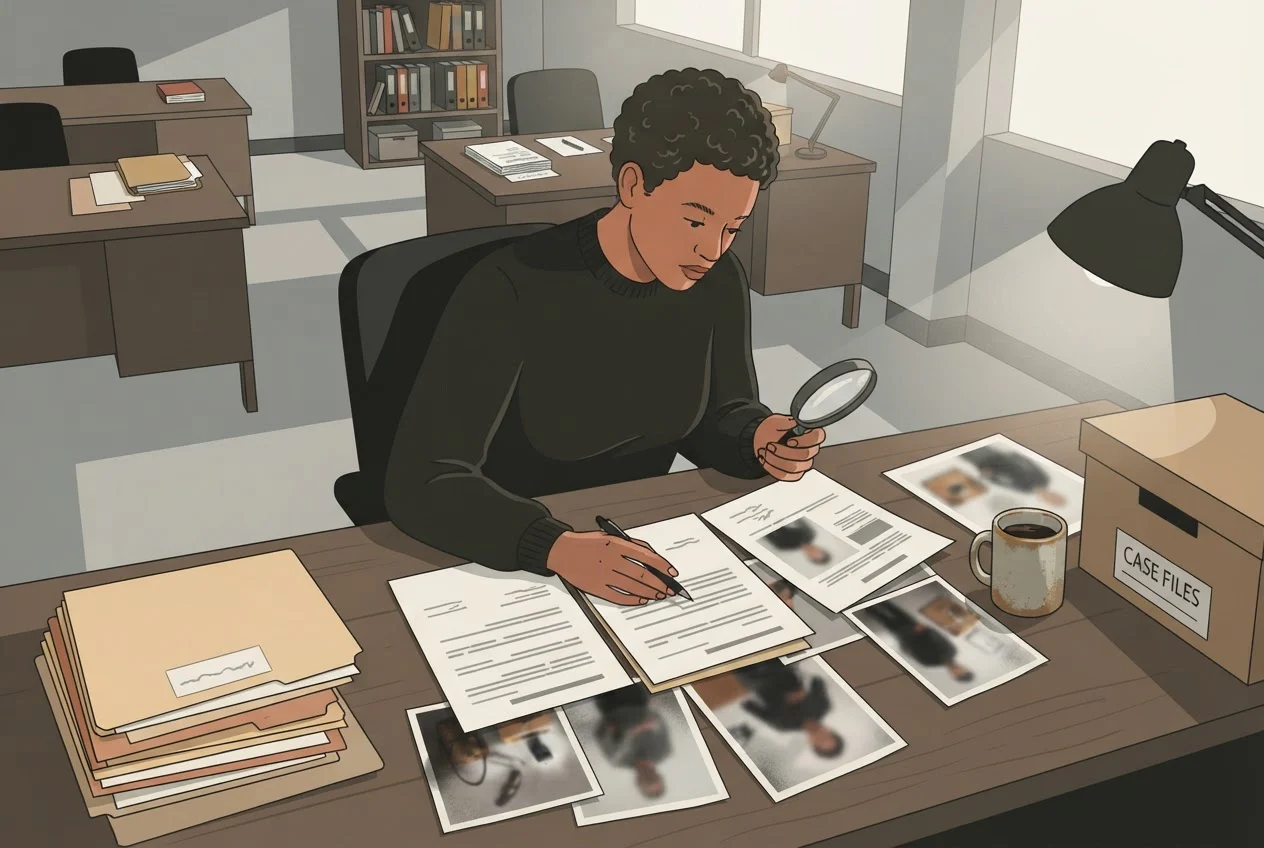
Fulton County, Georgia's public defender posting lists the daily work: supporting assistant public defenders, locating witnesses, serving subpoenas, transporting clients and attorneys, preparing investigative documents and testifying in court.
A defense investigator is not a police detective. The BLS notes that private detectives and investigators have no police authority and follow the same laws as any private citizen.
Do you need a private investigator license to work as a criminal defense investigator?
No, not for public defender investigator jobs. None of the eight postings and job classifications below requires a PI license, and all eight name a valid driver's license instead. For private defense work, state law decides, as the next section shows.
| Employer | Pay as listed | Entry route | PI license required? |
|---|---|---|---|
| $115,544 to $140,452 (from July 1, 2026) | 1 year of investigative experience in fields such as law, journalism or public health, or a bachelor's degree | No | |
| $109,338 to $132,900 (listed Oct. 2026) | Bachelor's degree plus 1 year of defense-related investigation, or 60 college units plus 2 more years of relevant work | No | |
| $64,792 to $86,985 (closed Sept. 2024) | Any one of: 1 year of government investigations, 2 years in a public defender office, a California PI license, or a related bachelor's degree | No (a license is one qualifying option) | |
| $61,380 to $114,167 (closed Jan. 2025) | Bachelor's degree plus 3 years of law enforcement or investigative work, or an equivalent combination | No; Georgia POST (Peace Officer Standards and Training) certification preferred | |
| $60,185 to $122,459 (closed Aug. 11, 2023) | Bachelor's degree at every grade; Grade 9 adds 1 year and Grade 11 adds 3 years as a criminal defense staff investigator | No | |
| $5,540 a month, about $66,480 a year (Sterling position, listed Oct. 2026) | Bachelor's degree or equivalent education or experience | No | |
| Starts at $39,000 (listed Oct. 2026) | Bachelor's degree plus investigation experience | No | |
| — | 2 years of college plus 2 years of law enforcement or investigative work, or a related bachelor's degree | No |
The eight entries were compiled in October 2026 and are dated 2023 to 2026, and several are now closed. They show how defender offices write requirements, not what is open today.
Six of the eight (San Francisco, Contra Costa, San Bernardino, Fulton, Colorado, Santa Cruz) accept a route without a bachelor's degree. Contra Costa's route needs 60 college units and Santa Cruz's needs 2 years of college. Fulton's route is an unspecified "equivalent combination." Only San Francisco, San Bernardino and Colorado are clearly open with no college at all. DC and Miami-Dade name a bachelor's degree.
When does a PI license matter for private defense investigation work?
A PI license matters when you take defense cases as a private investigator, because the BLS reports that most states require private detectives and investigators to be licensed. Whether an investigator employed by an attorney is exempt differs by state, so the answer depends on where you work and how you are engaged. Our state-by-state guide to private investigator license requirements shows where your state stands.
- Texas. The Department of Public Safety Private Security Program licenses investigators under Occupations Code Chapter 1702. Attorney General Opinion GA-0275 (2004) concluded that an employee working under an exempt attorney's direct supervision does not need an investigations license.
- Georgia. The Board of Private Detective and Security Agencies licenses private detective businesses under Title 43, Chapter 38. Section 43-38-14 lists the exceptions, which include persons employed only in connection with a single employer's affairs.
- Minnesota. Minnesota Statutes 326.3381 bars anyone from engaging in the business of private detective without a license from the Private Detective and Protective Agent Services Board. It exempts a proprietary employer from needing its own license.
Our inference: a staff investigator employed by the defending attorney or firm is more likely to be exempt than a freelancer billing several firms, who carries the licensing risk. Our recommendation: before accepting paid work, ask your state board in writing whether your arrangement requires a license.
What does a defense investigator earn?
Starting pay in seven posted defender roles (2023 to 2026, several now closed) ran from $39,000 to $115,544 a year, with a median of $64,792. That median is our figure from a small sample. The BLS reports a May 2025 median of $51,220 for all private detectives and investigators, across 39,500 jobs.
Our model, with the working shown. We used the seven table roles that state pay and took the lowest figure of each range. Colorado's $5,540 a month times 12 is $66,480. Sorted, the seven starts are $39,000, $60,185, $61,380, $64,792, $66,480, $109,338 and $115,544. The fourth of seven is the median: $64,792.
Treat it with care. Seven postings is a small sample, and two are California offices that pull the top end up. Colorado's figure is for one named position. Miami-Dade's $39,000 is a starting figure that can rise with qualifications. The BLS figure covers every pay level and every kind of private investigator, so the two numbers are not like-for-like. Ceilings are separate from starts: the highest top step in the table is $140,452 in San Francisco.
How do you read a defense investigator posting and decide where to apply?
Check six things in order: the license line, the entry route, the degree line, any trainee clock, the annualized pay, and the vehicle requirement. Each is a test with a clear result.
Defense Investigator Posting Check

License line
Search the minimum qualifications for "private investigator license." Pass: it is absent or listed as one of several routes, as in San Bernardino's trainee class. Fail: it is stated as required, so check your state's licensing rule before applying.Entry route
Count your documented years of paid investigative work, including journalism, legal services or social work. Pass: your years meet the posting's number (San Francisco and Contra Costa ask for 1, Fulton for 3). Fail: you are short, so look for the trainee or entry grade.Degree line
Does the posting offer a route without a bachelor's degree? Six of the eight did, but Contra Costa (60 college units) and Santa Cruz (2 years of college) still require coursework. Pass: you meet the degree route or an experience route. Fail: only a degree route is offered and you lack it.Trainee clock
San Bernardino's trainee must be promoted within 9 months or be terminated. Pass: you can show the promotion skills within that time. Fail: you would need longer, so ask whether a different class fits.Annualized pay
Convert hourly pay by multiplying by 2,080 hours and monthly pay by 12. Pass: the posting shows a salary range with steps, and the first-step annual figure meets your minimum. Fail: no range is shown, so ask the employer's human resources office for the step schedule.Vehicle and driver's license
All eight name a valid driver's license, and Colorado, DC and Miami-Dade also require a working, insured vehicle. Pass: you hold both before you apply. Fail: sort it out first.
Which posting type fits your background?
| Your background | Posting type to target |
|---|---|
| Bachelor's degree, no investigative work | Entry or trainee classes (San Bernardino trainee, DC Grade 7) |
| 1 year of investigative work in law, journalism, social work or a nonprofit | San Francisco or Contra Costa style classes |
| Law enforcement experience | Fulton style (degree plus 3 years) |
| Neither, and you want private defense work | Confirm your state's PI license rule first |
Our inference: a writing sample improves any application, because the postings put preparing investigative documents among the core duties. Our guides on writing investigation reports that hold up and interview techniques for investigators show how to build one.
Are the Certified Legal Investigator and Certified Criminal Defense Investigator credentials required?
No. Neither credential appeared in the minimum qualifications of the eight postings, and both require years of experience before you can apply, so they follow the job.
The CLI comes from the National Association of Legal Investigators. Requirements include five years of verifiable work experience as a legal investigator, with 60 college semester hours substituting for one year. You also submit a white paper of at least 1,000 words and pass an oral exam and a written exam. You need 70% or more in each of the three parts. Renewal runs in three-year periods with continuing education credits.
The CCDI comes from the Criminal Defense Investigation Training Council. Requirements include two years as a criminal defense investigator, either in a public defender's office or as a licensed private investigator, and 25 documented, comprehensive assignments. You also need two recommendations from defense counsel and a written test. Training of 16 hours, 8 hours (fast track) or approved distance learning must be used toward certification within five years of completion. The fee is $225, which includes first-year membership, or $175 for current paid members. Maintaining it takes 10 continuing education units every two years.
Our recommendation: start a case log from your first assignment, since the CCDI asks for 25 documented assignments and the log is hard to rebuild later.
Which training builds the skills a defense investigator needs?
Training that covers criminal law, evidence, interviewing and testimony matches the duties in the postings. Our Criminal Defense Investigation course costs $120 as of October 2026. It runs 8 hours across 63 lessons with 12 assessments (136 questions) and ends in a certificate of completion. The course is self-paced online.
It covers the roles of the investigator, defender, defendant and prosecutor, how the criminal courts operate, defenses to criminal charges, defendant's rights, reconstructing the scene, interviewing witnesses, forensic testing, evaluating the police investigation, chain of custody, search and seizure, evidence admissibility and testifying.
The course page lists approval in Missouri, Minnesota, Kansas, Iowa, Oregon, South Carolina, Oklahoma, Kentucky, Tennessee, New Mexico, Texas, North Carolina and Georgia, with North Carolina credit limited to 6 continuing education units. State approvals cover PI continuing education only and do not count toward CLI or CCDI requirements. Our guide to checking whether a PI course counts in your state walks through confirming it with your own state board.
Individuals can enroll on the course page. For a corporate account, call 706-268-2221 or 832-922-1215, Monday to Friday, 9 AM to 6 PM Eastern.
Build defense investigation skills with a $120 course
Frequently asked questions
A legal investigator provides litigation support to attorneys on any kind of case. A criminal defense investigator works only on the defense side of criminal cases. The National Association of Legal Investigators' CLI requirements cover work for law firms, public defenders' offices and private investigation firms.
Sources
- 1.San Francisco Public Defender's Investigator, classification 8142
- 2.Contra Costa County, Public Defender Investigator I
- 3.San Bernardino County, Public Defender Investigator/Trainee
- 4.Fulton County, Investigator, Public Defender
- 5.Public Defender Service for the District of Columbia, Investigative Specialist
- 6.Colorado State Public Defender, Investigators
- 7.Miami-Dade Public Defender, Investigator
- 8.Santa Cruz County, Public Defender Investigator I/II
- 9.U.S. Bureau of Labor Statistics, Private Detectives and Investigators
- 10.National Association of Legal Investigators, CLI requirements
- 11.Criminal Defense Investigation Training Council, CCDI board certification
- 12.Texas Department of Public Safety, Private Security Program
- 13.Texas Attorney General Opinion GA-0275 (2004)
- 14.Georgia Board of Private Detective and Security Agencies
- 15.Georgia Code Section 43-38-14, exceptions to operation of chapter
- 16.Minnesota Statutes 326.3381, licenses
- 17.Minnesota Private Detective and Protective Agent Services Board
- 18.Learningshopusa, 117. Criminal Defense Investigation