TSCM Training in the US: What $45 to $2,695 Gets You
Technical surveillance countermeasures (TSCM) training costs $45 to $100 online and $1,495 to $2,695 for five days of hands-on instrument training; only hands-on courses can lead toward selling bug sweeps.
By Sharon DeCet, Founder · Updated 10 Oct 2026

Key takeaways
- 01Online awareness courses ($45 to $100) teach what bugs are and how they work. Only hands-on instrument training ($1,495 to $2,695), plus the equipment it teaches, can lead toward selling sweeps.
- 02Hands-on TSCM courses in the US screen applicants, so confirm admission in writing before you pay.
- 03Licensing differs by state, so confirm it with your board before you advertise sweeps.
- 04Government TSCM jobs are clearance-gated, and a civilian course does not open them.
In this article
- 1How much does TSCM training cost in the United States?
- 2Which level of technical surveillance countermeasures training fits the work you plan to sell?
- 3What does the equipment cost on top of tuition?
- 4Who is allowed to enroll in TSCM training?
- 5Does your state license TSCM work?
- 6Can TSCM training lead to a TSCM job?
- 7Why does a short TSCM course not make you ready to sell sweeps?
- 8Where does our Eavesdropping Detection course fit?
- 9Frequently asked questions
A short online course and a week of instrument training are both sold as TSCM training. The price gap shows how different they are: Jigsaw Security charges $1,995.95 for its 40-hour course (Jigsaw Security).
Technical surveillance countermeasures means finding hidden microphones, cameras and transmitters, commonly called a bug sweep. The short course teaches what devices are and how to recognize the signs of them. The week of instrument training teaches you to operate the detection equipment. Neither is a license, and neither qualifies you for every job that carries the TSCM label.
Investigators and protection professionals who want to add sweeps to their services face three questions. Which tier matches the work you will sell? Will a provider admit you? Does your state license the work? Answer them before you enroll.
We publish this page and sell one awareness-level course in this field, so we say plainly where that course stops and where hands-on training has to start.
How much does TSCM training cost in the United States?
TSCM training costs $45 to $100 for online awareness courses and $1,495 to $2,695 for hands-on instrument courses, as of October 2026. Each figure comes from the linked page.
| Provider | Course | Length | Tuition (as of October 2026) |
|---|---|---|---|
| TSCM "Bugsweeps," online | 2 hours | $45 | |
| Eavesdropping Detection, online, self-paced | 6 hours | $100 | |
| Countermeasures Core Concepts | 5 days | $1,495 | |
| TSCM 40 Hour Licensing Course | 40 hours plus an 8-hour lab | $1,995.95 | |
| Advanced Equipment Use | 5 days | $2,695 |
LaSorsa & Associates does not publish its tuition; call 888-831-0809 for a quote. Its course carries 12 hours of continuing-education credit and is listed as a North Carolina Private Protective Services Board certified training course (LaSorsa). Whether continuing-education credit counts toward renewal depends on your state; see PI continuing education by state.
Tuition is only part of the cost, because a hands-on course teaches instruments you then have to buy.
Which level of technical surveillance countermeasures training fits the work you plan to sell?
Match the tier to the sentence you will say to clients. "I can brief you on eavesdropping risks" needs awareness training. "I will sweep your office" needs hands-on instrument training. The last column is our judgment, not a regulator's rule.
| Tier | Fits this goal | Courses and tuition | Admission | Does not qualify you to |
|---|---|---|---|---|
| 1. Awareness, online | Brief clients, recognize how devices work, test whether the field suits you | $45 to $100 | Open enrollment | Run or sell a sweep |
| 2. Hands-on instrument training | Learn the core instruments and a search method | $1,495 to $2,695 | Screened; varies by provider | Lead a full-scope sweep alone after one course |
| 3. Government-only training | Agency and contractor work | Restricted | Not open to the public | Applies only to approved agencies |
REI describes its introductory course as covering telephone testing, non-linear junction detectors (instruments that find electronics by their semiconductor components even when switched off), and basic radio frequency (RF) search techniques (REI). LaSorsa states that it does not teach any one brand's equipment (LaSorsa). Choose between brand-specific and general instruction based on the gear you plan to own.
What does the equipment cost on top of tuition?
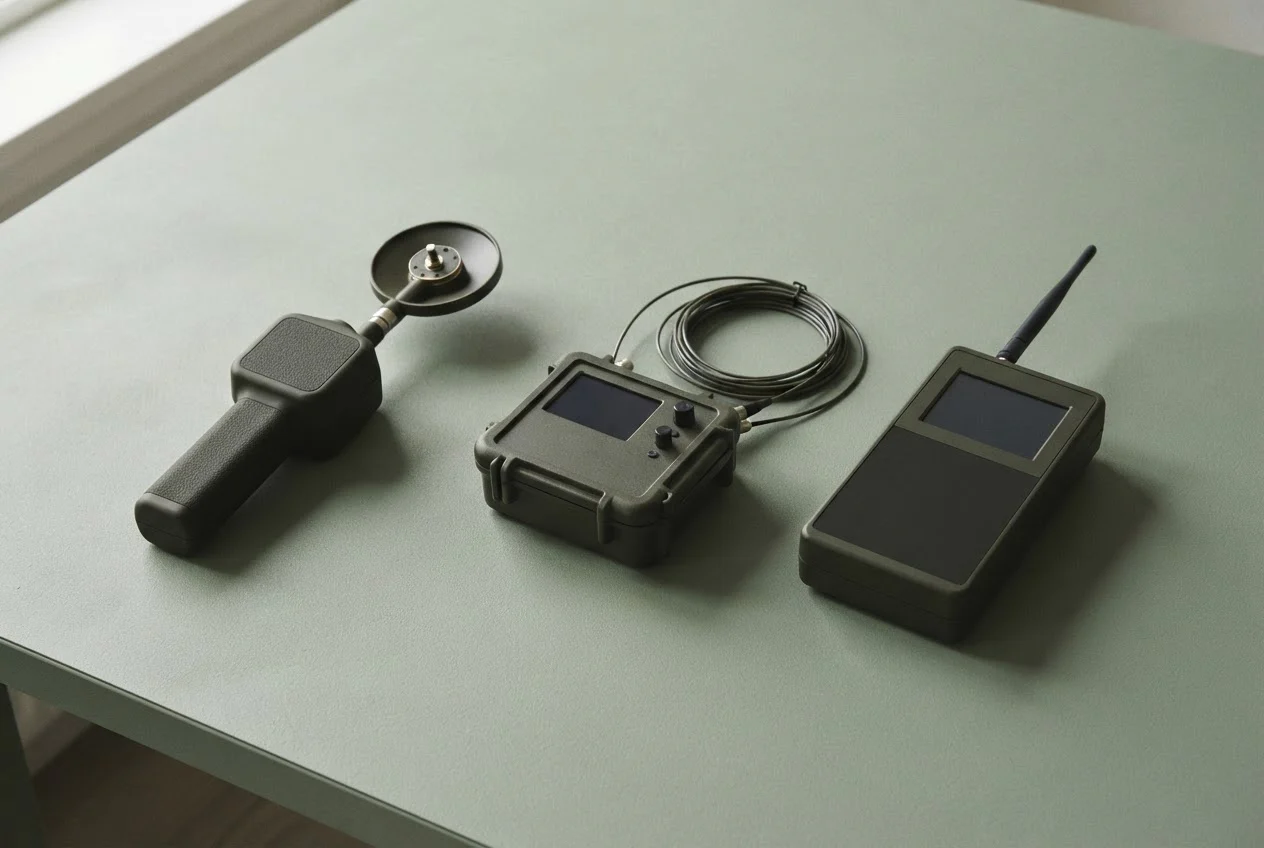
A basic set of the three core instruments costs roughly $41,400 to $48,350 at dealer prices as of October 2026. That is far more than any course tuition, so price the gear first.
| Instrument (what it does) | Dealer price |
|---|---|
REI ORION 2.4 non-linear junction detector (finds hidden electronics in walls and objects) | $15,200 |
REI TALAN 3.0 telephone and line analyzer (tests phone lines for taps) | $18,000 new |
| $24,950 | |
REI OSCOR Blue 24 GHz spectrum analyzer (shows radio signals across frequencies) | $8,200 used |
Our model, not an official figure: the low total adds the $15,200 detector, the $18,000 TALAN and the $8,200 used spectrum analyzer, which comes to $41,400. The high total swaps in the $24,950 TALAN, which comes to $48,350. Add tuition of $1,495 to $2,695, plus travel and lodging, for your all-in start-up cost. The totals exclude accessories and software, and a new spectrum analyzer would cost more than the used unit.
Our recommendation: ask each course provider which instruments it teaches and get a quote for each before you pay tuition.
Who is allowed to enroll in TSCM training?
Hands-on TSCM courses in the US screen applicants. Jigsaw states that all of its TSCM courses require verification of U.S. citizenship before registration. Its 40-hour course also requires a background investigation and registration four weeks ahead. Its TSCM Advanced Positive Operations course is "NOT AVAILABLE TO THE GENERAL PUBLIC" (Jigsaw Security).
The reason is export control. Jigsaw states that TSCM is an item listed in the International Traffic in Arms Regulations (ITAR), the US export-control rules, and that its training, documentation and devices are export-controlled.
LaSorsa accepts the general public but requires proof of citizenship or legal status before the first class day. It also warns that felony convictions may restrict licensing and permits in most states (LaSorsa).
Before you pay a deposit, get the admission rule in writing for your own situation.
Does your state license TSCM work?
Licensing differs by state. North Carolina issues a separate Electronic Countermeasures license. The Texas and Florida investigator statutes do not name bug sweeps. Whether a given sweep engagement falls under general investigator licensing is a question for your state board, and you should ask it in writing.
North Carolina. As of October 2026, an applicant needs three years of counterintelligence experience, or completion of a counterintelligence course at a Board-approved school (NC Private Protective Services Board, license types). Counterintelligence is work to detect and counter spying by others. Applicants must also be at least 18, hold a high school diploma or equivalent, and be a US citizen or resident alien.
The application fee is $188 and the license fee, if approved, is $550. The license is valid for two years. The process takes two to four months and includes a background investigation and five non-family character references (NC Private Protective Services Board, apply for a license).
Jigsaw states that its 40-hour course is approved by the Board for licensing. Confirm any school's approval with the Board before paying. LaSorsa's 12 hours of continuing-education credit serves people who already hold a license, so it is a separate matter from the approved-school route.
Worked example, our model: Jigsaw tuition of $1,995.95 plus the $188 application fee and the $550 license fee totals $2,733.95. Travel, lodging and equipment are extra.
Texas and Florida. Texas defines an investigations company by its activities, including obtaining information about crimes, identity and conduct, securing evidence for courts, and electronic tracking. Bug sweeps are not named (Texas Occupations Code § 1702.104). Florida's definition of private investigation likewise lists subjects of investigation and does not name sweeps (Florida Statutes § 493.6101).
For other states, start with our guide to private investigator license requirements by state, then use our checklist for verifying that a PI course counts in your state.
Can TSCM training lead to a TSCM job?
Most TSCM jobs are reached through government or military technical-security experience, not through buying a course. On 10 October 2026, a ClearanceJobs search for "TSCM" showed 80 jobs. We reviewed the first 20 listed (ClearanceJobs).
Seventeen of those 20 carried TSCM titles such as TSCM Specialist, Senior TSCM Technician, TSCM Practitioner and TSCM Instructor. The other three were an administrator role, a hardware engineer role and a technical security manager role.
Of the 17 TSCM-titled listings, 16 required TS/SCI (Top Secret with Sensitive Compartmented Information access) and one required Top Secret. Six of the 17 stated pay, ranging from $100,000 to $185,000 a year. The roles were in Northern Virginia, Washington, DC, Fort Meade in Maryland, and Fort Liberty in North Carolina, among other locations.
Our inference: a civilian course at any price is not the entry point to these roles. Investigators who want sweeps as a service line should look at the private-sector tiers above.
Why does a short TSCM course not make you ready to sell sweeps?
A short course teaches what a device is and how an instrument works. It does not give you the practice to tell a client a room is clean. Our recommendation: sell only what your training and instruments support, because a client who hears "nothing found" will speak freely.

A limited offer works. That means client briefings on eavesdropping risk, a documented physical inspection, and a referral to a fully equipped sweep team for anything beyond that. Write the limits into your engagement letter. If your core work is conventional surveillance rather than counter-surveillance, see our comparison of investigator surveillance training.
Test any course against these six checks before you enroll:
State rule
Read your licensing board's page or call it. Pass: you hold a written answer on whether a license applies. Fail: you have only a vendor's assurance.Admission
Ask the provider in writing whether citizenship, background-check or ITAR rules apply to you. Pass: a written yes or no for your case. Fail: "contact us later."Approval
Where your state requires an approved school, find the school on the board's own list. Pass: it is listed. Fail: the approval claim appears only in the provider's marketing.Hands-on time
Ask how many course hours you spend operating instruments. Our benchmark is a majority of class time. Pass: a number that meets it. Fail: no number, or mostly lecture.Total cost
Add tuition, travel, lodging and an equipment quote. Pass: all four figures on one sheet. Fail: tuition only.Scope sentence
Write one sentence stating what you will and will not do for clients after the course. Pass: it names a limit and a referral path. Fail: it promises "full sweeps" after a basic class.
Where does our Eavesdropping Detection course fit?
Our Eavesdropping Detection course is awareness-tier training: $100, six hours, self-paced, with 28 lessons and a certificate of completion.
It teaches basic procedures for detecting eavesdropping. It covers wiretaps, bugs and concealment devices, including crystal, dynamic, cardioid, omnidirectional, condenser and pneumatic microphones. It also covers contact and spike microphones, outdoor parabolic and shotgun microphones, and legal considerations. It ends with a three-step countermeasure inspection process, tested by three assessments with 31 questions in total.
Use it to brief clients, to understand what you would be looking for, and to prepare for a hands-on class. It is not a license, and it does not teach instrument operation.
Questions about which course fits your state or role? Call us at (832) 922-1215 or (706) 268-2221, Monday to Friday, 9:00 AM to 6:00 PM Eastern.
Start with awareness-level eavesdropping detection training
Frequently asked questions
Sources
- 1.REI: Countermeasures Core Concepts
- 2.REI: Advanced Equipment Use
- 3.Jigsaw Security: TSCM training courses
- 4.LaSorsa & Associates: TSCM course
- 5.PI Institute: TSCM "Bugsweeps"
- 6.Learningshopusa: Eavesdropping Detection
- 7.NC Private Protective Services Board: license types
- 8.NC Private Protective Services Board: apply for a license
- 9.Texas Occupations Code § 1702.104
- 10.Florida Statutes § 493.6101
- 11.Spy Associates: REI ORION 2.4 listing
- 12.NDT Advanced Tools: REI TALAN 3.0 listing
- 13.Spy Associates: REI TALAN 3.0 listing
- 14.NDT Advanced Tools: REI OSCOR Blue 24 GHz listing
- 15.ClearanceJobs: TSCM job search, 10 October 2026