State Rules Shape Private Investigator License Requirements
Use the state rule for your exact role before paying for training, documenting experience, or planning a renewal.
5 chapters · Updated Sep 16, 2026 · By Sharon DeCet
- 12 hours
- Minnesota pre-assignment training for covered employees, due within 21 days of hire
- 18 hours
- Texas renewal CE for PIs with fewer than 15 years of continued licensure
- 60 hours
- Virginia private-investigator entry-level training
Minnesota Private Detective and Protective Agent Services Board, 2026
In brief
Private investigator license requirements depend on the state and on whether you are applying as an employee, an independent investigator, or an agency qualifier. Minnesota, Texas and Virginia show why a course title alone is not enough: regulators set the hours, timing, experience and renewal rules.
Start with the role the regulator recognises
Private-investigator rules can apply differently to an employee, an independent practitioner and a business. An employee may need a registration or identification card tied to a licensed agency. A person who wants to operate independently may need qualifying experience, an examination or a separate individual licence. A business can have additional insurance, bond, ownership or qualifying-person requirements.
Iowa makes the separation explicit: agencies providing contracted investigative services need a state licence, while employees performing regulated services need a state-issued ID card through a licensed agency. Iowa Department of Public Safety also states that the employee must first be hired by a licensed agency. In Florida, an individual performing PI services needs a Class C licence, while a supervised PI intern uses a Class CC licence under a sponsoring licensee.
Do not use a state guide as a promise that every applicant follows one path. Your employment arrangement, authority to operate a firm and licence tenure can change the rule that applies.
Takeaway: Identify your employee, independent or agency role before comparing training or experience requirements.
Training hours change with the state and the purpose
Minnesota, Texas and Virginia illustrate why “PI training required” is too vague to guide a purchase. Minnesota requires 12 hours of pre-assignment training for covered employees, completed within 21 days of hire. The Board also specifies that private-detective pre-assignment content must cover the subjects in its rule. Minnesota’s Board training page is the controlling starting point for that employee route.
Texas uses a renewal structure, not Minnesota’s employee pre-assignment structure. The Texas Department of Public Safety requires 18 hours every two years for a PI with fewer than 15 years of continued licensure, including 14 investigation-related hours, 2 ethics hours and 2 hours reviewing the Act and rules. A PI with more than 15 years needs 12 hours with an 8, 2 and 2 allocation. Virginia instead identifies 60 hours of entry-level training and 8 hours of in-service training for the PI registration category.
Three state checkpoints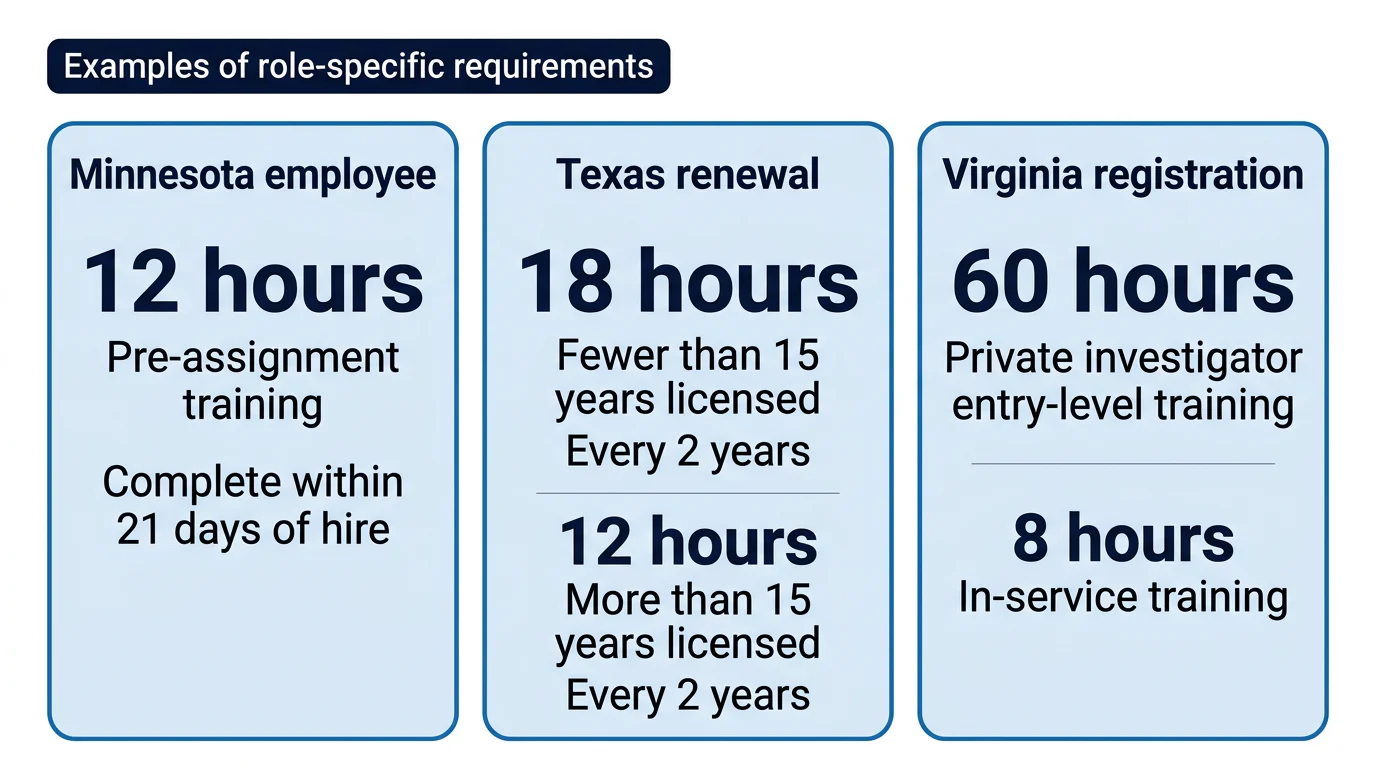
A course can be useful for skills development without satisfying the timing, subject allocation or approval rule for a specific licence route.
Takeaway: Match the course purpose to the regulator’s exact category, not merely to the words “private investigator.”
Experience is often the gate for independent work
Experience requirements often attach to the person who will independently practise, qualify a company or supervise investigative work. Texas says an applicant for an investigations-company licence needs three consecutive years of investigative-field experience as an employee or owner, unless another Commission-set route applies. That company-qualification rule is different from a PI’s continuing-education requirement.
Connecticut sets a higher experience threshold for a private-detective licence: the applicant must be at least 25 and have five years of qualifying full-time investigative experience, or ten years as a qualifying police officer. The Connecticut DESPP private-detective guidance also identifies general-liability insurance for licensees. North Carolina offers a different on-ramp: no experience is needed for a PI Associate licence, but the associate must work under a licensed PI, while the full PI route requires three years of qualifying experience.
A general training certificate does not replace documented experience when a statute or licensing unit demands employment history. It is also not a substitute for sponsorship where a state permits supervised entry.
Takeaway: Treat experience as a separate application requirement, especially if you plan to operate independently or qualify an agency.
Renewal requires the right hours and the right records
Renewal requirements are not interchangeable with entry-level training. Iowa requires private investigators to complete 12 acceptable continuing-education hours during each two-year licence period. Texas limits qualifying CE to the two-year period before the current expiration date and requires attendees and companies to retain completion certificates for two years. Those rules make timing and record retention part of compliance, not an afterthought.
The Texas requirement is also category-specific. A PI with fewer than 15 years of continued licensure needs investigation-related content, ethics and a review of the governing Act and rules within the 18-hour total. A generic class can develop professional knowledge while still failing to supply one of the required categories. Keep the course description, completion certificate and regulator approval information together with the renewal date.
This approach is not ideal for someone who only wants informal professional development and has no licence deadline. For renewal, however, the regulator’s categories and the course record matter more than a broad course title. Find PI continuing education by state when you need a state-specific follow-up.
Takeaway: Plan renewal from the licence deadline backward, with proof of the exact hours and categories required.
Use a regulator-first screening check before paying
Use a short screening sequence before enrolling. First, open the current state regulator source for your role. Second, identify whether you need pre-assignment training, entry-level training, documented experience, an exam, a registration, a company qualification or renewal CE. Third, compare the course’s stated hours and subjects with that requirement. Fourth, confirm the exact provider and course approval when the regulator requires approved training.
This process protects against a frequent category error: treating a skills course as if it creates a licence right. California, for example, requires applicants to be at least 18, have 6,000 compensated investigative-work hours and pass a written exam, with limited degree substitutions for experience. Its Bureau of Security and Investigative Services guidance shows that training is only one possible element of a broader licence application.
The same caution applies across borders. California’s reciprocity agreements are limited to specific states and continued home-state-originated investigations, with Bureau approval required before California work begins. Do not treat an out-of-state credential as automatic authority to take a new case elsewhere.
Takeaway: Confirm the exact regulator rule and approval status before relying on any course for licensing or renewal.
Go deeper
Frequently asked
No. A course completion record is not a private investigator licence. The applicable regulator decides whether your role requires training, documented experience, an examination, registration, insurance, fingerprints or a separate agency application.
Employees commonly work under a licensed agency or receive a registration, while an independent investigator or company qualifier may need separate experience and business-level approval. Iowa, North Carolina and Texas each distinguish those routes.
Texas requires 18 continuing-education hours every two years for private investigators with fewer than 15 years of continued licensure, and 12 hours every two years after 15 years, with specified investigation, ethics and law-and-rules categories.
No. Reciprocity is limited and state-specific. California’s listed agreements apply to continued investigations that began in the investigator’s home state, and California requires Bureau approval before work begins there.
Match your next course to your licence route
Start with your state, role and renewal position before choosing a course.
Find PI course options