Online PI Courses with Verifiable Certificates
Compare online PI courses with verifiable certificates by renewal fit, record fields, verification route, self-paced format, and price.

Online PI Courses with Verifiable Certificates
For Georgia private-detective employees, renewal generally requires 16 CE hours, including separate ethics and homeland-security coverage. That is why the course record matters as much as the course topic.
Online PI courses with verifiable certificates are useful when our completion record identifies the learner, course, provider, credited hours, completion date and applicable approval information, and when we can reissue or verify it. Before counting any course toward renewal, investigators must confirm the specific course meets their licensing authority’s current rules.
We built this guide to help you filter courses by purpose, compare certificate evidence, separate renewal credit from skills training, and keep records ready when a regulator or employer asks.
Find Courses by Renewal Fit and Certificate Proof
A good course finder does not make investigators decode a certificate after payment. We organize each course around the decisions that come first: your jurisdiction, whether you need renewal credit or professional development, the topic you need, the number of hours, your schedule, and the record you can keep afterward.
For a Georgia renewal path, start with our Georgia course guide before treating any 16-hour listing as a complete renewal solution. The right course must map its hours to the required categories and provide a record you can validate.
| State | Course | Hours | Topic | Level | Delivery | Current Approval Status | Certificate Fields | Verification Route | Price | Last Checked |
|---|---|---|---|---|---|---|---|---|---|---|
| Georgia | PI renewal course | 16 | Ethics, homeland security, industry-related training | Renewal | Online, self-paced | Confirm named facilitator, course details, and current state fit | Review against state-required fields | Account history, provider confirmation, regulator confirmation | $175 listed tuition | September 10, 2026 |
| Texas | PI CE course | 12 or 18, based on tenure | Investigation, ethics, state rules | Renewal | Online, self-paced | Confirm current department approval and correct tenure route | Learner, course, hours, completion evidence | Account history, school record, regulator confirmation | Confirm current checkout | September 10, 2026 |
| Minnesota | Pre-assignment PI course | 12 | Required private-detective subjects | Foundational | Online, self-paced | Confirm current board-certified course status | Subject areas and completed hours | Account history, provider record, board confirmation | $185 listed tuition | September 10, 2026 |
| Any State | Legal aspects course | Confirm on course card | Laws, boundaries, professional practice | Professional development | Online, self-paced | No renewal claim without state confirmation | Course and completion details | Account history and provider support | $120 listed tuition | September 10, 2026 |
Every course card should also state the learning outcome, syllabus topics, assessment, access period, support route, prerequisites, and certificate process. That prevents a common mistake: buying a useful skills course for a renewal requirement it was never represented to satisfy.
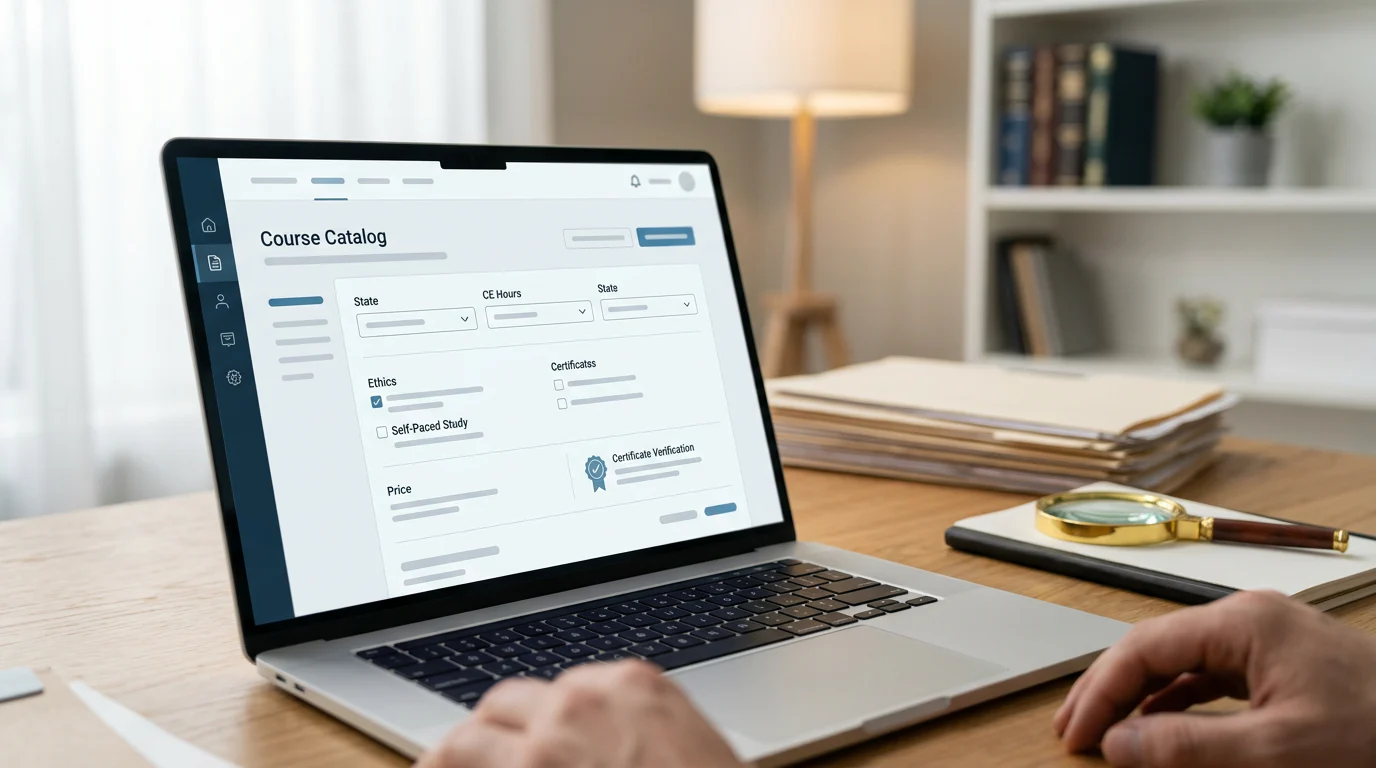
Use the finder’s topic grouping to locate ethics, state rules, background investigations, surveillance, evidence, interviewing, public records, privacy, and report writing. If your purpose is skill growth rather than renewal, our investigation skills training can help you choose a practical next subject without overstating its licensing value.
How Certificate Records Are Documented and Verified
A certificate is not just a printable finish line. It is the document that connects a completed course to a person, date, topic, hour total, and, where required, an approved training source. We treat that record as part of the product, not an afterthought.
Check the Certificate Fields Before You Rely on It
For Georgia-regulated training, the certificate must include the participant, training entity, training dates, course topics, actual hours, CE hours when different, and the licensed instructor or facilitator’s name, signature, and full license number under the state’s certificate rule. We recommend checking those details immediately after download, while corrections are still easy to request.
A strong completion record should show:
- Learner Identity: Your full name as it appears in the licensing record.
- Course Details: The complete title, topic, completion date, and credited hours.
- Provider Evidence: Provider identity, instructor or facilitator details, and approval code when applicable.
- Record Control: A unique record identifier and a clear replacement-certificate procedure.
Use Four Verification Routes
First, match the certificate against your account history and saved completion status. Second, ask us for written confirmation tied to your name, course, date, and record identifier. Third, verify any listed instructor, facilitator, school, or approval information with the relevant authority. Fourth, ask the receiving regulator whether the individual course counts for your current renewal period.
Those steps matter because provider approval and individual-course acceptance are not the same claim. A course may be professionally useful, available online, and documented well, yet still not fill a required state category.
Keep a Replacement Path
Save the support channel, course title, completion date, and record identifier with your certificate. If a document is lost, damaged, or needs a name correction, those details let us locate the right completion record without reconstructing your training history from memory. Our Georgia audit checklist shows how to keep the supporting documents together.
Determine Whether a Course Counts for Renewal
Renewal suitability begins with your own license type, jurisdiction, and deadline. It does not begin with a generic “certificate included” label. We display an approval field on course cards because investigators need to see what has been confirmed, what remains conditional, and when the status was last checked.
In Texas, investigators with more than 15 years of continued licensure need 12 hours, while those with fewer than 15 years need 18 hours. Both paths include required ethics and state-rule content under the current Texas CE rule. That is why the finder separates a 12-hour route from an 18-hour route rather than treating “Texas PI CE” as one interchangeable product.
Match Hours to Required Categories
For Georgia, the required 16 hours include two homeland-security hours, two ethics hours, and 12 industry-related hours. For Texas, the precise investigation, ethics, and state-rule allocation changes by licensure tenure. For Minnesota, pre-assignment training and annual continuing training are separate obligations.
We show these requirements as category fields, not just a total-hours badge. Before enrolling, compare the course syllabus with the official requirement, then use our Texas CE requirements to confirm the route that applies to you.
Read the Approval Field as of Its Date
Every approval statement needs a date. “As of September 10, 2026” means the listing reflects the status checked on that date, not a permanent promise that rules, approvals, instructor status, or renewal windows cannot change.
When an approval field says “confirm,” contact us and the regulator before payment. That caution is especially important near a renewal deadline, when a missing two-hour ethics or state-rules segment can leave an otherwise completed course unusable.
Separate Renewal Credit from General Learning
Background investigations, surveillance, evidence handling, interviewing, public-record research, privacy, and report writing can all strengthen investigator practice. They count for renewal only when the applicable authority accepts that particular course, topic, provider, and completion date for the current period.
For a deadline-sensitive Texas route, use our Texas course planner to match your tenure, required subjects, study time, and completion-record checks before your renewal window closes.
Compare Online PI Course Formats
The words “online” and “self-paced” describe delivery, not regulatory value. We use format labels to help investigators select a course that fits their schedule, then use approval and certificate fields to show whether the record could serve a separate compliance purpose.
| Course Type | Best For | Record To Keep | Renewal Assumption | Selection Rule |
|---|---|---|---|---|
| Renewal CE | Licensed investigators approaching renewal | Certificate, syllabus, approval check, receipt | Never assume acceptance | Match exact state, hours, topics, and renewal period |
| Foundational Training | New hires or entrants | Completion evidence and required subject record | Only if the exact training category is recognized | Confirm required curriculum and timing |
| Advanced Skills Training | Working investigators improving a method | Certificate or account completion record | Usually professional development | Choose for a defined skill outcome |
| Non-Credit Professional Development | Topic-specific learning | Completion record and notes | No CE claim without confirmation | Use for knowledge, not presumed credit |
Minnesota makes the distinction clear: private-detective employees must complete 12 hours of pre-assignment training within their first 21 days, while continuing training is a separate annual requirement under the state’s training rules. A foundational certificate should never be filed as annual renewal CE without checking the relevant rule.
Choose a self-paced course when you need flexible study blocks and can test your device, progress saving, assessments, and certificate download early. Choose a live or blended format when the requirement or subject requires scheduled participation. For deadline planning, our Minnesota refresher checklist can help you keep the training type and due date aligned.

Learningshopusa Course Support
At Learning Shop USA, we built our private-investigator learning experience for people who need more than a completion screen. We make it easier to compare course purpose, delivery, assessment, price, and the record you will need to keep after the lesson closes. Our online, self-paced platform lets you work from a desktop, tablet, or phone, track progress, complete required assessments, and download certificate records after completion. We also encourage you to check state-specific requirements before enrolling, especially when your renewal has category rules or an audit risk. Use the course finder to identify your objective first, then save the syllabus, receipt, certificate, and approval check in one renewal folder. If a detail is not shown on a course card, contact us before purchase so you can get a written answer while you still have time to choose. Start with Learning Shop USA.
FAQs on Online PI Courses with Verifiable Certificates
Which Private Investigator Course Offers Clear Certificate Records?
Choose a course whose record identifies the learner, course, provider, hours, completion date, and approval information, with account-history evidence and a documented replacement-certificate process available.
Which PI Classes Are Fully Online and Self-Paced?
Our online courses support self-paced study. Confirm each course card’s access period, assessment rules, device compatibility, certificate process, and state-credit status before making an enrollment decision.
How Can I Verify a PI Course Certificate?
Match the certificate to account history, request provider confirmation, verify approval details with the authority, and ask whether that exact completed course counts toward your renewal.
Which Online PI Courses Count for License Renewal?
Only courses accepted for your license type, jurisdiction, topic allocation, and current renewal period count. Confirm the individual course before purchase, not merely the provider, for your active license.
Which PI CE Course Covers Ethics and State Rules?
Select a course card that separately identifies ethics and state-rules hours when required. Then compare its syllabus with your jurisdiction’s current, tenure-specific renewal requirement before you enroll.