Security Guard Report Writing: Field Note to Finished Report
Security guard report writing works when you take a timed note at the scene, then write a factual report in time order that records what you saw, heard and did.
By Sharon DeCet, Founder · Updated 10 Oct 2026
Key takeaways
- 01Write what you observed, what you did and what happened next, in time order and past tense. Leave out opinions and guesses.
- 02Take a timed field note at the scene. The report can only be as accurate as the note it is built from.
- 03Replace every conclusion about a person ("suspicious," "drunk," "aggressive") with the behavior you saw, or attribute it to the person who said it.
- 04Some states turn a report into a legal filing with deadlines and fines. Know your state's rule and your employer's procedure before an incident happens.
In this article
- 1What goes into a security guard incident report, and in what order?
- 2Why does security guard report writing start with the field note?
- 3How do you replace opinions with observations in an incident report?
- 4What does a finished incident report look like?
- 5Should a security guard write in first person or third person?
- 6When does an incident report become a filing to the state?
- 7How can you check an incident report before you submit it?
- 8Where can a security guard learn report writing?
- 9Frequently asked questions
A security guard incident report is read by people who were not there, long after the shift ended: a client's risk manager, a lawyer, an investigator, sometimes a regulator. The guard who wrote it is rarely in the room to explain what a word meant, so one vague adjective can cost more than a missing detail.
The stakes are formal in some states. As of October 2026, the California Bureau of Security and Investigative Services (BSIS) states on its incident report form 311-9 (Rev. 06/25) that a private patrol operator (the licensed company that provides the guards) that fails to report a firearm discharge or a qualifying physical altercation may be fined $5,000.
The fix starts earlier than the report: a short, dated note taken at the scene from what you saw and heard. This page gives you the note format, a report template, a worked example and a check to run before you hand anything in.
What goes into a security guard incident report, and in what order?
A security guard incident report answers six questions (the 5 W's and 1 H): who was involved, what happened, when it occurred and was discovered and reported, where it happened, why (only if known or stated), and how it unfolded. It then records what you did and whom you notified, in time order and past tense.
Three terms are used below. A field note is a short, timed entry in your notebook made at the scene. An incident report is the formal written account of one event; "report" is shorthand for it on this page. A daily report is the end-of-shift summary of everything that happened on your post. The U.S. Bureau of Labor Statistics lists "Write reports on what they observed while on duty" among the duties of security guards and gambling surveillance officers, an occupation with 1,304,000 jobs in 2025. If you work cases as an investigator rather than standing a post, our guide to writing investigation reports that hold up covers that format.
Copy this template. Its detail prompts, and the apartment-complex field note in the next section, come from the Texas Department of Public Safety (DPS) Level II security officer training guide. Level II is Texas's training tier for non-commissioned security officers.
REPORT NUMBER:            DATE:
TIME OF INCIDENT:         TIME DISCOVERED:        TIME REPORTED:
TIME THIS REPORT WRITTEN:
POST / EXACT LOCATION:    (building, floor, entrance, reference points)
OFFICER NAME / ID:

WHO
  People involved: full names, correctly spelled, or a description:
    approximate age, height, weight, hair and eye color, clothing,
    distinguishing marks
  Vehicle: year, model, color, plate
  Witnesses: name, role, contact details as your employer allows

WHAT HAPPENED (time order, past tense, one fact per sentence)
  [time] ...
  [time] ...

WHY (only if known or stated, and attributed to the person who said it)

HOW (how you were notified; how the person entered or left; any gap in security)

WHAT I DID (each action, with time)

NOTIFIED (name, role, time: supervisor, police, EMS (emergency medical
services), client)

EVIDENCE (photos, camera footage, logs, objects, and where each is kept)

OUTCOME / FOLLOW-UP NEEDED
UNKNOWN: (anything you could not establish, labeled as unknown)
Why does security guard report writing start with the field note?
A field note is the short, timed entry you write at the scene, and it sets the ceiling on report quality, because the report is built from it. Record the time, who told you, what you observed and what you did before memory starts filling gaps.
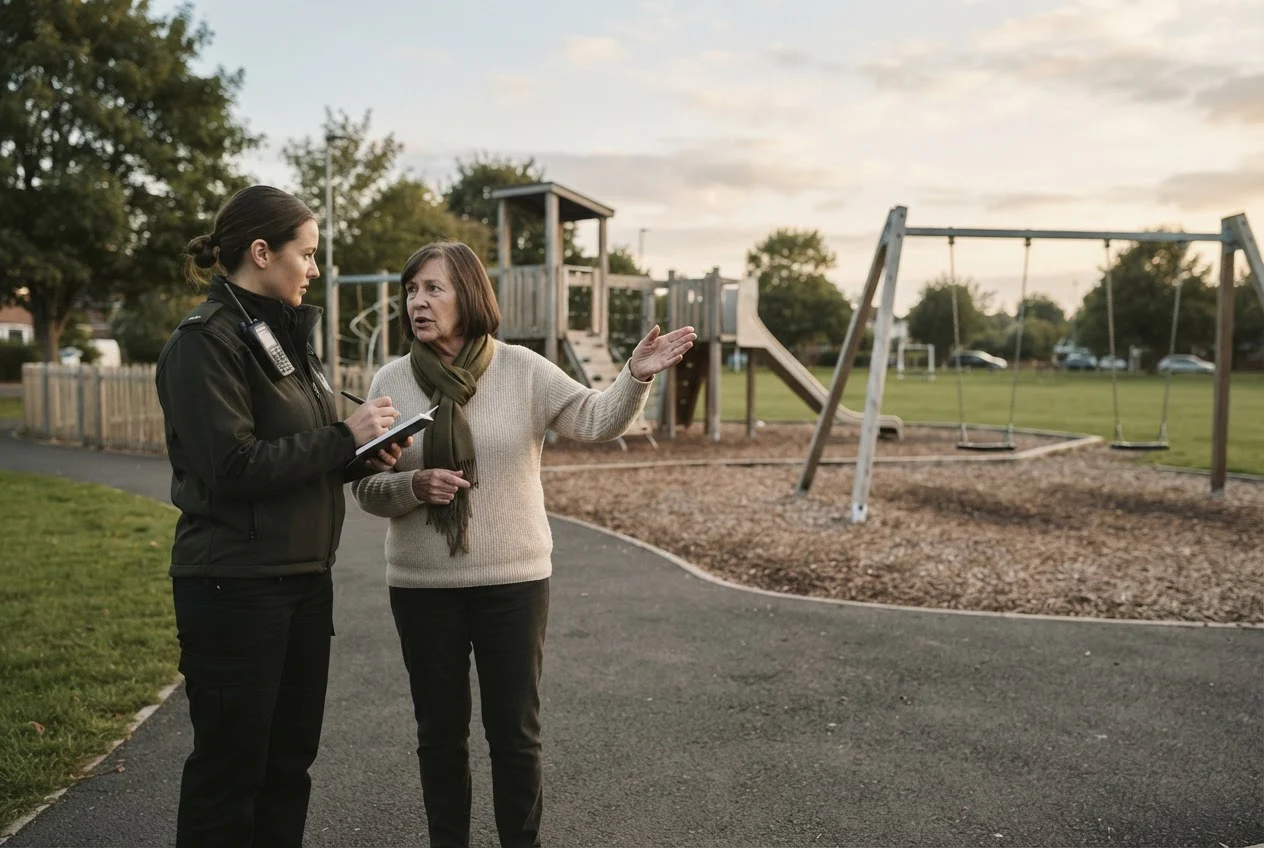
Here is the apartment-complex case. A resident, Mary from apartment 8, tells the officer she saw "a really weird looking guy" by the swings. The officer asks the questions that turn "weird" into something usable: is he still here, what does he look like, what is he wearing, how old does he seem, what made him "weird"? The note reads:
6 PM Mary, #8 approached me advising of a "really weird looking guy" by the
swings. No longer there. Description - red short hair, right eye black.
Wearing red coat, blue jeans, white tennis shoes. Appeared to be in his late
40's, about 6 ft tall.
Look at what that note does. It names the source and the time. It turns "weird" into a description someone else could use. It also keeps the black eye as something Mary reported. You did not see it, and if the man were later found injured, your note shows you never came into contact with him. A description like this can become the missing piece in a police investigation weeks later.
Keep your shorthand in the notebook and expand it in the report. Do not write "see field notes" or "watch video" in a report: readers cannot be expected to follow your shorthand, and a camera can fail.
How do you replace opinions with observations in an incident report?
Replace each conclusion about a person with the behavior that led you to it, and attribute anything someone told you to the person who said it. State only facts, keep opinions out, and never fabricate or omit anything.
Use this swap table before you submit anything:
| Instead of | Write |
|---|---|
| He looked suspicious. | He walked the fence line twice and pulled on two locked doors. |
| She was drunk. | Her speech was slurred, I smelled alcohol, and she steadied herself against the wall. |
| He was aggressive. | He raised his voice, stepped within arm's reach of me, and said, "[exact words]." |
| Someone broke in. | The rear door was open and the lock was bent. No one was in the room when I entered. |
| A man was loitering. | A man stood by the east entrance for [number] minutes and did not enter or speak to anyone. |
| Management was told. | At [time] I called [name, title] and told him [what you said]. |
The reason is the reader. According to the Texas DPS guide, a formal report can end up with the client that hired the security company, at an administrative hearing, or read out loud as evidence in court. If you are ever questioned on yours, our guide to testifying in court covers what to say and how to use your notes. A report made of observable facts survives questioning. One built on adjectives gives a cross-examiner something to attack.
What does a finished incident report look like?
A finished incident report attributes each statement to its speaker, describes people by what could be seen, records every action you took with times, and says plainly what you did not do. This example is a vehicle parked in a fire lane; bracketed items are yours to fill in, and the same text can be entered in your daily report.
INCIDENT REPORT
Date: [date]   Post: [property name]   Officer: [name, ID]
Report number: [number]   Time written: [time]

At 9:40 PM, while on patrol, I saw a [color, year, make, model] with
[state] plate [plate number] parked in the marked fire lane outside the east
entrance of Building B. The engine was off and no one was inside.

At 9:44 PM a man walked from the building to the vehicle. He appeared to be
in his [decade] and about [height], wearing [clothing]. I asked whether the
vehicle was his. He said, "Yes, I was only dropping off a package." I told him
the lane was marked no parking and asked him to move it.

At 9:47 PM he drove the vehicle out of the lane. I did not issue a citation.
[Notified: name, role, time, or "no one."]

Unknown: the man's name. I did not ask for identification.
Three choices make this report hold up. The man's words are in quotation marks and attributed to him. The first paragraph records only what could be seen: the engine was off and no one was inside. The last lines say what you did not do and what you do not know.
Should a security guard write in first person or third person?
Follow the format your employer sets; if it sets none, write in first person. The Texas DPS guide describes both: first person uses "I," and third person refers to people as he, she or they. Pick one and keep it throughout the report, because mixing them confuses the reader.
If you write in third person, you would refer to yourself as "the officer." That is where mistakes creep in when two officers are on the scene, since "the officer called the supervisor" does not say which one. "I called the supervisor" cannot be misread.
When does an incident report become a filing to the state?
In California, a guard involved in a firearm discharge must file a written report within 7 days with both BSIS and the local police or sheriff, and a private patrol operator has 7 business days to report firearm discharges and certain physical altercations. These are the rules in force as of October 2026, from BSIS form 311-9:
| Who files | What triggers it | Deadline | Fine the form says may apply |
|---|---|---|---|
| Private patrol operator (Business and Professions Code section 7583.2(f)) | A firearm discharge, or a physical altercation with a member of the public that involves an arrest of a guard, a police report filed by the public, first aid or medical attention, discipline of the guard, or any physical use of force | 7 business days after the incident | $5,000 |
| Registered guard and employer (section 7583.4) | A firearm discharge, reported to both BSIS and the local police or sheriff | 7 days after the incident | $500 |
California enacted SB 1203 on September 30, 2026. Its legislative digest states that from January 1, 2029 the fine on private patrol operators for failing to deliver these reports drops from $5,000 to $2,500 per violation, and the bill also changes what the reports must contain. Confirm current amounts and content requirements in the statutes before relying on the table.
The form asks for the date and time, the post address, whether police took a report (agency and report number), and whether there was a citation or arrest. The narrative must describe the circumstances leading to the use of force, name the suspect and witnesses with addresses, and list deaths, injuries and damage, plus the number of shots fired if a firearm was involved. The person involved signs it under penalty of perjury.
You cannot complete that form accurately from memory. Your field note is what lets you do it. Other states set their own reporting rules, so check your licensing board and your post orders (the written instructions for your site) before an incident, not after.
How can you check an incident report before you submit it?
Run eight tests on every report before you hand it in. Each has a pass and a fail, and a single fail means you rewrite that part.
Opinion scan
Circle every word that describes a person's state or intent, such as drunk, angry or suspicious. Pass: each one is backed by an observed behavior or a quoted statement. Fail: any one stands alone.Time check
Find the time of the incident, the time discovered, the time reported and the time you wrote the report. Pass: each is no later than the next one in that list. Fail: any time is missing or any order is reversed.Stranger test
Give the report to someone who was not there. Pass: they can state who, what and where without asking you a question. Fail: they ask even one.Reference scan
Search for "see notes," "see video" and "as discussed." Pass: none appear. Fail: any appears.Abbreviation scan
Pass: each abbreviation is expanded the first time it appears, and a stranger can read it without asking. Fail: any abbreviation appears with no expansion.Unknowns
Pass: every missing detail is labeled "unknown." Fail: a blank, or a guess presented as fact.Attribution
Pass: every statement by another person names the speaker, with exact words in quotation marks. Fail: any "it was said" or paraphrase with no speaker.Order and tense
Pass: events run start to finish in past tense. Fail: you jump back and forth in time.
If you find an error after you have submitted, our recommendation is to tell your supervisor and add a supplemental report (a follow-up document that adds or corrects details without changing the original) instead of altering the original.
Where can a security guard learn report writing?
Report writing is taught inside state-approved guard training and in standalone courses. Texas covers field note capture and written reports in its Level II course. Our Georgia basic security officer course, $65 for 24 hours as of October 2026, includes a lesson on writing a professional security report and is approved by the Georgia Board of Private Detective and Security Agencies; the steps to a license are in our guide to the Georgia security guard license.
For report writing alone, take our 222. Report Writing - Security Officer course. It costs $80 as of October 2026 and takes 4 hours, self-paced. It has 34 lessons in 3 chapters, 4 assessments with 34 questions, and a final exam. It covers types and purposes of reports, the who, what, where, when, how and why elements, notes and key points, objectivity, supplemental reports, and critique and revision. You earn a certificate of completion. The course is approved in Georgia and North Carolina, and North Carolina accepts a total of 6 hours of online learning, so check your own state before you enroll; our guide to which online guard training meets state rules shows how.
Two companion courses are $80 each as of October 2026 and run 4 hours: 221. Note Taking - Security Officers and 223. Testifying - Security Officer. To ask which course fits your state, call (832) 922-1215 or (706) 268-2221, Monday to Friday, 9:00 AM to 6:00 PM Eastern.
Build your report writing skills with a focused course
Frequently asked questions
Sources
- 1.Private Security Level II Participant Guide, December 2023, Texas Department of Public Safety
- 2.Incident Report, form 311-9 (Rev. 06/25), California Bureau of Security and Investigative Services
- 3.SB 1203, Security services (Chapter 1016, Statutes of 2026), California Legislature
- 4.Security Guards and Gambling Surveillance Officers, Occupational Outlook Handbook, U.S. Bureau of Labor Statistics