Glossary · private-security-training
Online security guard training
By Sharon DeCet, Founder · Reviewed 30 Sept 2026
Also called online guard training or online security officer training
On this page
- 01Definition
- 02Quick facts
- 03A course record and a state credential do different jobs
- 04Three state models show why the word online is not enough
- 05The course subjects are work skills, not a generic credential
- 06Worked example: choosing the Vermont licensed-guard route
- 07Confirm these five points before enrolling
- 08Example
- 09Related terms
- 10Frequently asked
What is online security guard training, and how is it different from a guard license?
Online security guard training is web-delivered coursework that may satisfy part of a state’s required training route for a particular guard role. Completing the course normally produces a completion certificate. A guard license, registration, or certification can still require a separate application, background check, employer status, examination, or state decision.
Key takeaways
- A completion certificate and a state-issued guard credential do different jobs.
- The state, guard role, delivery format, provider, and instructor can all affect whether a course counts.
- Armed work, renewals, and first-time guard routes can have separate requirements.
Quick facts
- Vermont licensed-guard training
- 40 hours
- California initial skills training after registration
- 32 hours within 6 months
- Maryland initial training
- 12 approved hours
A course record and a state credential do different jobs
A course certificate shows that a learner completed the course requirements. A state credential authorizes work only after the state’s own route is complete.
Vermont’s February 2026 application instructions require a licensed-guard applicant to upload a 40-hour approved-course certificate, but also require an application, two character references, experience verification, a jurisprudence examination, and background-check steps. The state also says that beginning employment without a valid registration is a criminal offense.
California’s Security Guard Registration fact sheet and Maryland’s Security Guard Certification guidance use different names and requirements for their state credentials. The label on the certificate is therefore not enough to tell a reader whether they may work.
Three state models show why the word online is not enough
A generic promise that a course is online does not establish that it satisfies a particular state route. The requirement can turn on the role, the required hours, the provider or instructor, and whether any subject must be taught in a particular format.
- State
- Vermont
- Training requirement
- 40-hour approved course for the licensed-guard route
- What remains after or around training
- Application, certificate upload, two references, experience verification, jurisprudence examination, and background checks
- State
- California
- Training requirement
- Power to Arrest training before registration, then 32 skills-training hours within six months
- What remains after or around training
- Background check, registration, and eight skills-training hours annually
- State
- Maryland
- Training requirement
- 12 hours of approved initial training
- What remains after or around training
- Employment or job-applicant status, fingerprints, agency review, state review, and renewal training
The course subjects are work skills, not a generic credential
Vermont’s licensed-security-guard rule assigns minimum hours to the role of the guard, ethics and conduct, legal powers and limitations, communication and public relations, patrolling and investigation, emergency response, observation and note taking, statements, evidence, access control, and report writing.
California’s training regulation also includes practical subjects such as public relations, observation and documentation, report writing, ethics, professionalism, and appropriate use of force. These topics help explain what a guard course teaches, but they do not remove the need to finish the applicable credential route.
Worked example: choosing the Vermont licensed-guard route
A person planning to pursue Vermont’s licensed-guard route must choose the 40-hour approved-course path, not treat any short online security course as interchangeable. After completing the 40 hours, the applicant still uploads the certificate, submits two character references and experience verification, completes the jurisprudence examination, and completes the background-check process.
The decision is practical: finishing the 40-hour course creates the training record, while completing the remaining steps leads to the state registration required before employment.
Confirm these five points before enrolling
- Identify the state where you expect to work.
- Identify the exact role, such as initial unarmed work, renewal, or an armed specialty.
- Match the course hours and subjects to that route.
- Confirm whether online delivery is accepted for the exact requirement.
- List the application, checks, employer, examination, and renewal steps that remain after course completion.
The credential route changes after the course
The same phrase, online security guard training, can sit inside three substantially different state routes. The diagram compares official Vermont, California, and Maryland requirements, as of September 2026.
Three state paths after training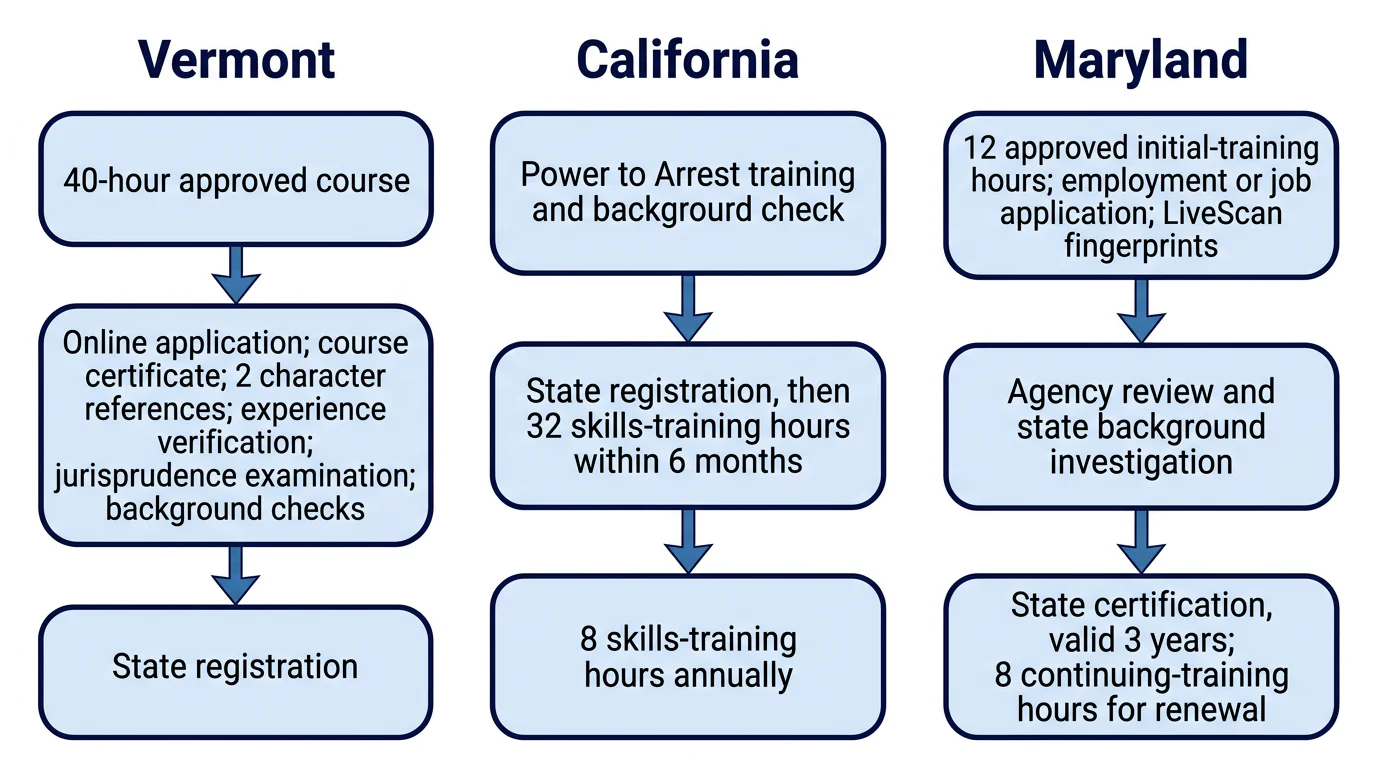
Example
A Maryland job applicant completes 12 hours of approved initial training. The applicant still needs the required employment or job-applicant status, LiveScan fingerprints, agency review, and Maryland State Police review before receiving a Security Guard Certification.
Frequently asked
No. Online security guard training documents that you completed a course. A guard license, registration, or certification is a separate state credential that may require an application, background review, an employer relationship, an examination, or further training.
Do not assume every required subject can be completed online. California, for example, defines in-person instruction for applicable appropriate-use-of-force material, so the exact state, role, course, provider, and delivery method all matter before enrollment.
States set different credential routes. Vermont uses a 40-hour licensed-guard curriculum, California requires post-registration skills training, and Maryland requires 12 hours of approved initial training for its certification route.
Confirm the state where you will work, your intended role, the required course hours, whether the delivery format counts, whether the provider and instructor are acceptable, and every remaining state step needed after course completion.
Sources
- 1.Licensed Private Investigator or Security Guard Application Instructions, Vermont Office of Professional Regulation, 2026
- 2.Administrative Rules for the Board of Private Investigative and Security Services, Legal Information Institute, Cornell Law School, 2026
- 3.Security Guard Registration Fact Sheet, California Bureau of Security and Investigative Services, 2026
- 4.Security Guard Training Regulation, California Bureau of Security and Investigative Services, 2026
- 5.Security Guard Certification, Maryland State Police, 2026
Match the course to your state and role
Use the readiness quiz before choosing a security guard training route.
Check My Training Route