Before Enrolling, What Security Guard Course Fits Your State and Role?
Answer six quick questions. Each answer scores 0–3 points, where higher points mean more regulator and employer verification is needed before choosing training.
Question 1 of 6
How clear is your work state and regulator?
Pick an answer to continue. Your result appears after question 6.
By Sharon DeCet, Founder · Reviewed 25 Sept 2026
In brief
The security guard training you need is determined first by your state regulator, employment route, armed status and actual duties. This six-question quiz scores how much regulator and employer verification you need before choosing a course.
Your score measures verification, not job eligibility
Each answer is worth 0 to 3 points. Higher points mean more variables could change the required course, delivery format, records or next step. Your total falls into three equal-width bands: 0–5, 6–11 and 12–17.
A low score means you have supplied more of the details needed to start a regulator check. A high score means state, employer, armed-role or site-duty details still need to be settled before course selection.
Why the same job title can produce different training routes
The U.S. Bureau of Labor Statistics says security guards typically need a high-school diploma or equivalent and on-the-job training, while most states require registration or licensing, particularly for guards who carry firearms. In 2025, more than 99.5% of security-guard jobs required on-the-job training. BLS occupational requirements data, 2026
Employment can place training on a distinct timeline. Vermont's current application route requires a 40-hour approved course, while New York places a 16-hour on-the-job requirement within 90 days of employment. Vermont Office of Professional Regulation application instructions, February 2026 New York Department of State training requirements
Armed work needs its own check. Georgia requires at least 15 hours of handgun instruction plus written and range scores of at least 80%, and New York requires a pistol permit and guard registration before a person may enrol in its 47-hour firearms course. Georgia Board training rules, 2026 New York Department of State training requirements
Specific duties can add requirements too. California has a separate 24-hour school-security syllabus, and Tennessee adds training for less-lethal devices and for assignments at locations with on-premises alcohol consumption. California BSIS school-security syllabus Tennessee unarmed-guard requirements
The score tracks six checks, not a course recommendation
Use the result to identify the information you need next. A course certificate can document completed training, but the regulator and employer still determine whether it fits the role.
Six checks before selecting a course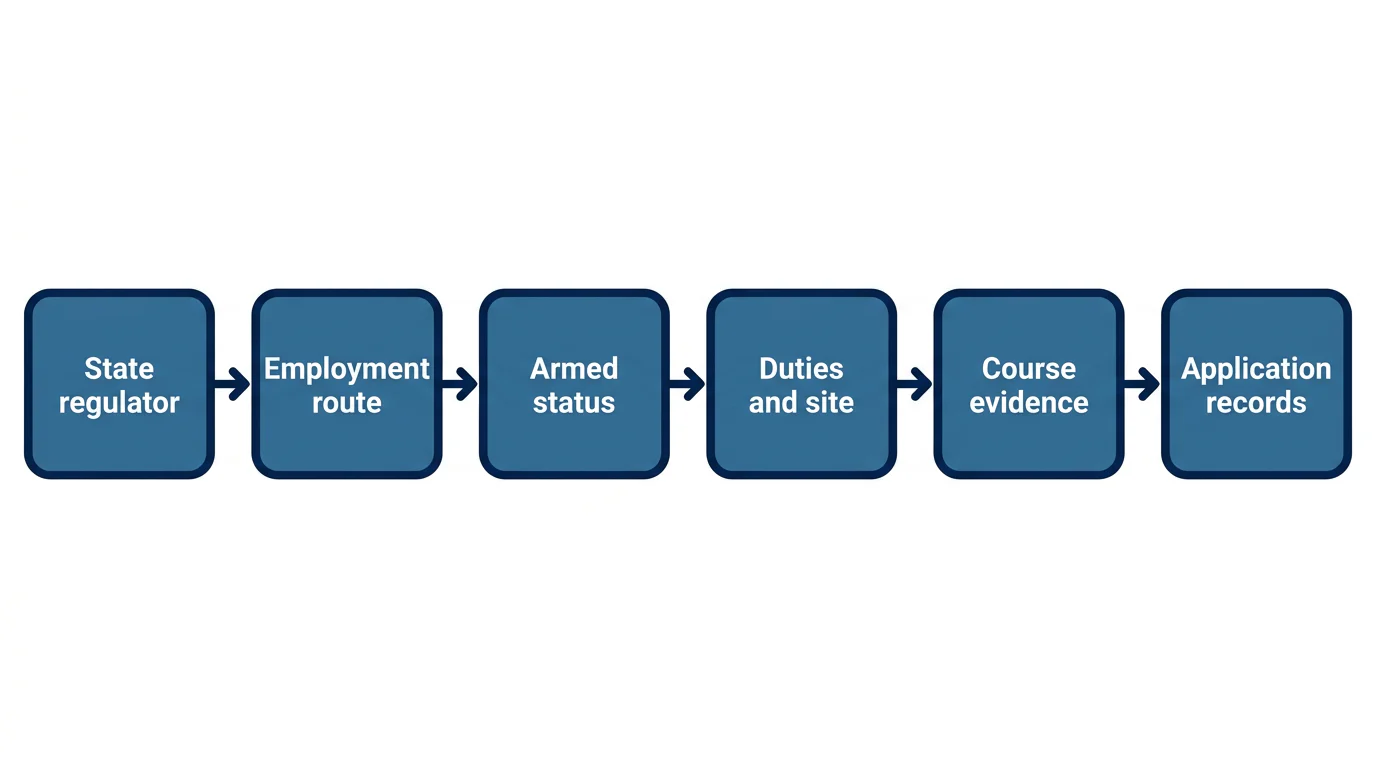
Turn your result into a useful regulator check
Before enrolling, identify the state regulator, your exact role, whether you are an employee or independent applicant, whether you will be armed, your site duties, and the course's provider, instructor, hours and delivery format. Georgia requires Board-certified instructors for its covered basic training, while Texas requires the relevant Level II or Level III course and test for its security-officer routes. Georgia Board training rules, 2026 Texas Department of Public Safety training guidance, 2020
Use your result alongside our guides to match online security guard training to your state and role and decide which self-paced security guard course counts in your state.
What this assessment asks
6 questions. Each answer carries points; your total picks the result band below.
01How clear is your work state and regulator?
- I know the state, but I have not checked the regulator's rule.
- I may work in more than one state or have not chosen a state.
- I know the state and the regulator for my guard role.
02What is your employer situation?
- I am not hired, or my employee, in-house or independent route is unclear.
- A security employer has given me role and training instructions.
- I am applying to employers but have no training instructions yet.
03Will your planned role involve a weapon or device?
- Possibly a baton, stun gun, chemical spray or similar device.
- No, I am pursuing an unarmed role.
- Yes, I expect to carry a firearm or pursue an armed role.
04Which duties best describe the role you want?
- Commissioned security or personal-protection work.
- General patrol, observation, access control or reporting.
- School security or a site with on-premises alcohol service.
05How well can you prove that a course fits the role?
- I know a course name or hour count, but acceptance is not confirmed.
- I am considering a generic certificate or do not know what evidence to check.
- I have checked the exact course, provider, instructor, hours and format with the relevant rule.
06Where are you with the non-course steps?
- I have started some paperwork but do not know every remaining step.
- I know the application, background-check and record steps for my route.
- I have not identified the application, background or record requirements.
How to read your score
| Score | Result | What it means |
|---|---|---|
| 0–5 | 0–5: You have a course-match starting point | Your state, role and work setting are relatively defined. Before choosing training, confirm that the regulator accepts the exact provider, instructor, hours and delivery format for your route. |
| 6–11 | 6–11: Confirm the employer and role details first | Your next decision is likely shaped by employer instructions, duty type or a course-acceptance detail. Get those answers before treating a course title or certificate as the final requirement. |
| 12–17 | 12–17: Start with the regulator, not a course | Your result includes major variables such as an unclear state route, armed work, specialised duties or missing application steps. Identify the regulator and employer pathway before spending time or money on training. |
Keep reading



Frequently asked
No. A useful certificate must match the state regulator's accepted course type, hours, provider, instructor and delivery format for the role you plan to perform.
It can. Employers may set site-specific training or documentation expectations, and New York places part of its required guard training within the employment period.
Yes, armed work can add firearms instruction, range qualification, permits, registration and employer steps. A basic unarmed course does not by itself authorise armed work.
Site duties can create extra requirements. California has school-security training, while Tennessee adds training rules for certain devices and alcohol-serving locations.
Keep your completion certificate and the records required by your regulator or employer. Those documents may be needed for an application, employer file, renewal or audit.