Security Guard Code of Ethics: Wording and Hard Cases
A security guard code of ethics is a written pledge covering honesty, confidentiality, gifts, and lawful conduct. It is not itself a law, so check your state rules and employer policy.
By Sharon DeCet, Founder · Updated 14 Oct 2026

Key takeaways
- A security guard code of ethics is a professional pledge, not a statute. The enforceable parts are your state's licensing rules, the criminal law, and your employer's written policy.
- Virginia's code commits the officer to nine duties, and its gift line is an integrity test. We recommend adding a second test: written employer permission.
- Never put anything but the truth in a report or log, even when a supervisor pushes you to.
- A stand-alone ethics course is not the same as a guard license. Check whether your state's required course already covers ethics before you buy another.
In this article
- 1What does a security guard code of ethics say?
- 2Is a security guard code of ethics a law?
- 3How should a guard apply the code's gift and confidentiality lines?
- 4What should a guard do when a tip, a favor, or an order tests the code?
- 5Does your state require ethics training for a guard license?
- 6How can you test yourself against the code before you sign it?
- 7What does our ethics course cover?
- 8Frequently asked questions
Two lines in a guard's code of ethics cause nearly all the trouble on a real post: the one about gifts and the one about confidential information. Honesty, courtesy, and staying alert are rarely in dispute. A tip from a tenant, a client who wants a door left unlocked, a supervisor who wants a patrol log filled in, or a police officer asking what a client said are the moments where the wording gets tested.
Codes differ from state to state and employer to employer, so the line you sign may not read like the one in this guide. The purpose here is to give you the full text of a published state code, explain what a code does and does not bind you to, work through those four situations, and show where one state puts ethics inside required training. A decision table and an eight-test self-check are included.
What does a security guard code of ethics say?
A security guard code of ethics commits the officer to a short list of duties. Virginia's Private Security Services Advisory Board publishes a clear example, a pledge made "as a member of the Virginia Private Security community." This is its full text, with what each pledge means on a post (Virginia Department of Criminal Justice Services, Private Security Code of Ethics).
| Pledge, verbatim | What it means on a post |
|---|---|
| "To accept private security responsibilities and obligations by protecting life and property; preventing and reducing crimes; upholding the law; and respecting the constitutional rights of all persons." | Your authority comes from protecting people and property, not from power over them. |
| "To conduct myself with honesty and integrity and to adhere to the highest moral principles in the performance of my security duties." | Reports, logs, and statements are true. |
| "To be faithful, diligent, and dependable in discharging my duties, and to uphold at all times the laws, policies, and procedures that protect the rights of others." | Work the post as ordered, including when nobody checks. |
| "To observe the precepts of truth, accuracy and prudence, without allowing personal feelings, prejudices, animosities or friendships to influence my judgments." | Treat the friendly tenant and the hostile one the same. |
| "To respect and protect confidential and privileged information except in those instances contrary to law or to this Code of Ethics." | Keep client business private unless the law requires otherwise. |
| "To cooperate with appropriate criminal justice and government agencies concerning matters within their purview." | Help police and regulators with what is properly theirs. |
| "To accept no gratuity, promise or other favor which would compromise my integrity." | Gifts and favors are tested against your judgment. |
| "To strive continually to improve my performance through training and educational opportunities to better prepare me for my duties." | Take the courses. |
| "To conduct myself professionally at all times and to perform my duties in a manner that reflects credit upon myself, my company, and the private security community." | Appearance, language, and restraint count. |
A 1976 U.S. Department of Justice document, "Codes of Ethics for Private Security Management and Private Security Employees" (28 pages), compiled codes from existing private security and law enforcement groups. It describes a code of ethics as one that prescribes the moral duties and obligations that set standards of proper conduct (National Criminal Justice Reference Service abstract).
Is a security guard code of ethics a law?
A code of ethics is a pledge of conduct, not a statute. Three other things bind you.
- State licensing rules. Your state board sets who may work, what training counts, and what happens when a guard breaks its rules.
- The criminal law. Taking money to leave a door unlocked or falsifying a record can be a crime, whether or not you signed a code.
- Your employer's written policy and post orders (the written instructions for a specific site). These decide what you may do on a given post, and breaking them is the usual route to being fired.
Our recommendation: treat the code as the standard clients and licensing boards will judge you against, even where it is not the document that technically binds you.
One more code is often confused with this one. ASIS International, a professional security association, publishes a Code of Ethics that applies to its members and board-certified holders (ASIS Certification Code of Professional Responsibility). It is not the pledge an ordinary guard signs at hire.
How should a guard apply the code's gift and confidentiality lines?
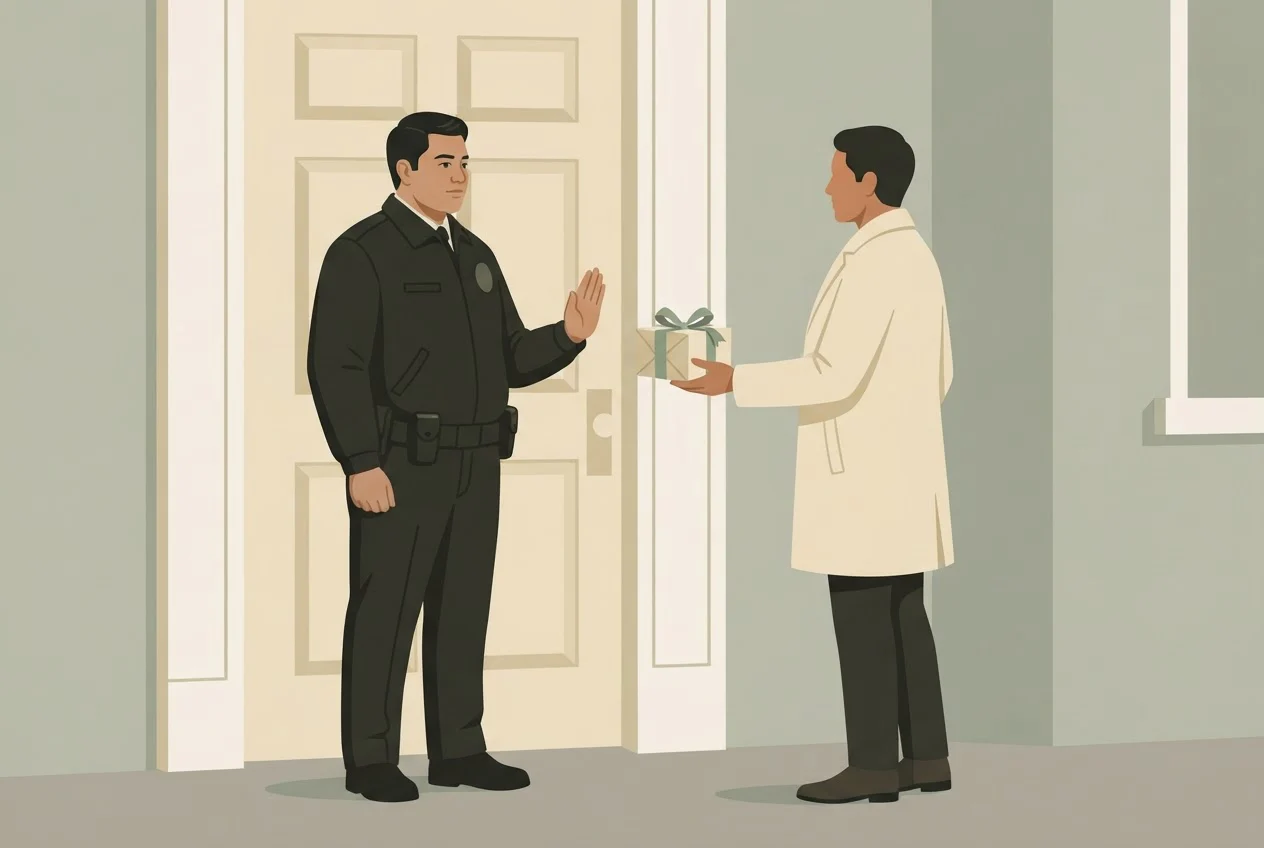
Apply two tests to every gift: would it compromise your integrity, and do you have written employer permission? Virginia's wording supplies the first test: "no gratuity, promise or other favor which would compromise my integrity." Our recommendation adds the second, because your employer's written policy, not your own judgment, decides what is allowed on a site.
A gift passes only if both tests pass. Refuse anything tied to what you do, allow, or overlook on the post, even if your employer would permit it.
On confidentiality, Virginia's code lets the duty to protect information yield where the law requires, and it includes a pledge to cooperate with criminal justice and government agencies "concerning matters within their purview." It does not say what to do when your own supervisor is the problem. Our recommendation is to know in advance who sits above your supervisor and how to reach them.
What should a guard do when a tip, a favor, or an order tests the code?
Decline anything offered in return for access, silence, or leniency, and put every incident in writing exactly as it happened. The table below applies the gift and confidentiality tests. These are our recommended steps, and your employer's written policy and your state's law come first.

| Situation | Test to run | What we recommend |
|---|---|---|
| A tenant or visitor offers cash or a tip | Written employer permission? Any link to what you do on post? | Decline unless your written policy allows it and it has no link to your duties. If unsure, decline and tell your supervisor. |
| A client asks you to leave a door unlocked or skip a patrol point | Does it contradict the post orders? | Follow the post orders. Report the request to your supervisor the same shift. |
| A supervisor tells you to enter patrol times you did not walk | Is the entry true? | Write only what happened. Keep your own dated notes. Take it to the next level of the company if the order is repeated. |
| A police officer asks what a client told you | Is it confidential, and does the law compel disclosure? | Tell your supervisor first. In an emergency, give what is needed to protect life. Otherwise provide what the law requires. |
| A holiday gift from a regular client | Employer permission? Any strings? | Tell your supervisor and follow written policy. Small gifts with no connection to your duties are the easiest to defend. |
A log entry matters beyond the company, because a report or log can be read aloud in court. Our guide to security guard report writing covers how a true, specific record protects you.
Does your state require ethics training for a guard license?
Georgia lists ethics inside its required guard course; Virginia and North Carolina require a set number of training hours without a separate ethics course. None of the three states below requires a stand-alone ethics course. Facts are as of October 2026.
- Georgia. The Board of Private Detective and Security Agencies requires a minimum of 24 hours of classroom instruction for private security employees. The curriculum lists "Ethics and Professionalism" under the Role of Private Security, in rules effective January 1, 2022 (Georgia Rules, Chapter 509-3). Our guide to the Georgia security guard license steps walks through the full sequence.
- Virginia. The Department of Criminal Justice Services lists 18 hours of entry-level training for an unarmed security officer. An officer may work up to 90 consecutive days while completing it, if fingerprints were submitted on or before the date of hire and the employer issues a 90-day authorization document (Virginia DCJS, Unarmed Security Officer).
- North Carolina. Unarmed registration requires a certificate of completion for the 16-hour unarmed guard course, dated less than one year before the application. The fees are $30 for the application and $38 for fingerprints, $68 in total (North Carolina Private Protective Services Board).
For Virginia and North Carolina, confirm the curriculum with the board to see whether the required course covers ethics. Whatever your state, confirm in writing which course satisfies the requirement before you pay for it. Our page on online guard training and state approval lists the checks to run, and our overview of private security officer training explains how the pieces fit together.
How can you test yourself against the code before you sign it?
Run these eight tests against your own post and the version of the code you are asked to sign. Each has a clear pass.
- Gift test. Can you produce written employer permission for every gift or tip you have accepted? Pass: yes, in writing. Fail: verbal only, or none.
- Strings test. Did any gift come before or after you granted access, ignored something, or changed a report? Pass: no connection. Fail: any connection.
- Log test. Does every entry in your log match what you did and when? Pass: every entry. Fail: any rounded, copied, or invented entry.
- Order test. Can you point to a written post order for every instruction you follow that departs from normal procedure? Pass: yes. Fail: it exists only as a spoken request.
- Confidentiality test. Can you name who may receive client information from you, and in what circumstances? Pass: you can name them from policy. Fail: you guess.
- Reporting test. Do you know the next person to tell if your direct supervisor is the problem? Pass: you have a name or hotline. Fail: you have no one.
- Wording test. Does the code you are asked to sign test gifts by integrity, by employer consent, or both? Pass: you know which, and you apply both. Fail: you have not read the line.
- Training test. Does your state's required course already cover ethics, or has your employer assigned a separate module? Pass: you can show the certificate. Fail: you do not know.
What does our ethics course cover?
We offer Course 224, Ethics for Security Guards, for $40 as of October 2026. It is a self-paced online course of about two hours, delivered through video and PDF materials. It has five chapters and 35 lessons, with four chapter quizzes and a final exam totaling 37 questions. You receive a certificate of completion when you pass the course. The course is approved in Georgia and North Carolina.
This two-hour course does not replace the 24-hour Georgia or 16-hour North Carolina required courses. Confirm with the board what the approval covers.
The syllabus covers codes of ethics, employee ethics, conflict of interest, confidential information, bribery, gratuities and gifts, honest business dealings, respect for law, authority versus power, and use of force. These are the topics behind the decision table above. Disable any VPN before watching the course videos.
Course completion is not a guard license. The certificate shows you finished the course, and your state board decides what registration requires. For employers who want to enroll a team, call 706-268-2221 or 832-922-1215 to set up a corporate account.
Build ethics training into your guard career
Frequently asked questions
Not as a separate course in Georgia, Virginia, or North Carolina. Georgia lists Ethics and Professionalism inside its 24-hour curriculum (Georgia Rules, Chapter 509-3). For Virginia and North Carolina, ask the board whether the required course covers ethics.
Not necessarily. Virginia's board publishes a nine-pledge code (Virginia DCJS), and your state or employer may use different wording. Read the gift and confidentiality lines of the version you are asked to sign.
Sources
- 1.Virginia Department of Criminal Justice Services, Private Security Code of Ethics (PDF)
- 2.National Criminal Justice Reference Service, Codes of Ethics for Private Security Management and Private Security Employees (1976)
- 3.Georgia Rules and Regulations, Chapter 509-3, Instructors and Training Program Requirements
- 4.Virginia DCJS, Unarmed Security Officer/Courier
- 5.North Carolina Private Protective Services Board, Security Employee Registration
- 6.ASIS International, Certification Code of Professional Responsibility