Can One Georgia Security Training Certificate Work in Multiple States?

TL;DR
We explain why a Georgia security training certificate does not create automatic interstate credit, even when course topics look similar. Use our six-step regulator check, compare hours and provider rules, confirm certificate fees before ordering documents, and keep written acceptance from each state that matters to your work.
If you are building a security career across state lines, the certificate needs more scrutiny than its title. Georgia requires 24 classroom hours for its basic security-officer training curriculum.
A Georgia security training certificate can be used in more than one state only when each regulator independently accepts the course, instructor, subject matter, completion date, actual hours, and certificate format for its own credential. The document proves completion. It does not create automatic reciprocity or state credit, and a second state may require its own training or form.
We explain how to distinguish a usable record from accepted regulatory credit, compare common outcomes, and verify your position before paying for another document.
Does a Georgia Security Training Certificate Transfer Automatically?
No. We issue a completion record for the course a learner finished, while each state decides whether that record meets its separate licensing or employment rules. That distinction matters whether you are changing employers, relocating, or trying to document training for a second jurisdiction.
Georgia-focused learners should first understand the state-specific baseline in our Georgia security requirements. The intended role matters too. A certificate used for an unarmed position does not automatically establish armed eligibility, employer authorization, or a different state’s registration status.
| Outcome | What It Means | Best Next Step |
|---|---|---|
| Accepted | The destination regulator confirms the exact course and certificate satisfy its requirement. | Keep the written confirmation with your certificate. |
| Requires Review | The regulator may consider equivalent training but needs course, provider, or instructor details. | Submit the requested records before enrolling or applying. |
| Not Accepted | Required hours, provider approval, state form, or subjects do not match. | Complete the required state-specific training. |
A course can be similar without being interchangeable. Regulators often evaluate the credential type, actual instructional hours, course date, instructor authorization, and the subjects covered, not just the words printed in a course title. They may also require the employer to retain records, require additional workplace instruction, or limit the use of a certificate to a particular credential.
That is why we encourage learners to compare a Georgia-specific curriculum with a generic-course difference before treating any course as portable. The practical question is not whether the document looks official. It is whether the destination regulator recognizes what the document proves.
What Makes a Certificate Usable for Georgia Training?
For Georgia work, the certificate is part of a broader training record. It needs to support the required curriculum and instructor qualifications, and it must be useful to an employer or regulator reviewing the learner’s actual preparation.
Proof of Completion Versus State Credit
Proof of completion establishes that you finished a course. State credit means the relevant regulator accepts that completed course for a defined credential. We never treat those as the same promise.
Georgia’s rule requires the certificate to identify the participant, training entity, date or dates, topics, actual hours, instructor or facilitator name and signature, and Board-issued license number. It also prohibits the use of the Board or Secretary of State seal.
Those details make it easier to ask a regulator a precise question. Rather than asking whether a course “transfers,” send the record and ask whether it satisfies the training requirement for the exact role you intend to hold. Review Georgia first steps before relying on a record from another jurisdiction.
When Similar Content Can Still Qualify
Identical content can qualify in more than one jurisdiction if both regulators accept the provider, instructor, dates, actual hours, and subjects for the exact security role. Written confirmation is the evidence that turns a possibility into a safe enrollment decision.
A matching hour total alone is not enough. One state may require a named instructor qualification, a local legal-content module, a specified examination, or a provider that appears on its own approval list. A second state can also treat initial training, continuing education, and armed training as entirely different categories.
Why Georgia’s Rules Still Control
Georgia requires its own 24-hour classroom curriculum for basic security personnel. An out-of-state certificate may show valuable training, but it does not by itself show that Georgia’s instructor, curriculum, and documentation rules were met.
For online learners, our online training guidance explains the questions to settle before treating convenience as regulatory acceptance. The best time to ask is before course enrollment, not after a hiring deadline or application submission creates pressure to find a quick substitute.
How Do You Verify Recognition Before You Enroll?
The safest approach is to ask both states before you spend money or submit records. This avoids relying on informal advice from an employer, a colleague, or a course title that sounds portable.
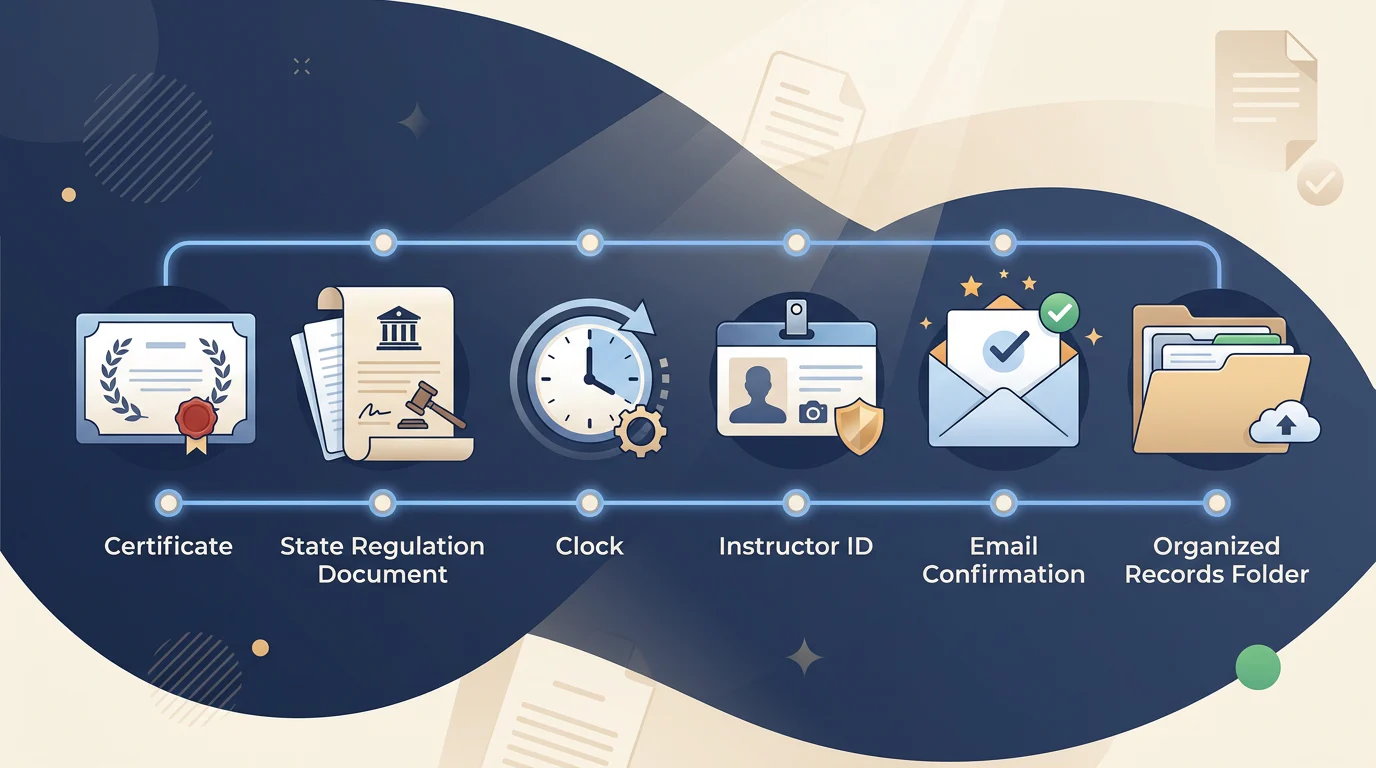
Follow This Six-Step Check
- Identify the exact credential you need in each state, such as unarmed security officer or armed security officer.
- Read the current regulator rule and application instructions for both states.
- Compare actual hours and subject categories, not only the course title.
- Confirm whether the destination state requires its own approved provider or instructor.
- Send the regulator your course details and request a written answer before enrolling.
- Save the response, certificate, outline, and any state-specific form with your records.
A useful request names the course, completion date, hours, provider, instructor information, and the precise credential you seek. Ask whether the regulator requires prior approval, a state form, or additional training. Our out-of-state certificate guide can help you frame that comparison.
| State | Standard Training Rule | Portability Result For A Georgia 24-Hour Record |
|---|---|---|
| Georgia | 24 classroom hours under Georgia curriculum and instructor rules | May meet Georgia requirements when all state conditions are satisfied |
| Florida | At least 40 hours from a Florida-licensed security school | Not sufficient for the standard Class D requirement |
| Tennessee | Four hours, with possible review of equivalent recent training | Requires regulator review before relying on equivalency |
Florida’s standard Class D requirement is 40 hours from a state-licensed school, so a Georgia 24-hour certificate should not be presented as an automatic substitute. Tennessee allows potential consideration of equivalent recent training, but its own equivalency guidance still makes written confirmation the prudent choice.
If you plan to work in Georgia after training elsewhere, compare the out-of-state record against Georgia’s required topics and instructor documentation. Our Georgia training overview offers additional context on why course labels alone do not establish compliance.
What Do Additional Certificates and Corrections Cost?
We publish the Georgia 24-hour course at $65, and our current course listing describes a certificate of completion after the required lessons and assessments. It does not publicly itemize charges for duplicate, corrected, or state-specific documents, so we do not describe any of those charges as free.
| Document Or Charge | Publicly Available Information | What To Confirm Before Ordering |
|---|---|---|
| Georgia 24-hour course enrollment | $65 | Course price and access terms |
| Completion certificate | Certificate of completion is described | Whether any separate issuance charge applies |
| Duplicate certificate | Not publicly listed | Duplicate-document cost and delivery method |
| Corrected certificate | Not publicly listed | Correction process and any associated charge |
| Additional-state form | Not publicly listed | Whether a separate form or document is needed |
Ask us about the exact document you need before ordering it, especially when a regulator requires a particular format. Our course-price overview can help you separate course enrollment costs from licensing, application, and document costs that may sit outside the course purchase.
A correction may be necessary when a name, completion date, instructor detail, or course hour total does not match the documents a regulator expects. Retain the original certificate and the written explanation of any correction so your records remain consistent.
Learningshopusa Can Help You Prepare
At Learningshopusa, we built our Georgia basic security officer course for learners who want a clear record of what they completed, not vague promises about automatic portability. Our public listing shows the 24-hour course at $65, with rolling access, and our certificate is earned after the required lessons and assessments. Before you enroll, we encourage you to ask the receiving regulator whether it recognizes the exact course, instructor information, actual hours, and subjects for your intended role. We can help you identify the certificate details you should request and explain what our course record contains, but the receiving regulator makes the acceptance decision. If your goal is Georgia work, understand whether your intended role is unarmed or armed before selecting training. We also encourage employers to compare the certificate with their hiring files before assigning duties. Then enroll or contact our team through Learningshopusa.
FAQs on Georgia Security Training Certificate
Can a Certificate Be Used in More Than One State?
A certificate can support another application only when the destination regulator independently accepts the course, instructor, hours, subjects, dates, and document format for its credential.
Does a Course Certificate Transfer Between States?
No. Completion proves you finished our course. Regulatory credit begins only after the relevant state confirms the course, provider, instructor, record, and timing meet its stated licensing rules.
Will Georgia Accept an Out-Of-State Training Certificate?
Georgia requires 24 classroom hours under its curriculum. An out-of-state record needs confirmation that its instructor, content, dates, certificate fields, and actual hours meet Georgia rules.
How Do I Verify Whether Two States Recognize the Same Course?
Request the destination regulator’s written answer and keep it with your records. Ask us about document fees before ordering a duplicate, correction, or state-specific form.
Is There an Extra Fee for Another Certificate?
Our public listing shows $65 for the 24-hour Georgia course but does not itemize document charges. Ask us before assuming a duplicate or correction is free.