Chain of Custody for Investigators: What to Log and Why
Chain of custody is the written record of who held evidence, when, and why. Investigators start it at receipt, because courts have treated gaps as affecting weight, though rules differ by court.
By Sharon DeCet, Founder · Updated 23 Oct 2026

Key takeaways
- Chain of custody is the written record naming every person who held an item and accounting for every period of custody. For an investigator it begins when the item reaches you, so log receipt at the handover.
- Of four public agency custody forms, all record transfer date and time; only Indiana's records a tamper seal and condition at collection. Our custody log adds both.
- In rulings from Maryland and the Fifth Circuit, a gap in the record affected how much weight evidence carried, not whether it was admitted (whether the judge lets the jury see it). Rules differ by court, so confirm yours with an attorney.
- For digital files, record a hash value at receipt and work from copies. Federal Rule of Evidence 902(14) lets data copied from a device be authenticated by a digital identification process, such as hash matching, with a certification.
In this article
- 1What is chain of custody, and what does an investigator have to record?
- 2What should a custody log for private investigators contain?
- 3Which details do public chain of custody forms leave out?
- 4What happens if the chain of custody is broken?
- 5How do you keep chain of custody for digital files, photos and video?
- 6Which evidence-handling course covers chain of custody?
- 7Frequently asked questions
The first link in an investigator's chain of custody is often one the investigator did not make. A client hands over a phone, a USB drive or a folder of photos, and nobody wrote down where it had been before that moment.
Standard definitions assume a police evidence room or a laboratory, where handlers are staff and the first handoff is controlled. A private investigator starts further down the line. The history has to be asked for, written down and, where the client cannot supply it, recorded as unknown.
This page gives the custody log we recommend, the written record an investigator keeps for each item, with a pass test for every field. It then compares that log with what four public agency forms record, and sets out what two appellate courts, which review lower-court decisions, did with gaps in the record.
Digital files get their own section, because they are copied, renamed and re-sent far more easily than a sealed bag.
What is chain of custody, and what does an investigator have to record?
Chain of custody is the written record that identifies each person who handled an item of evidence and accounts for every period of custody between collection and trial. The National Institute of Justice (NIJ) defines it as "a recorded means of verifying where the evidence has travelled and who handled it before the trial."
The same NIJ module says the record exists to prevent substitution, tampering, misidentification, damage, contamination, loss and falsification. It has to establish the evidence's identity, authenticity and legal integrity. Authentication means showing that an item is what you say it is. Federal Rule of Evidence (FRE) 901(a) asks for "evidence sufficient to support a finding that the item is what the proponent claims it is."
The custody log starts the moment the item reaches you, whether you collected it or a client handed it over. Everything before that moment is something you can only report as told, and the log should say so.
What should a custody log for private investigators contain?
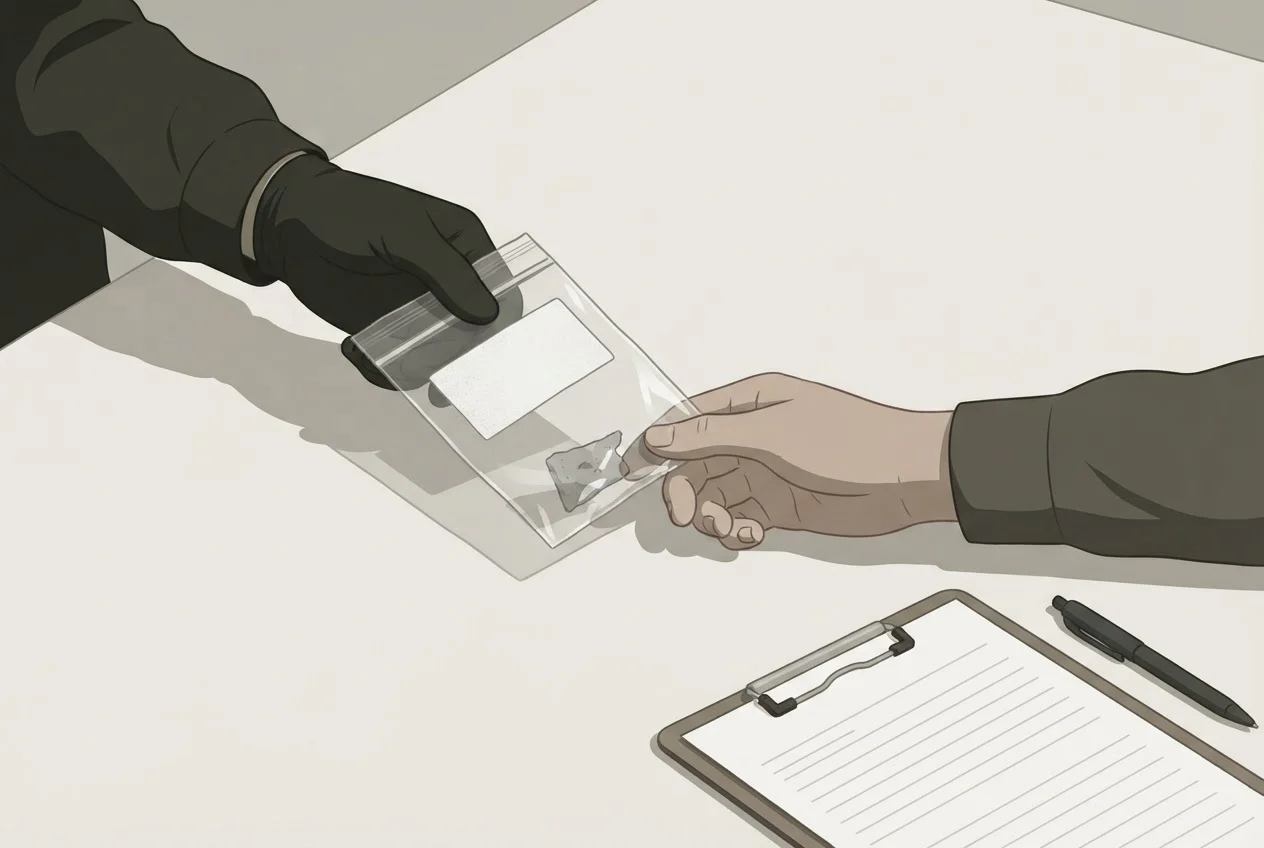
A custody log has three parts: an intake block completed at handover, one transfer row for every later handoff, and a disposition line when the item leaves your control. Each field below has a pass test. A field that fails its test is a gap someone will ask about.
| Intake field | Pass test | Fails when |
|---|---|---|
| Item ID | Unique to the item, written on the item or its container and on the log | Two items share an ID, or the ID was assigned afterward |
| Date, time and time zone of receipt | Entered at the handover | Reconstructed from memory later |
| Who handed it over | Full name, contact details, role in the case | Only a first name or "the client" |
| What they say it is | Their description, in their words, signed by them | Your summary replaces their statement |
| History before you | Where it was kept, who else had access, whether anything was opened, copied, edited or deleted. If unknown, the log says "unknown" | Left blank |
| Condition on arrival | Described and photographed before you touch it, so a stranger could tell from the log and photos whether it was sealed or damaged | Photos taken after opening |
| Seal number | Recorded if the item is sealed. Any opening is logged with a reason | Seal broken with no entry |
| Hash value (digital files) | Algorithm (the calculation method, for example SHA-256), value and tool name recorded at receipt and again after copying, both calculated with the same tool, and the two values are identical | No hash, no algorithm or tool name recorded, or a mismatch with no explanation |
Every later handoff gets a transfer row: date and time, released by, received by (printed name and signature), purpose, and storage location. The pass test is that no signature is empty and each row's "received by" matches the next row's "released by." Opening, copying or moving an item without handing it to anyone still gets a row.
The disposition line records whether the item was returned, delivered to an attorney or destroyed, with date, name and signature.
Three questions open every handover. Where has this been since it was created or found? Who else has had access to it? Has anything been opened, copied, edited or deleted? Write the answers in the client's words.
| Item | Log at receipt | Do not |
|---|---|---|
| Sealed bag, document or device | Description, photos of all sides, seal number | Open it to "take a look" without a log entry |
| Client's photos or video | Original files, who took them, on which device, when | Crop, rename or re-save the original. Work from a copy |
| USB drive or phone export | Source device, hash value | Browse the original drive. Copy first, confirm the hash matches, then work on the copy |
| Your own surveillance footage | Device, operator, date, storage location | Edit the original. Export a copy for the report |
| Records from a third party | Source, how obtained, date | Mix them into working notes |
Put the item ID on every line of the report that relies on the item. How to Write Investigation Reports That Hold Up covers the report itself.
Which details do public chain of custody forms leave out?
Of the four public agency custody forms we read in October 2026, all four record the date and time of each transfer. Only one records a tamper seal and only one records the item's condition at collection. In our view, those two fields do the most to show that an item did not change between hands.
We opened the blank form from each agency and marked a field present when the form has a labeled place to enter it. The forms are Indiana Department of Health State Form 57209 (1-23), the Environmental Protection Agency (EPA) sample chain-of-custody form, the Los Angeles County Public Health Laboratory form and the North Carolina State Laboratory of Public Health form.
| Field on the form | Indiana | EPA | Los Angeles County | North Carolina | Forms with the field |
|---|---|---|---|---|---|
| Date and time of each transfer | Yes | Yes | Yes | Yes | 4 of 4 |
| Unique item or sample ID | Yes | Yes | No | Yes | 3 of 4 |
| Reason for each transfer | Yes | No | Yes | Yes (labeled "Action") | 3 of 4 |
| Tamper seal | Yes | No | No | No | 1 of 4 |
| Condition at collection | Yes | No | No | No | 1 of 4 |
| Final disposition | No | No | No | Yes | 1 of 4 |
Four forms is a small sample, and all four are built for laboratory samples, not investigator work. The pattern is a reason for the extra fields in our custody log, not a measure of the whole field.
A laboratory receives samples collected under a known procedure. An item a client hands you arrives with its history unknown, so its condition on arrival is the only baseline you can establish. That is why the intake block puts condition, photos and seal number ahead of everything else.
What happens if the chain of custody is broken?
A broken chain of custody usually lets opposing counsel attack how much the evidence should count, and in some cases a court may exclude it. In Wheeler v. State (Maryland, 2018) and United States v. Campbell (Fifth Circuit, unpublished), the courts treated gaps as going to weight, not admissibility.
Weight means how much the jury believes the evidence. Admissibility means whether the judge lets the jury see it. That is how those courts ruled, not a promise for every court.
In Wheeler, decided June 25, 2018, the Maryland Court of Appeals (now the Supreme Court of Maryland) held that once chain of custody is established, challenges "go to the weight and credibility of the evidence, not its admissibility." The test was whether the proof showed a reasonable probability that tampering did not occur. Wheeler is the only precedential ruling of the two.
In Campbell, an early-1990s drug-prosecution appeal in the Fifth Circuit, the court designated its opinion unpublished and without precedential value. Mismatched initials on evidence seals and differing receipt dates "relate to the weight, rather than the admissibility, of the evidence." That followed a basic showing that the exhibits were authentic.
The NIJ module is less forgiving. Without proof of an intact chain, evidence "may be excluded from trial or afforded less weight", and the jury may receive a limiting instruction on how to weigh it. A limiting instruction is the judge's direction to jurors on how they may use a piece of evidence.
Our reading is that the gap that hurts an investigator is the unexplained one. A recorded handoff with a reason and a signature can be explained on the witness stand. A missing entry cannot. Expect opposing counsel to ask either way, and make the log the answer. Our guide to testifying in court covers the stand itself.
Which rule applies depends on the court and the case, so ask the attorney who retained you. This page is not legal advice. Whether you were permitted to collect or receive the item is a separate question from custody; what a private investigator license does and doesn't cover is the place to start on that. For broader grounding in evidence rules and court procedure, see our Legal Aspects of Private Investigation course.
How do you keep chain of custody for digital files, photos and video?
Record a hash value the day a file arrives, keep the original untouched, and work only from copies. A hash value is a number a program calculates from a file's contents. A copy that produces the same number as the original is an exact duplicate.
The Federal Rules of Evidence give that practice a use in court. Rule 902(14) lets data copied from an electronic device, storage medium or file be authenticated "by a process of digital identification," shown by a certification of a qualified person, without a live witness. The committee notes tie this to hash values. The party relying on it must give the other side advance notice. Rule 901(a) still governs everything else: the item must be shown to be what you claim.
Our recommendations for investigators:
- Keep native files, meaning the original file with its metadata (the date and device details stored inside it), not screenshots.
- Log every export and copy as a transfer row.
- Never rename or re-save the original.
- Tell the retaining attorney that the hash exists, because whether a certification will be used is the attorney's decision.

Which evidence-handling course covers chain of custody?
Our Collection and Preservation of Evidence course covers chain of custody in three lessons. It has 30 self-paced lessons, takes about 4 hours and costs $80 as of October 2026.
We teach the full handling sequence the custody log depends on: physical evidence defined, systematic processing, search methods, incident scene photography, sketching and measuring, marking and packaging, documentation and forensic testing. It covers chain of custody in three lessons: lesson 1.4 (a 62-minute video), lesson 4.4 (a 5-page PDF) and lesson 4.5 (a 3-minute video). Five progress quizzes and a final exam, 78 questions in all, lead to a certificate of completion on passing every assessment.
The course teaches how to mark, package and document an item and why the record matters. The custody log above is the document you keep. Start with Collection and Preservation of Evidence.
A certificate of completion records the training you finished. It is not a license, and whether a state board accepts a course for credit is that board's decision. Will This PI Course Count in My State? shows how to check.
Build a custody log you can defend in court
Frequently asked questions
Sources
- 1.National Institute of Justice, Law 101: Chain of Custody (archived training module)
- 2.Federal Rule of Evidence 901, Legal Information Institute, Cornell Law School
- 3.Federal Rule of Evidence 902, Legal Information Institute, Cornell Law School
- 4.Wheeler v. State, No. 50, Maryland Court of Appeals, filed June 25, 2018
- 5.United States v. Campbell, No. 92-1897, U.S. Court of Appeals for the Fifth Circuit (unpublished)
- 6.Indiana Department of Health, Sample Collection Chain of Custody, State Form 57209 (1-23)
- 7.U.S. Environmental Protection Agency, sample chain-of-custody form
- 8.Los Angeles County Department of Public Health, Public Health Laboratory chain of custody form
- 9.North Carolina State Laboratory of Public Health, chain of custody form
- 10.Learningshopusa, Collection and Preservation of Evidence (course 122)
- 11.Learningshopusa, Legal Aspects of Private Investigation (course 115)