What Training Does a New Private Investigator Need? A Private Investigator Training Guide
Private investigator training starts with state rules. Verify required courses, applications, certificates, and practical skills before enrolling.

Private-investigator work has a real entry path, not a one-course shortcut. The occupation is projected to see 6 percent growth from 2024 to 2034, so we encourage applicants to separate legal eligibility from useful professional development.
Private investigator training starts with the licensing authority for the state where you will work. We recommend verifying the license class, approved course, experience, examination, fingerprinting, and application rules first. Skills training in surveillance, interviewing, research, evidence documentation, and report writing improves readiness, but a completion certificate never authorizes practice by itself.
Below, we show how to identify the required path, choose practical skills training, compare courses, and keep records that remain useful to regulators and employers.
What Is Required Private Investigator Training, and What Is Optional?
Required training is whatever your regulator assigns to your specific license class or employee status. Optional training is still valuable, but it should be purchased for a defined skill outcome, not on the assumption that it creates a license, registration, or renewal credit.
| Training Type | What It Does | When It May Be Required | What It Does Not Do |
|---|---|---|---|
| Pre-Licensing Education | Meets a stated curriculum or hour requirement | Before an application or employee assignment | Issue a license |
| Examination Preparation | Builds familiarity with tested laws and procedures | Only when a regulator requires it | Replace the licensing examination |
| Employee Registration | Documents authority to work under an agency | Where a state registers employees or interns | Authorize independent practice |
| Continuing Education | Supports renewal or current professional competence | During a renewal cycle | Replace initial training |
| Skills Training | Improves investigation methods | Usually optional unless specifically mandated | Guarantee state credit |
| Voluntary Certification | Demonstrates a credential or specialization | Voluntary | Override licensing rules |
Florida, for example, requires an intern applicant to complete at least 40 hours of professional training, submit the original certificate, and have a sponsor. That is a specific Florida 40-hour rule, not a national standard for every new investigator.
A state can also distinguish between an employee route and independent licensure. Start with our PI certification path, then match every course claim to your own license class and current applicant status.
How Do You Verify State-Approved Private Investigator Training?
We recommend beginning with the regulator, not the course catalog. Your work state, intended role, and whether you are applying as an employee, intern, provisional applicant, or independent licensee determine which rules matter.
Locate the Current Licensing Authority
Search for the state agency that regulates private investigation, then open its current application, rules, forms, and approved-provider list. Save the page date and URL with your application documents, because provider lists, fees, and delivery rules can change.
Match Your License Class and Applicant Status
An intern or registered employee may have a different route from someone seeking authority to operate independently. Florida’s Class “C” license requires two years of verifiable full-time experience, while the Class “CC” intern path combines training with sponsorship and supervision.
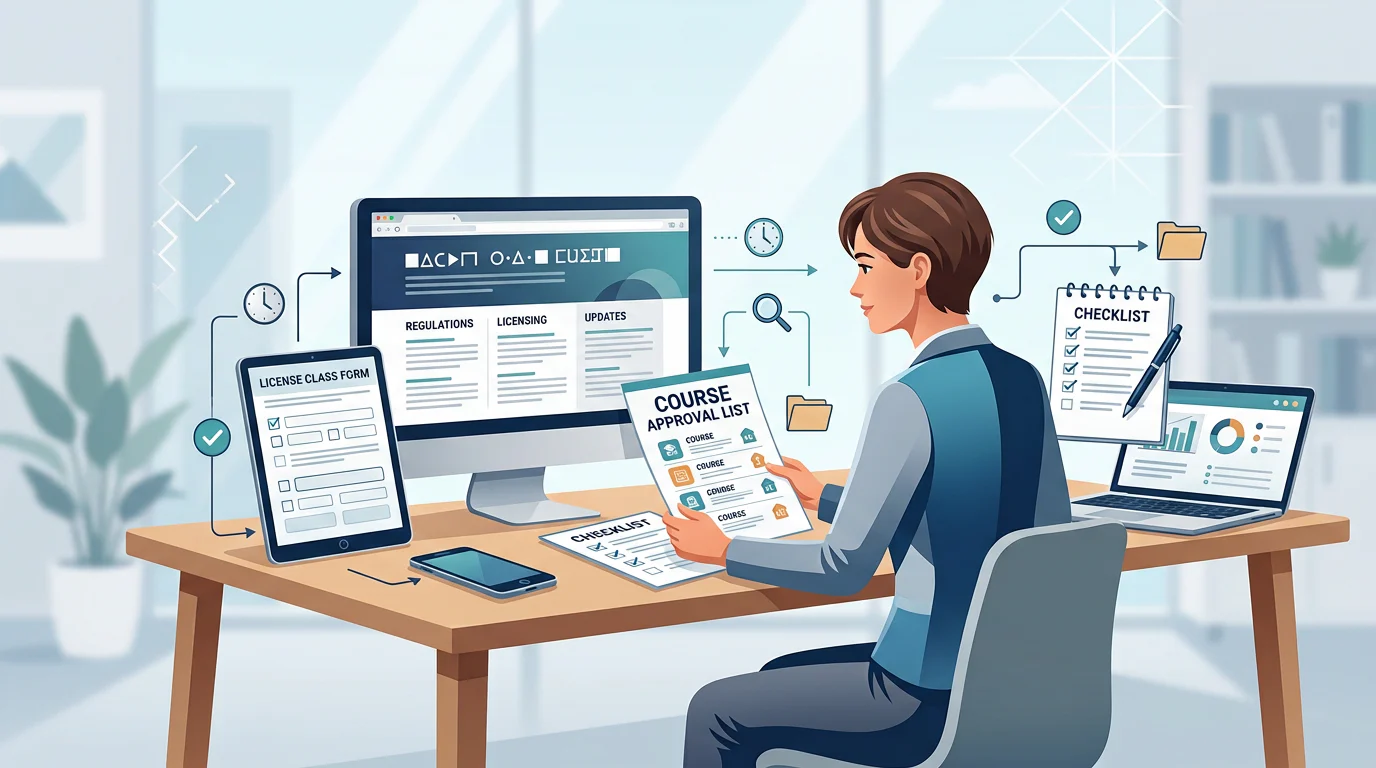
Verify the Course Before Paying
Use this four-step flow:
- Find the current licensing authority for the state where you will work.
- Select the exact license class and applicant status.
- List every prerequisite, including experience, examination, fingerprints, sponsorship, insurance or bonding, and delivery restrictions.
- Confirm the individual provider and course with the authority, then save dated proof of that confirmation.
Oregon illustrates why a full application review matters. Its new-applicant process includes an application, fingerprints, references, an examination, security such as a bond or insurance, and fees. The current Oregon application page lists an $800 licensing fee and a $45 background fee through September 30, 2026.
Keep Employee Training Separate from Renewal Training
Do not file foundational employee training as continuing education unless the regulator says it counts. Minnesota requires private-detective employees to complete 12 hours of preassignment training within their first 21 days of employment, and its Minnesota training rule treats that as a defined requirement.
For a Minnesota-specific starting point, review the Minnesota training route before assuming a general skills course fills that obligation.
Which New PI Training Path Fits a First-Time Applicant?
The best course for a first-time applicant is the one that fits the state route already confirmed. A career changer should not begin by comparing course titles alone, because relevant work experience, education, military training, or agency sponsorship may affect the legal route.
| Your Starting Point | First Check | Training Priority |
|---|---|---|
| No investigative experience | Intern, employee, or provisional options | Required entry curriculum and supervised practice |
| Related investigative experience | Experience-credit rules | Documented proof and any required examination |
| Career changer with relevant education | Education-substitution limits | State approval and practical fundamentals |
| Licensed Investigator | Renewal category and current assignment gap | CE or targeted skills development |
If your goal is independent licensure, verify whether experience is mandatory before investing heavily in a generic course. If your goal is agency employment, ask the employer and regulator what must be completed before you are assigned work, what can be completed after hire, and who retains the training record.
A career change can make related skills useful, but it does not automatically eliminate legal requirements. Use our career-path comparison to distinguish transferable experience from a state’s actual licensing criteria.
Which Beginner Skills Make Coursework Useful on Assignment?
Once the legal path is clear, practical private investigator training should make you more reliable on real assignments. We look for curriculum that teaches boundaries and documentation alongside technique, because good investigation depends on lawful decisions and defensible records.
Legal Boundaries, Privacy, and Ethics
A beginner course should explain scope of authority, confidentiality, privacy, conflicts, and when to pause for supervisor guidance. These subjects prevent a new investigator from confusing curiosity, access, or client pressure with lawful authority.
Public-Record Research and OSINT
Useful instruction covers source evaluation, public-record requests, permissible access, search documentation, and privacy checks. Keep research notes clear enough that another investigator can understand what was reviewed, when it was reviewed, and why it mattered.
Surveillance and Interviewing
Look for planning exercises, observation notes, interview preparation, question design, rapport, and documentation. Georgia’s Georgia curriculum includes OSINT, interviewing, evidence, report writing, and at least four hours of covert-surveillance methodology.
Evidence Documentation and Report Writing
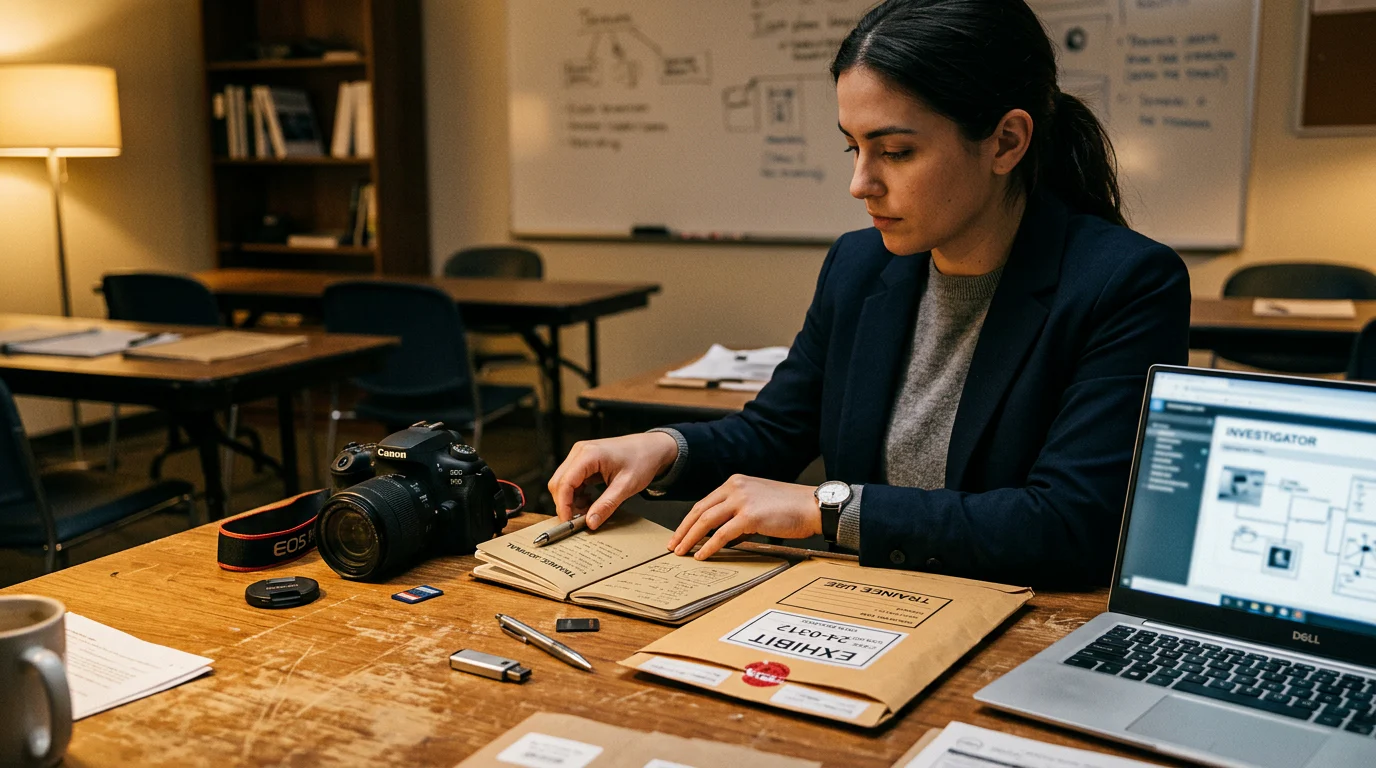
Choose training that distinguishes observed facts from opinions, uses timestamps consistently, explains media handling, and requires a written report. We recommend practical PI modules when you need structured professional development, then apply those skills under the direction required by your state or employer.
How Do You Compare Online and In-Person Courses?
Online and in-person describe delivery, not regulatory value. We recommend comparing every program with the same worksheet, especially when a course claims to be approved, self-paced, suitable for renewal, or useful for first-time applicants.
| Comparison Check | What To Confirm |
|---|---|
| Approval Status | Authority, provider, course, and as-of date |
| Prerequisites | License class, experience, sponsorship, and eligibility |
| Curriculum | Required topics and practical skill coverage |
| Delivery | Online, live, classroom, attendance, and identity rules |
| Verified Duration | Actual required hours, not estimated study time |
| Total Cost | Tuition, application, examination, fingerprints, travel, and retests |
| Assessment | Test, exercise, identity verification, and passing standard |
| Certificate Fields | Learner, provider, hours, dates, instructor, and approval details |
Do not compare tuition alone. California’s current private-investigator application lists a $374 application and examination fee plus a $424 initial license fee, for $798 before other applicant costs. Use the California fee schedule as a reminder to total the state process separately from course price.
To keep this estimate organized, use our course cost guide before comparing providers.
Clear records matter as much as completion. Illinois requires licensed private detectives to keep training documentation for at least five years, and employers must maintain applicable records. Review the Illinois record law, then use our certificate-record guide to organize your own files.
How Can Learningshopusa Help You Choose Training?
At Learningshopusa, we build training for investigators who want a useful learning record without pretending that one generic course settles every state requirement. Our course information should help you compare your goal, delivery needs, topic coverage, assessment, price, and certificate process before you enroll. We also encourage you to keep your license class, approval check, course receipt, syllabus, and completion evidence together, because that makes employer review and future renewal planning easier.
If you need professional development in investigation methods, choose it for the skill you want to strengthen, then confirm separately whether it serves any state requirement. We make it easier to ask the right questions before you buy, including whether you need mandated training, continuing education, or practical subject knowledge. Build your plan from the regulator outward, then choose the learning format that fits your work. Explore Learning Shop USA
FAQs on Private Investigator Training
Which PI Training Is Best for a First-Time Applicant?
Choose the option your regulator confirms for your applicant status. Then prioritize legal boundaries, evidence documentation, assessment, record quality, instructor access, and skills that match expected assignments.
Do I Need a Degree to Start?
Check your state pathway first. Some authorities credit related education toward experience, but a degree or course does not replace required licensing, registration, examination, or supervised work.
Can a Certificate Make Me Licensed?
No. A certificate records course completion. Your state may require that evidence, but only the applicable authority can issue the license or registration needed for regulated investigative work.
How Do I Check Whether an Online Course Counts?
First, identify the regulator’s approved-provider list. Then confirm your license class, renewal period, course, delivery format, instructor, completion date, and certificate requirements before you enroll.
What Records Should I Keep?
Save the certificate, syllabus, receipt, approval evidence, assessment result, and regulator correspondence together. Keep files for the period required by your state, employer, or audit rule.