Law-Enforcement Training vs PI Training: Which Fits Your Goal?
Compare law-enforcement training vs private investigator training by credit, evidence practice, access, price, and career fit.

Law-Enforcement Training vs PI Training: Which Fits Your Goal?
Texas sets its intermediate crime-scene curriculum at a 40-hour minimum, but course hours alone do not tell a private investigator whether that training fits a renewal file, a client case, or a career move.
Choose law-enforcement training when you need agency-linked crime-scene work, public-safety credit, or scheduled classroom practice. Choose PI continuing education when your licence renewal depends on state-approved hours, and professional investigation-skills training when you need accessible methods for private or corporate casework. The credentials, admission rules, practical exercises, and regulatory value are not interchangeable.
We compare law-enforcement training vs private investigator training by audience, credit, curriculum, evidence practice, access, price, and the next duty you need to perform.
Who Is Each Path For?
We built this comparison for working and prospective private investigators, not for readers trying to choose a police academy or tactical program. The useful starting point is the work you are authorized to perform next: renew a PI credential, strengthen a private-case skill, or complete agency-directed public-safety training.
Public-safety crime-scene classes can be a strong fit for commissioned personnel, agency-employed investigators, and some civilians assigned to investigative duties. A private investigator may find the subject matter valuable, especially for documentation and preservation awareness, but access rules, employer restrictions, and the resulting credit can make it a poor replacement for a PI-specific route.
Georgia shows why career stage matters. Its basic private-detective curriculum requires 70 classroom hours and includes scope of practice, background investigations, surveillance law, reports, case management, and ethics under the state rule. That is different from a short renewal course, and both are different from a focused skills course.
- Licensed PI With A Renewal Deadline: Start with your regulator, licence class, required hours, and topic allocation.
- Corporate Investigator Or Career Changer: Start with the specific task you need, such as research, interviewing, documentation, or report writing.
- Agency-Affiliated Investigator: Consider the public-safety path when your employer accepts the schedule, field exercises, and resulting credit.
For a broader career-route check before you enroll, see our PI certification path.
What Credit Does Each Provide?
Credit is the point where similar-sounding courses stop being interchangeable. We recommend treating every certificate as evidence of completing a particular course, not as automatic proof of licence eligibility, state renewal credit, forensic certification, or authority to perform a specialist task.
| Criterion | Public-Safety Crime-Scene Training | State-Specific PI CE | Professional Skills Training |
|---|---|---|---|
| Primary Audience | Agency-affiliated investigative personnel | Eligible licensed or registered PIs | PIs, corporate investigators, career changers |
| Eligibility | Provider and employer rules may apply | State, licence class, and tenure may apply | Usually course-specific |
| Credential | Public-safety credit and completion record | Qualifying PI renewal credit and certificate | Provider certificate or non-credit development |
| Regulatory Alignment | Public-safety proficiency requirements | Private-investigator renewal rules | Only if a regulator accepts the exact course |
| Topics | Crime scenes, evidence, photography, legal search | Investigation topics, ethics, state rules | Reports, research, surveillance, interviewing |
| Format | Usually scheduled, in-person instruction | Often online or self-paced where allowed | Online, live online, classroom, or blended |
| Practical Exercises | Scenario and assessment potential | Must be verified course by course | Must be verified course by course |
| Schedule | Fixed dates and full attendance | Built around the state renewal cycle | Depends on the provider |
| Location | Classroom or field location | Often remote | Varies |
| Price | $705 listed when checked, recheck before enrolling | $175 listed for selected Texas and Georgia routes | Focused subjects commonly list from $40 to $175 |
| Verification Source | Curriculum and current enrolment terms | Regulator rule, approval record, course card | Published outcomes, assignments, and feedback terms |
Public-Safety Credit Is Not PI Renewal Credit
Public-safety credit reflects the applicable public-safety curriculum and reporting process. It does not automatically satisfy a private-investigator regulator, even when both courses address evidence, reports, ethics, or investigations.
Texas Requires a Specific PI CE Mix
Texas private investigators with more than 15 years of continued licensure need 12 hours, including eight investigation-related hours, two ethics hours, and two law-and-rules hours. Those with less than 15 years need 18 hours, including 14 investigation-related hours, two ethics hours, and two law-and-rules hours under the DPS requirements.
Our current Texas course card lists 18 hours and a $175 price for the less-than-15-year route. Before buying, match your tenure and course record with our Texas CE hour guide.
Georgia Requires Categories, Not Just Hours
Georgia registered PI employees generally need 16 renewal hours after the first-renewal exemption: 12 industry-related hours, two ethics hours, and two homeland-security hours. The provider, facilitator, attendance record, and certificate details all matter, including when instruction is completed online.

How Does Law-Enforcement Training vs Private Investigator Training Differ?
The strongest law-enforcement training vs private investigator training comparison is not about which path sounds more advanced. It is about whether the curriculum matches the investigation you are legally permitted to conduct and the record you need when a regulator, employer, client, or court asks questions later.
Crime Scenes, Evidence, and Photography
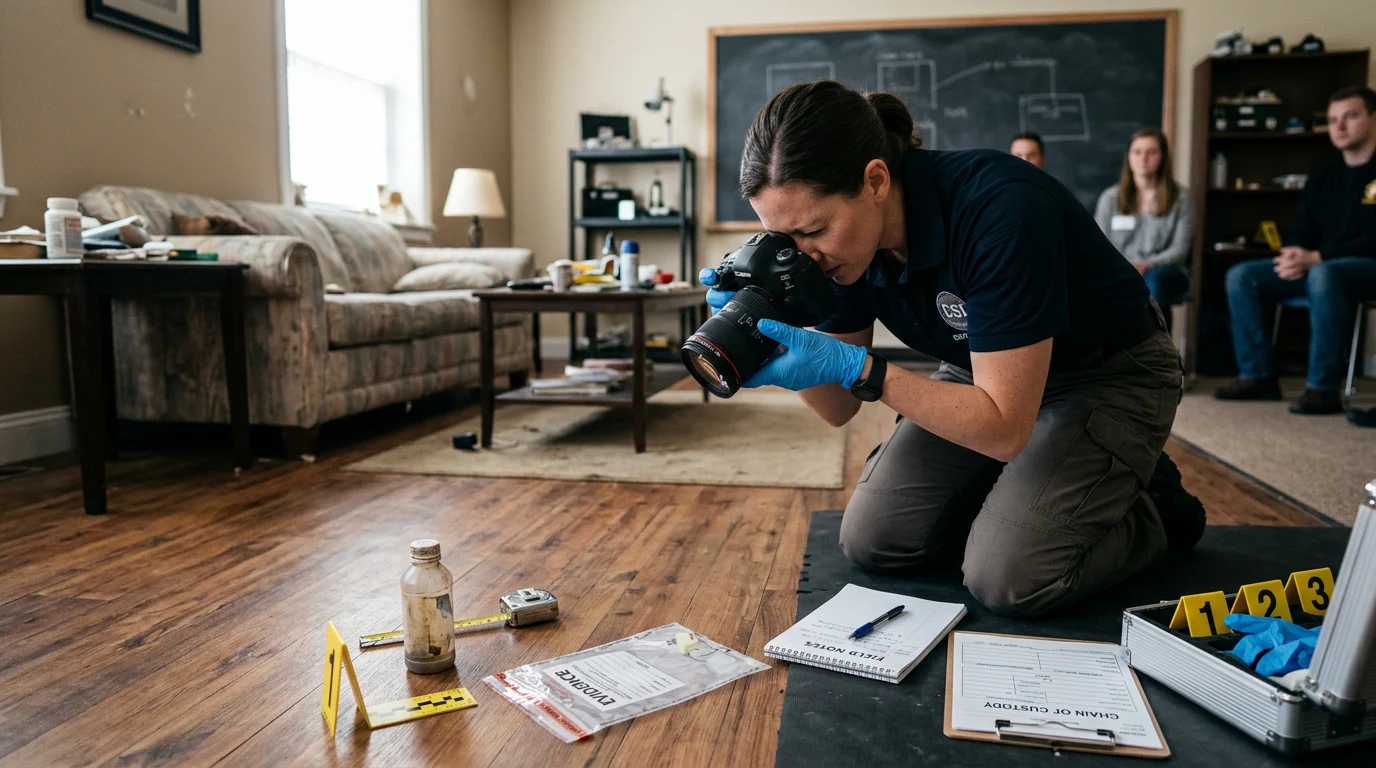
Public-safety crime-scene curricula concentrate on legal scene searches, scene protection, photographs, sketches, evidence collection, preservation, fingerprints, and electronic evidence. The state curriculum also includes simulated crime-scene investigation and requires students to attend every hour for credit.
That focus can improve a PI’s evidence awareness, especially the habit of documenting before touching, moving, or transferring an item. It does not by itself create police authority, warrant authority, laboratory competence, or a PI renewal entitlement.
Research, Surveillance, and Civil Casework
PI-focused training is more likely to align with private-case tasks: lawful background research, client intake, case-file organization, report writing, surveillance planning, source evaluation, and civil or corporate investigations. A course should identify those outcomes directly before we treat it as a fit for active casework.
For a skills-first route, use our working investigator guide to separate surveillance, interviewing, OSINT, and reporting needs instead of assuming one general course covers all four.
Scope of Practice Still Controls
Training can help an investigator recognize preservation risks, document a device’s visible condition, and protect a chain of custody. It does not let a learner bypass access controls, acquire data from a device, conduct a forensic examination, or exceed the legal authority of the assignment.
Where Is Training Hands-On?
Hands-on is a performance claim, not a format label. We look for evidence that learners complete a realistic task, make defensible decisions, create a record, and receive feedback. A lecture, broad topic list, case discussion, or multiple-choice test may be useful, but it is not the same as learner-performed field practice.
A public-safety crime-scene curriculum can support practical work because it is in person and permits assessment through case studies, scenarios, interaction, and testing. Its stated learning outcomes include photographs, sketches, collection and preservation methods, fingerprint processing, and a simulated scene investigation.
| Practical Check | Strong Evidence | Weak Evidence |
|---|---|---|
| Scenario Work | Learner completes a simulated scene or realistic case task | Topic appears only in a syllabus |
| Documentation | Learner creates notes, photo log, sketch, or report | Course says “documentation” without an assignment |
| Custody Practice | Learner records identifiers, transfers, and storage decisions | Chain of custody is mentioned without a learner log |
| Feedback | Instructor reviews submitted work individually | General support channel only |
| Equipment | Learner uses relevant tools or materials | Demonstration only |
| Assessment | Performance is assessed against stated criteria | Recall quiz only |
The public-safety curriculum emphasizes that every transfer in a chain of custody should be documented, including handlers and movement between locations. We recommend the same standard when judging any evidence course, because a course title alone cannot prove practice quality.
For physical or digital evidence questions, compare the actual assignments against our evidence training checklist. If a provider cannot show what learners do, submit, and receive feedback on, we would not describe the training as hands-on.
Which Option Is More Accessible?
Accessibility includes more than whether a course is online. We compare entry requirements, agency affiliation, application process, full attendance, travel, price, equipment, device access, assessment rules, and whether the schedule works around surveillance windows, interviews, and client deadlines.
A scheduled public-safety course can provide concentrated classroom practice, but it may require agency affiliation, travel, a camera, a laptop or tablet, and full attendance. A PI renewal course can be more flexible, but it must still match the right licence route and required topic categories.
Our Texas 18-hour PI route lists $175, while our Georgia 16-hour renewal route also lists $175. For a Minnesota private-detective employee, our current pre-assignment course lists 12 hours, $185, online delivery, 84 lessons, 11 assessments, and 80 questions. Compare the role before choosing a course, because the deadline and training type are separate from a licence itself.
Price matters, but it should be your final filter after regulatory fit and course outcomes. Our PI training cost guide explains why a low tuition figure can still be the wrong purchase when travel, equipment, retakes, extensions, or missing renewal categories change the real commitment.
Which Should You Choose?
We recommend scoring each option against the job you need it to do, rather than trying to declare one training path universally better. An investigator with a renewal deadline should give regulatory credit the most weight. An investigator handling private evidence questions should give verified exercises and feedback more weight.
| Scenario | Best Starting Path | Why It Fits | Do Not Assume |
|---|---|---|---|
| PI Renewal | State-specific PI CE | It can match required hours, ethics, and law topics | Public-safety credit transfers automatically |
| Immediate Private-Case Skills | Skills course with verified practice | It can target reports, research, interviews, or documentation | A certificate proves forensic competence |
| Law-Enforcement Advancement | Agency-directed public-safety course | It can align with public-safety curriculum and scenario work | It solves a PI renewal requirement |
Use five filters before enrolling:
- Regulatory Credit: Does your current regulator accept this exact course for your current licence route?
- Case Relevance: Does the syllabus address the private or corporate work you actually perform?
- Hands-On Intensity: Does the course publish a scenario, learner task, assessment, and feedback process?
- Schedule Fit: Can you meet every attendance, equipment, and completion requirement?
- Career-Stage Fit: Is this renewal education, career entry, skill development, or agency advancement?
If your immediate goal is Texas compliance, begin by identifying the correct hour route through our Texas course selector. That simple check can prevent an impressive-looking course from becoming an unusable certificate.
Start Your Training with Learningshopusa
At Learning Shop USA, we help investigators choose training by the record it creates, not by a broad course title. Our current catalogue includes self-paced options for state-specific renewal, career-entry requirements, and foundational professional study. We publish course hours and visible prices, but we also ask you to check your licence category, regulator record, completion requirements, and support terms before you buy. That approach matters when a course must meet a renewal deadline, fit irregular casework, or support a new role without overstating hands-on competence. If you need a Texas renewal route, begin with the hours and topic allocation. If you need a Georgia renewal route, confirm the facilitator and certificate fields. If you need evidence practice, ask for supervised assignments and individual feedback. Then keep your receipt, certificate, and approval check together for the full retention period. When you are ready, start with our course overview.
FAQs on Law-enforcement Training vs Private Investigator Training
Does Law-Enforcement Training Count as Private Investigator Continuing Education?
Not automatically. Match the course to your state regulator, licence class, required topic allocation, and current approval record before relying on it for PI renewal.
Which Investigator Training Offers Hands-On Evidence Practice?
Choose a course that publishes a simulated scene or realistic case task, requires documentation or a custody log, and provides individual feedback on completed work.
Can Online PI Training Be Hands-On?
Online instruction can support renewal or foundations, but published assignments, instructor review, and evidence of performance are needed before treating it as hands-on training for field work.
What Records Should I Keep After Training?
Keep your completion certificate, receipt, course description, regulator verification, and applicable approval details. Texas attendees must retain certificates for two years and provide them upon request.