Which Private Investigator Certification Path Fits Your Career?
Compare private investigator certification paths by career goal. Separate licensing education, CE, voluntary credentials, and practical investigator training.

Career moves in investigation can look simple until a course title, a certificate, and a licensing rule point in different directions. In Minnesota, the licensing board reports about 16,000 security professionals, which makes clear role matching matters more than choosing the fastest-looking program.
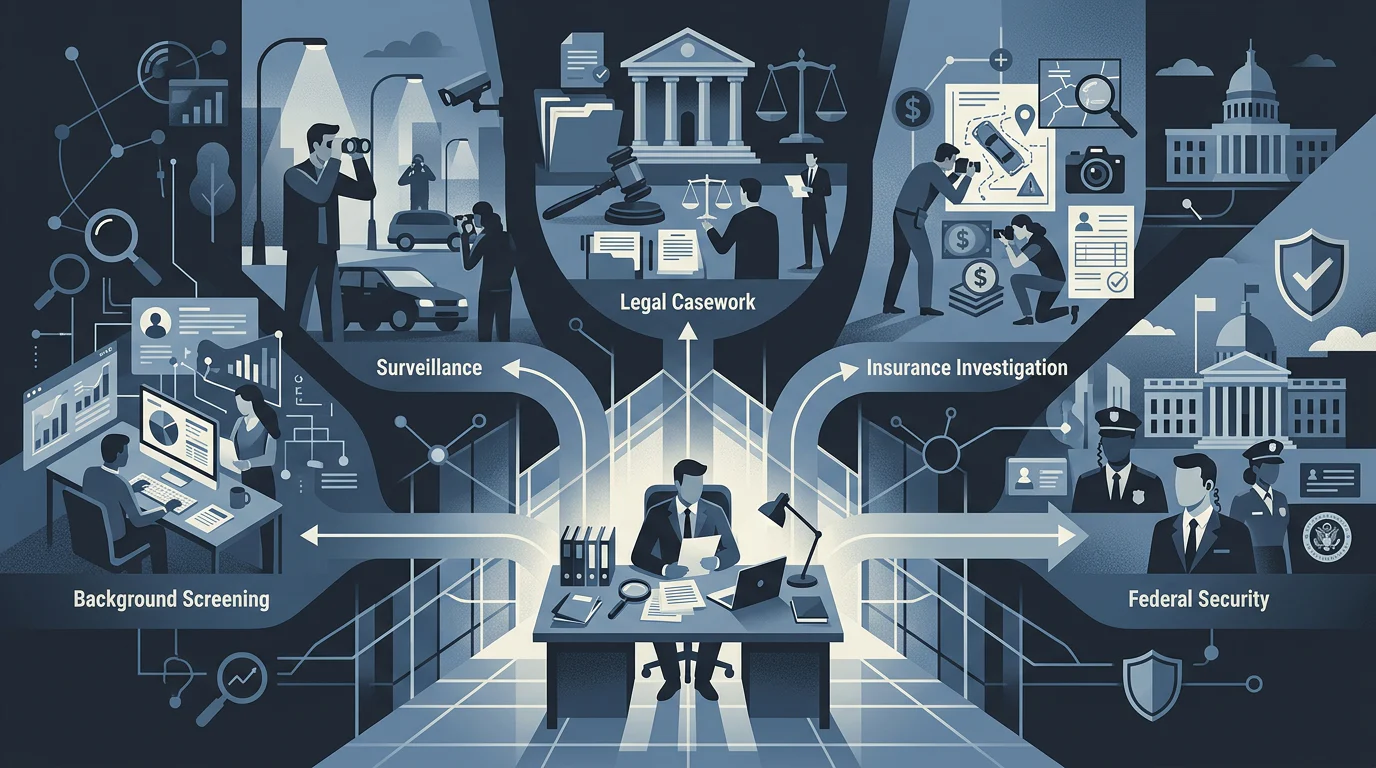
The private investigator certification path that fits your career depends on your intended work and the rules where you will work. Career changers should separate mandatory licensing education from voluntary certifications, continuing education, and skills courses. Background screening, federal clearance work, surveillance, and general investigations each call for different preparation, and no voluntary certificate automatically replaces licensing or experience requirements.
We will help you identify the right training gate, compare career paths, test a program’s beginner fit, and keep records that support your next step.
What Makes a Credential Different from a License Course?
A course completion certificate proves that you completed a defined program. It does not automatically prove that you may work independently, satisfy an employer’s hiring standard, or meet a state’s experience rule. For example, Minnesota requires private-detective employees to complete 12 hours of approved training within 21 days of hire, under its Minnesota training rules.
| Training Type | What It Usually Proves | Best Fit | What It Does Not Replace |
|---|---|---|---|
| Voluntary certification | Knowledge and, sometimes, professional experience | Experienced investigators seeking a portable credential | State licensing, employer authorization, or required experience |
| Pre-assignment or pre-licensing education | Completion of a jurisdiction-specific course | New hires and applicants in states with required training | An operating license or independent authority |
| Continuing education | Renewal-related learning hours | Already licensed or registered investigators | Initial licensing education or missing work experience |
| College certificate | Academic study in a related subject | Career changers building foundational knowledge | State-specific approval or field experience |
| Employer training | A firm’s procedures and role expectations | New staff entering a defined investigative role | A public credential or state-required course unless approved |
The practical question is not, “Does this sound investigative?” It is, “What exact requirement does this solve?” Working investigators planning a renewal should first check their own record against the Texas PI CE requirements before treating a useful skills course as renewal credit.
Which Private Investigator Certification Path Fits Each Career?
Start with the work you want to perform, then identify the legal or employer gate. The right private investigator certification path is often a sequence, not a single purchase: required training first, supervised work next, then specialty education or a voluntary credential when your experience supports it.
General Private Investigation and Surveillance
A career changer aiming for general PI work should check state rules, identify whether employment under a licensed firm is available, and choose the required course type before adding surveillance or interview skills. In Minnesota, that means matching the employee role to the correct pre-assignment training, not selecting a protective-agent course because the title sounds similar.
Surveillance-focused investigators should prioritize lawful observation, documentation, case planning, privacy limits, and report writing. These are practical competencies that make a new investigator more useful under supervision, even where they do not count as licensing education.
Employment Background Screening
Employment screening is not simply general PI work with database searches. When an employer uses third-party consumer reports, it must meet disclosure, authorization, and adverse-action duties described in FTC guidance.
That makes FCRA literacy, public-record accuracy, consent workflows, and careful reporting more relevant than a broad surveillance certificate. An entry-level learner should seek assignments that test judgment, not only recall.
Federal Clearance Work
Federal personnel-security work has its own audience, procedures, and access limits. The government’s federal course covers five investigation categories over eight virtual instructor-led weeks, but it is restricted to eligible government, military, and specified contractor audiences.
A public online certificate can build useful foundations, but it is not a substitute for employer-directed federal onboarding, eligibility, or assignment. Investigators considering a Minnesota employee role should still confirm the correct pre-assignment training before enrolling.
Insurance and Legal Investigations
Insurance and legal work reward disciplined evidence handling, interviews, chronology building, concise reports, and awareness of the client’s legal boundaries. Our practical investigation skills guidance can help working investigators identify which field abilities belong beside, rather than inside, a licensing or CE requirement.
Experienced investigators may later consider a professional credential that assesses case management, investigative procedures, and case presentation. That is a career-development option, not a beginner shortcut.
What Should Background-Investigation Training Cover?
Background-investigation training should be judged by the work product it prepares you to create. A useful program teaches how to gather, assess, document, and communicate information lawfully, while recognizing that employment screening and federal personnel security are separate roles.
The Consumer Financial Protection Bureau explains that many background dossiers used for employment can be consumer reports, making permissible purpose, accuracy, disputes, and privacy central to the work under CFPB guidance.
-
Interviewing: Prepare questions, verify identity, document statements accurately, and distinguish facts from impressions.
-
Public-Record Research: Locate lawful sources, confirm whether records belong to the right person, and capture source details for later review.
-
FCRA Compliance: Understand consent, permissible purpose, accuracy duties, and the employer’s required notices when third-party reports inform employment decisions.
-
Report Writing: Build a clear chronology, identify sources, separate findings from assumptions, and write for the reader who must make a defensible decision.
-
Privacy And Data Handling: Protect sensitive information, limit access, and follow role-specific retention and disclosure procedures.
-
Role-Specific Procedures: Learn the difference between employer screening workflows, insurance claims inquiries, legal investigations, and government personnel-security processes.
| Training Element | Employment Background Screening | Federal Personnel-Security Work |
|---|---|---|
| Consent and legal authority | Central to obtaining and using consumer reports | Governed by agency and employer procedures |
| Public-record research | Must emphasize accuracy, identity matching, and FCRA obligations | Used within defined personnel-security processes |
| Interviews | Supports investigative consumer reports and verification | Used within authorized federal investigative methods |
| Report writing | Supports hiring or employment decisions | Supports security and adjudicative workflows |
| Privacy | Protects consumer-report information | Protects sensitive personnel and security information |
For a working investigator, a broad skills course is valuable when it fills a genuine capability gap. It should not be marketed as automatic renewal credit, which is why comparing Texas PI course platforms against the required category is more useful than comparing course titles alone.
How Should First-Time Applicants Build a Lawful Route?
First-time applicants should treat training as one part of a documented route. The safest order is role, jurisdiction, requirement, training, supervised work, then continuing development. Trying to reverse that order often produces a certificate that does not solve the actual application problem.
California shows why experience must remain part of the plan. Its PI qualified-manager route generally requires 6,000 hours of compensated investigative experience, a written examination, and a criminal-history review through the California regulator.

Choose the Work and Jurisdiction
-
Define the target role: Decide whether you want general PI work, background screening, surveillance, insurance cases, legal support, or a federal personnel-security role.
-
Check the governing authority: Confirm the state board, licensing agency, employer, or government program that controls entry into that role.
Complete the Correct Training Category
-
Match the course to the requirement: Select the exact course type, such as pre-assignment education or approved continuing education, rather than relying on a broad label.
-
Save proof before moving on: Keep the listing, receipt, syllabus, assessment result, and completion certificate together.
Build Qualifying Experience
-
Work under the right authority: Many jurisdictions distinguish between an employee under a licensed firm and a person operating an investigative business.
-
Document the work: Preserve employer verification, role descriptions, dates, duties, and any records needed for a future application.
Minnesota’s employee-training route and business-license route are not interchangeable. Our Minnesota PI license route explains why a 12-hour course can support employment while documented experience remains essential for an independent operating path.
Continuing education belongs after you know your renewal obligation. Investigators expanding into another state should check its approval, timing, and completion-record rules before assuming prior coursework carries over.
How Do You Verify a Program Before You Pay?
Verification is part of choosing training, not an administrative chore after checkout. Approval can confirm that a course meets a regulator’s minimum content and instructor rules, but Minnesota’s board expressly says course approval is not an endorsement or guarantee of quality in its Board warning.
Ask the provider for the exact course category, active approval record, full checkout price, refund terms, assessment rules, retake policy, access window, certificate timing, and verification method. A provider that cannot answer those questions clearly should not be your deadline-sensitive choice.
For investigators considering work across jurisdictions, compare the active approval record and completion requirements before enrollment. Our guide to Georgia PI CE shows why a course certificate should be matched to the role, timing, and record the governing authority expects.
| Option | Entry Fit | Format And Assessment | Published Duration And Price | License Relevance | Verification Method |
|---|---|---|---|---|---|
| Our Minnesota private-detective pre-assignment course | New Minnesota PI employees | Online, self-paced, 11 assessments | 12 hours, $185 | Supports the required employee-training category when the live Board record matches | Confirm the active approved-course listing and retain completion evidence |
| Our Texas PI CE course | Existing qualifying Texas PI registrants | Online, self-paced, required assessments | 18 hours, $175 | Supports the applicable renewal route when hours and subject categories match | Confirm active Texas TOPS school status and retain the certificate |
| Experienced professional investigation credential | Established investigators | Formal examination | About 140 questions, official fees vary by membership | Does not replace licensing education or experience | Confirm directly with the issuing body |
| Restricted federal investigation course | Eligible government and contractor audiences | Virtual instructor-led education | Eight weeks, no public price asserted | Professional development, not public PI licensing education | Confirm eligibility and completion through the agency system |
The professional investigation credential above requires documented experience, including case-management experience, so its published fee should never be the only comparison point. The official fee page dated February 2025 lists $580 for members and $910 for nonmembers, and should be rechecked before applying.
Use this beginner-fit scorecard to compare programs without confusing a high convenience score for regulatory approval.
| Criterion | 0 Points | 1 Point | 2 Points |
|---|---|---|---|
| Prerequisites | You do not meet them | You need one clarification | You clearly meet them |
| Instructor Access | No published access path | General support only | Named, reachable instructional support |
| Practical Assignments | Recall-only learning | Limited exercises | Role-relevant reports, scenarios, or research tasks |
| Schedule Flexibility | Fixed timing conflicts | Some flexibility | Fits your work schedule without reducing required hours |
| Career Services | No stated pathway | General guidance | Clear employer, mentoring, or placement support |
A regulatory mismatch overrides every other score. For Texas renewal planning, use our Texas CE planner to calculate the required category first, then compare convenience, price, and support.
Choose Your Next Step with Learningshopusa
At Learningshopusa, we help working investigators turn a course decision into a record they can defend. We explain the difference between initial training, renewal credit, and broad skills development before you enroll, because the most convenient class is not always the one your license record needs. Our online options are built for people balancing cases, shifts, and renewal windows, with published course details that make it easier to compare hours, subjects, assessments, and completion evidence. Start by matching your current registration or career target to the exact course category, then save the regulator lookup, course description, receipt, and certificate together. We also encourage you to compare the certificate’s details against your file requirements. If you are unsure whether a course applies to your work, confirm the active approval record first and contact us with the facts you found. Explore current investigator training at your own pace through Learning Shop USA
FAQs on Private Investigator Certification Path
Does a Certificate Make Me Licensed?
No. A certificate records completed coursework, but authority to work may still depend on state licensing, an employer relationship, background checks, examinations, and documented qualifying experience.
Which Path Fits a Career Changer?
Start with your intended role and jurisdiction. Complete the required pre-assignment education or licensing steps first, then add practical skills and voluntary credentials as experience grows.
What Must Background-Investigation Training Cover?
Look for interviewing, lawful public-record research, FCRA compliance, accurate report writing, privacy protections, and procedures tailored to employment screening, federal work, or another defined investigation role.
Can Continuing Education Count as Initial Training?
Not automatically. Continuing education usually supports renewal for existing registrants, while initial education, pre-assignment training, and qualifying experience follow separate rules, approval categories, and application steps.
How Can I Verify a PI Course?
Check the live regulator or credential record, confirm the course category and hours, request written policies, then retain the listing, receipt, assessment results, and certificate.
Is a Professional Certification Good for Beginners?
Usually not. Many professional credentials assess prior investigative and case-management experience, so they are best pursued after you have built documented field competence in relevant roles.