Minnesota PI License Requires 6,000 Hours Beyond a 12-Hour Course
You will have either an employee-training record under a licensed Minnesota business or a complete, evidence-backed PI business-license application path.
- Time
- 12 hours or 6,000 documented hours
- Difficulty
- Advanced
- Steps
- 5
- Cost:
- Business route: $1,000 Board fee plus bond and financial-responsibility costs
Before you start, have
- Choose whether you will work for a licensed business or operate and advertise a PI business.
- For the employee route: a licensed Minnesota employer, fingerprint consent, and a plan to complete required training.
- For the business route: an eligible application signer aged 18 or over, five nonrelative references, employment records, fingerprints, a recent photo, a $10,000 surety bond, and proof of financial responsibility.
- Use the current Minnesota Board application packet and retain records of training and qualifying experience.
- If you will carry a weapon or use a restraint technique, obtain the separate Board-directed certified training before doing so.
Heads up: The $10,000 surety-bond amount is the bond face value, not a verified out-of-pocket premium.
Heads up: Minnesota does not publish a fixed PI-license approval time. The statutory 20-day notice is only one part of the Board process.
Heads up: Do not advertise or offer PI business services before the Board has issued the required operating license.
By Sharon DeCet, Founder · Updated 4 Sept 2026
In brief
Minnesota allows unlicensed employees to work under a licensed PI business, but operating or advertising a PI business requires a Board license. The employee route includes 12 hours of training within 21 days, while the business-license route requires 6,000 documented investigative hours, a $10,000 surety bond, financial responsibility, and a Board application.
Choose your route
Decide whether your goal is to work under an existing licensed PI business or to operate and advertise a PI business yourself. A license holder may employ unlicensed people, but operating or advertising the business requires a Board license. Your route is clear when you can answer either “I will work under a license holder” or “I will apply to operate the business.” Minn. Stat. sections 326.336 and 326.3381
Build the records for that route
For an employee role, give the licensed employer your fingerprints and written consent for the required criminal-history process. You may be trained while conditional, but you may not serve in the role until the report is received. For the business route, obtain a present or former employer’s sworn statement showing at least 6,000 qualifying investigative hours from an accepted setting or an occupation the Board finds equivalent. This step is complete when your employer documentation identifies your duties and hours. Minn. Stat. sections 326.336 and 326.3382
Complete the training that applies to your role
If you are entering work under a licensed business, complete at least 12 hours of preassignment training within your first 21 days of employment, unless you can provide acceptable equivalent-training evidence. Keep the completion evidence showing course subject areas and hours. Continue with six hours of certified training each year, and complete separate certified training before carrying or using a weapon or restraint technique. This step works when your certificate and employer records are available for review. Minn. Rules 7506.2600 and Minn. Stat. section 326.3361 govern these training duties.
File a business application only when qualified
If you will operate the business, assemble the Board form, five qualifying references, recent photo, fingerprints, sworn experience statement, $10,000 surety bond, and financial-responsibility evidence. The Board also requires the application information for each signer, including residence and employment history. The current DPS listing gives a $1,000 fee for a new individual private-detective license and $1,900 for a corporation or LLC. Your filing is ready when every attachment is present and the applicable fee is identified. Minn. Stat. section 326.3382 and the Minnesota DPS eLicense listing provide the current requirements and fees.
Wait for Board review and keep your records current
After the application arrives, the Board posts notice for 20 days, may investigate qualifications, and notifies the applicant of the Board-review date. A compliant license remains effective for two years. Keep training certificates, employee records, bond documentation, and financial-responsibility evidence organized so you can support continued compliance. You will know this step is complete when the Board has issued the license or you have your employee training and clearance records in place. Minn. Stat. sections 326.3381 and 326.3383
You'll know it worked when
Employee route: your licensed employer has your required clearance and training record. Business route: you have the full application evidence and, after Board approval, an issued Minnesota private-detective license.
Choose the legal route before paying for training
Minnesota separates working for a licensed PI business from operating one. The employee route can begin under a license holder, while the business route requires the statutory experience, financial, and Board-application conditions. Minnesota Statutes sections 326.336 and 326.3381 set out that distinction.
Operate a business or join an agency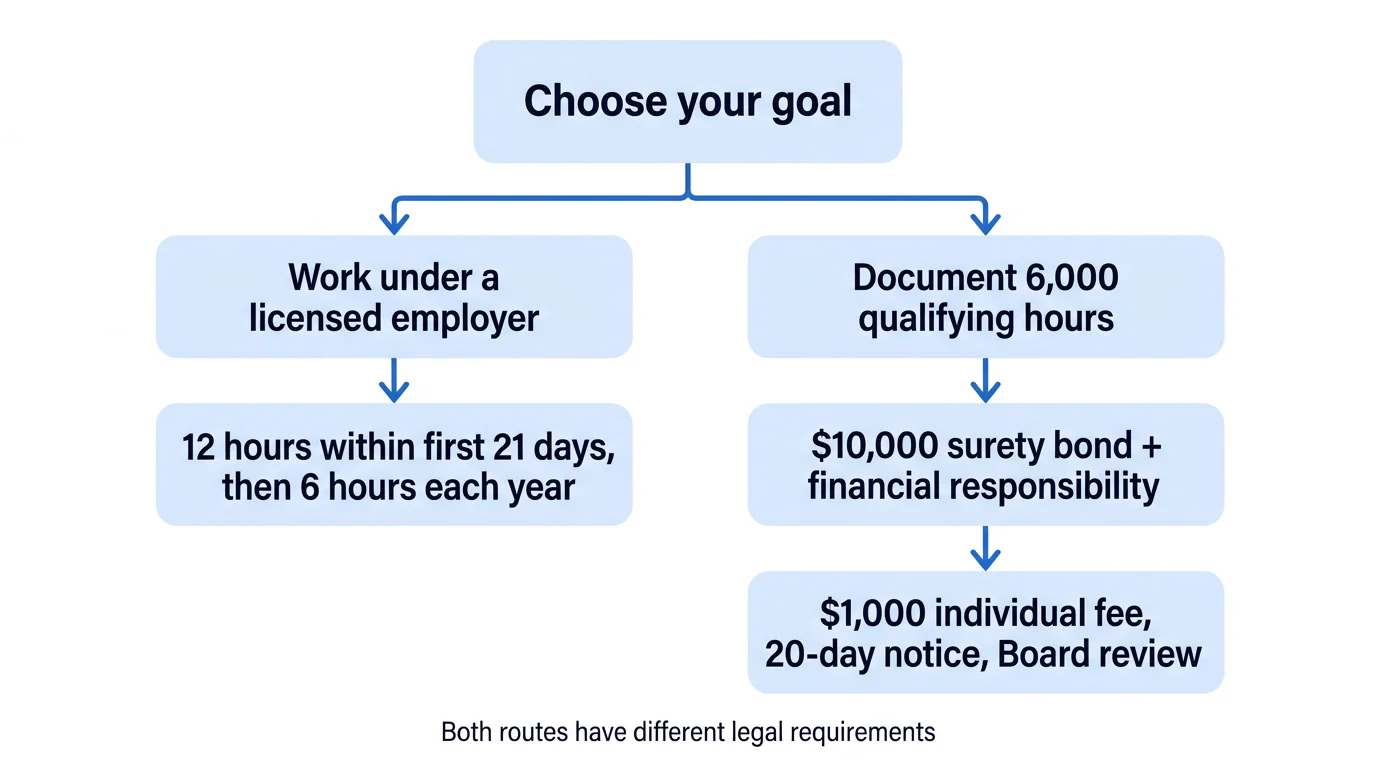
For the employee route, review how Minnesota PI pre-assignment training works before enrolling. If you already work in the field, use the Minnesota PI refresher deadline checklist to plan annual training records.