What Private Investigator Training for Career Changers Do You Need?
Private investigator training for career changers starts with state rules. Compare required courses, experience routes, skills, formats, and records.

Private investigation is a regulated career transition, not simply a course purchase. The United States had 43,600 PI jobs in 2024, and the work combines research, documentation, interviews, and field assignments.
Career changers should begin private investigator training for career changers with the requirements of the licensing authority where they plan to work, then add practical instruction in surveillance, interviewing, evidence handling, research, and report writing. A general PI certificate does not automatically meet licensing rules, so confirm the provider, hours, format, and completion record before enrolling.
Below, we separate legally required education from optional job skills, explain how to verify a state route, and provide tools for comparing programs without paying for the wrong credential.
What Private Investigator Training for Career Changers Is Legally Required?
The first decision is whether a course is legally required for your specific route or simply useful preparation. States can require pre-licensing education, supervised experience, an examination, ongoing education, or a combination, so avoid relying on a national course description alone.
Florida, for example, requires PI intern applicants to complete at least 40 hours of qualifying training, submit a completion certificate, and obtain sponsorship from an eligible licensee under its intern requirements.
| Training Type | Legal Purpose | Typical Audience | Verification Source | Outcome |
|---|---|---|---|---|
| Pre-licensing or pre-assignment course | Meets a stated rule | New applicant or employee | State regulator | Completion evidence that may count |
| Exam preparation | Prepares for a licensing exam | Exam-eligible applicant | Regulator exam bulletin | Better exam readiness |
| Continuing education | Supports renewal compliance | Licensed PI or employee | Regulator renewal rules | Approved hours where required |
| Professional-skills course | Builds everyday capability | Career changer or working PI | Syllabus and instructor record | Practical competence |
| Specialty certification | Demonstrates a niche focus | Experienced investigator | Credential issuer | Specialty credential |
| Criminal justice degree | May support eligibility in some states | Long-term career planner | State regulator | Academic credential |
Pre-Licensing Education Is Not Universal
Some jurisdictions specify course hours and approved providers. Others focus more heavily on documented experience, a licensing examination, sponsorship, or background review. Start with your regulator’s requirements, then match the course to the actual state rule. Do not let an attractive online course cost make the decision first.
Exam Preparation Is Preparation, Not Authorization
An exam-prep course can help when a regulator tests law, liability, terminology, evidence, or surveillance. It does not grant authority to investigate, replace an application, or prove that a training provider is approved.
Continuing Education Comes Later
Continuing education is usually for people already working under a valid route. Minnesota requires 12 hours of pre-assignment training within the first 21 days of employment, then six annual continuing-education hours for covered personnel under its state rules.
How Do You Verify Your State Path Before Paying?
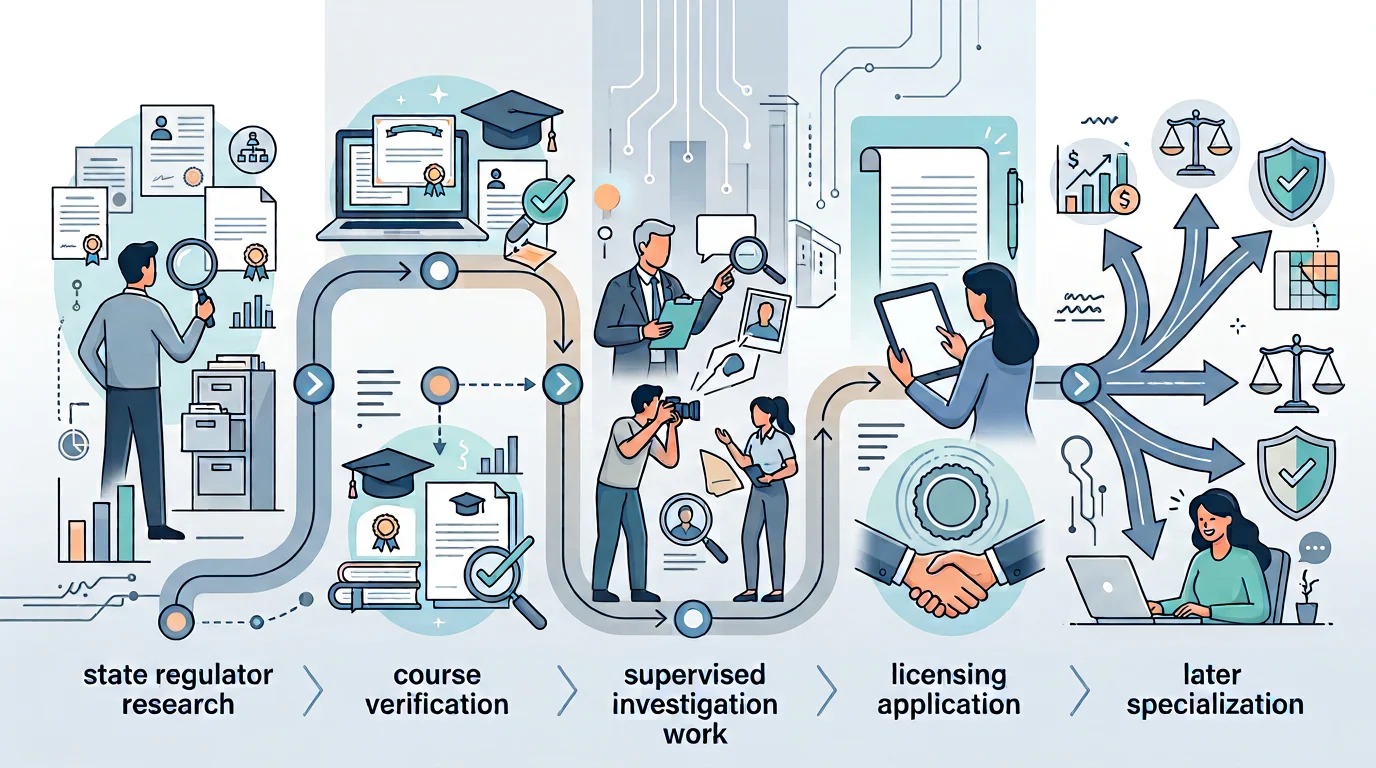
A state-first process protects a career changer from buying a course that does not solve the real eligibility gap. Identify the regulator, exact license class, required experience, approved-provider rules, examination requirements, and permitted delivery formats before comparing tuition.
Find the Regulator and License Class
Search the state agency that regulates private security or investigative services. Determine whether you are applying as an intern, employee, individual investigator, qualified manager, or business owner, because each route can have different obligations.
Check Experience Before Buying Training
Experience rules can be more important than course hours. California, for example, generally requires 6,000 hours of compensated investigative work for its PI qualified-manager route, while certain relevant degrees can offset part of that requirement under the PI factsheet.
Confirm Approval, Format, and Records
Ask the regulator or provider whether the precise course, hours, online delivery method, identity checks, and certificate format will be accepted for your route. Keep that confirmation, plus your receipt and syllabus, with your certificate records.
Texas illustrates why this check matters. Its regulator states that training certificates are prerequisites for specified security roles, while other individual license categories do not have a training prerequisite in the same way under its individual FAQ.
Can You Enter Private Investigation Without Law-Enforcement Experience?
Yes, depending on the jurisdiction and license class, but a course alone rarely replaces every experience requirement. The practical question is not whether you previously worked in law enforcement, it is whether your state offers an entry route that lets you gain qualifying experience under supervision.
Florida’s PI intern route is one example of a career-changer path: the intern receives direction and control from a sponsoring licensee, then can build relevant work history toward fuller licensure. Its official PI handbook says applicants for that intern license are not expected to already have investigative experience.
Build your pathway around transferable strengths and evidence you can document:
- Research And Analysis: Public-record research, claims review, compliance work, and financial analysis can support case preparation.
- Interviewing And Communication: Customer service, journalism, legal support, and case management can strengthen listening and questioning skills.
- Documentation: Report writing, audits, incident records, and chronology building translate directly to defensible investigative work.
- Supervised Experience: An intern or employee role can provide the documented exposure that a regulator or future employer needs.
We recommend keeping a dated record of job duties, supervisors, training, and completed assignments as you progress. Our career-path guide can help you distinguish the training milestone from the licensing milestone.
Which Practical Skills Should Follow the Required Course?
Once the legal route is clear, practical instruction should make you safer, more useful, and better prepared to produce work that can withstand review. Prioritize skills that support legal limits, accurate observations, secure evidence handling, credible reporting, and client communication.
Legal Limits and Ethics
A capable investigator understands privacy, trespass, misrepresentation, confidentiality, conflicts, and the limits of private authority. Those boundaries should come before surveillance tactics or specialty tools, because poor judgment can undermine an otherwise sound case.
Surveillance, Interviews, and Evidence
Look for structured practice in planning observations, maintaining notes, handling photographs or video, interviewing ethically, preserving an evidence trail, and writing reports. Florida’s official curriculum includes ethics, privacy, chain-of-custody issues, surveillance, and report writing in its curriculum guide.
Research, OSINT, and Digital Awareness
Foundational research training should cover lawful public-record searches, source evaluation, online research limits, documentation, and the difference between collecting useful information and overstepping legal or ethical boundaries. For deeper practice, compare evidence training choices against the type of cases you expect to handle.
| Criterion | Online Training May Fit When | Classroom Training May Fit When | Confirm Before Enrolling |
|---|---|---|---|
| Scheduling | You need flexible study windows | You can attend fixed sessions | Completion deadlines |
| Instructor Access | Live virtual support is available | Immediate coaching matters | Feedback method |
| Practical Exercises | Simulations are assessed | Field drills are essential | Exercise details |
| Identity Verification | Digital attendance is accepted | Physical attendance is required | Regulator rules |
| Certificate Delivery | Digital records are accepted | Original signed records are needed | Submission requirements |
How Do You Compare Programs, Formats, and Certificates?
Comparing programs is easier when you score them against the outcome you actually need. A polished course page, broad curriculum, or low price does not matter if the provider cannot document completion in the format your regulator, sponsor, or employer needs.
Before choosing a format, decide whether you need theory, assessed simulations, or supervised field feedback. For that decision, review our surveillance training overview.
| Scorecard Criterion | What To Look For |
|---|---|
| Approval | Current regulator approval or written confirmation of acceptance |
| Curriculum | Legal limits, ethics, surveillance, interviewing, evidence, research, and reports |
| Practice | Assessed exercises, feedback, and realistic scenarios |
| Instructor Qualifications | Relevant investigative and teaching background |
| Total Cost | Tuition plus examination, record, or delivery fees |
| Duration | Required hours, pacing, and expiration window |
| Support | Responsive help for access, records, and completion issues |
| Records | Hours, subject coverage, replacement process, and retention policy |
A completion certificate should prove what you completed, not more than that. It may document the course, subject matter, date, and hours. It does not independently grant a license, guarantee employment, establish state acceptance, or authorize independent investigative work.
Records matter because they can be requested later. Minnesota-certified programs must retain attendance and successful-completion records, including hours, for at least three years under its record rules. Compare tuition and documentation expenses with our course prices.
Train with Learningshopusa
At Learningshopusa, we build investigator training around the decision that comes before enrollment: what will your regulator and next work setting actually require? Our courses are meant to strengthen the foundational judgment, documentation, research, and field awareness that a new investigator needs after confirming the legal route. We keep the learning focus practical, helping you assess a syllabus, prepare questions for a regulator, and retain the records that matter after completion.
We do not treat a completion record as a substitute for licensure or promise that one course fits every state. Instead, we encourage you to verify provider acceptance, delivery rules, experience requirements, and any exam or sponsorship condition before choosing a program. If your path calls for additional skills, use our material to build them deliberately and keep proof of what you complete. Start today by exploring Learningshopusa training
FAQs on Private Investigator Training for Career Changers
These answers address the approval, prerequisite, certificate, and course-selection checks career changers should complete before committing money or time to investigator training.
Which PI Training Is Required Before Applying?
It depends on your state and license class. Confirm required hours, provider approval, examination, experience, sponsorship, and delivery rules with the regulator before enrolling in writing.
Can I Become a Private Investigator Without Law-Enforcement Experience?
Often, yes. Some states offer supervised intern or employee routes, but a course rarely replaces required experience. Map transferable experience and confirm the regulator’s accepted path.
Does a Completion Certificate Mean I Am Licensed?
No. It documents your completed coursework, typically its subject and hours, but it does not independently grant a license, guarantee employment, or establish state acceptance.
How Do I Choose a Course After Verifying My State Route?
Compare regulator acceptance, hours, assessments, instructor access, record replacement, cost, and practical exercises. Enroll only after confirming the provider’s course fits your verified state route.