Types of Physical Evidence: Sort by Class, Not Just Name
Types of physical evidence include biological, trace and impression material, but lists run from two to eight categories. Sorting by class or individual value tells an investigator how to handle each item.
By Sharon DeCet, Founder · Updated 23 Nov 2026
Key takeaways
- Types of physical evidence have no single standard list. Sort each item by whether it is class or individual evidence and by how easily it is lost or contaminated.
- In the five classification schemes we compared on 23 November 2026, the number of groups ran from 2 to 8. Only biological, trace and impression appear in both eight-group lists.
- To authenticate an item, Federal Rule of Evidence 901 requires evidence sufficient to support a finding that it is what you claim it is. Your receipt log and testimony supply that, but admission also depends on other rules.
- Handle individual items such as fingerprints and rooted hair with the least contact, and pass four receipt tests the day an item arrives.
In this article
- 1What are the main types of physical evidence?
- 2Why do lists of physical evidence types disagree?
- 3Should an investigator sort physical evidence by class or individual value?
- 4How do you handle each type of physical evidence you receive?
- 5When a client hands you an item, which four tests should your file pass?
- 6How does a court decide an item of physical evidence is what you say it is?
- 7Which of our courses covers collecting evidence, and which covers what a laboratory does?
- 8Frequently asked questions
Two investigators can both be right about the types of physical evidence and still give different lists, from two groups to eight. One divides all evidence into testimonial and physical. Another splits physical evidence into eight groups, including chemical, conditional and associative. A third uses eight different groups and adds documents, controlled substances and digital files.
A student can pick one list and move on. An investigator cannot, because a list of names does not say what to do when a client hands over a torn shirt or you find a shoe print outside a door. What decides your actions is whether the item can point to one source or only to a group of sources, and how easily it can be lost or contaminated.
This page gives you that sort, a table to use on the next item you receive, a four-test receipt checklist, and the point where your work ends and a laboratory's begins. It is written for someone who may be hired to find, receive or keep physical evidence, not for a classroom quiz.
What are the main types of physical evidence?
The main types of physical evidence an investigator meets are biological, trace, impression, fingerprints, firearms and tool marks, controlled substances and questioned documents (documents whose authenticity is in doubt). Physical evidence, also called real evidence, is tangible items that a judge or jury can hold and inspect (FindLaw, updated December 2023). The National Institute of Justice (NIJ), part of the U.S. Department of Justice, gives examples: hairs, fibers, latent fingerprints (prints not visible until developed) and biological material (NIJ, June 2023). Its other type is testimonial evidence, the spoken statements of victims and witnesses.
The groups you will meet most often in an investigation are these:
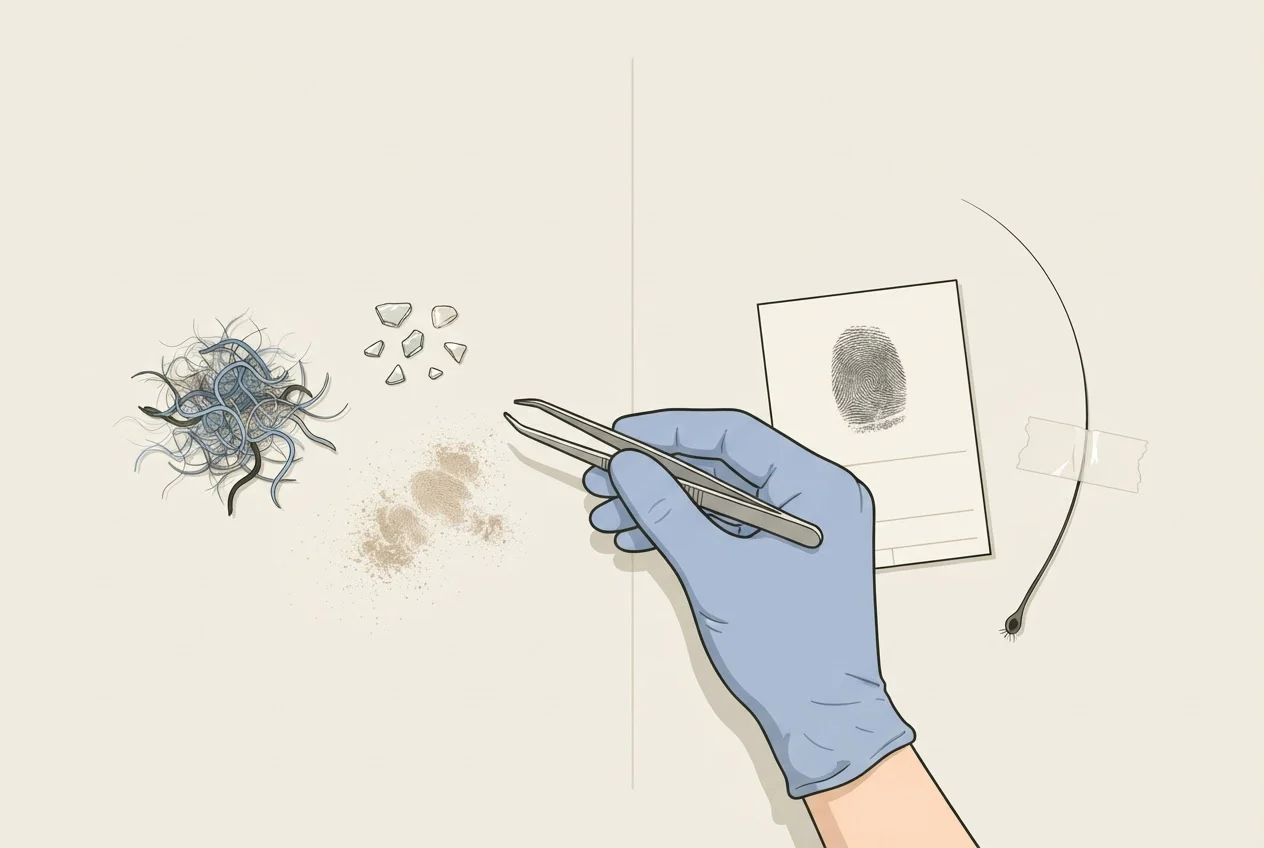
- Biological: blood, saliva, hair with roots and other material that may carry DNA, the genetic material a laboratory uses to build an identifying profile.
- Trace: physical evidence that results from the transfer of small quantities of material, such as hair, textile fibers, paint chips, glass fragments or gunshot residue (NIJ glossary). Under Locard's Exchange Principle, "every contact leaves a trace" (NIJ, June 2023).
- Impression: objects or materials that have retained the characteristics of other objects pressed against them (NIJ glossary), such as shoe prints, tire tracks and tool marks (NIJ, June 2023).
- Fingerprints, firearms and tool marks, controlled substances, questioned documents: each is often listed as its own group and each normally goes to a specialist examiner.
Why do lists of physical evidence types disagree?
Lists disagree because they divide different things. Some divide all evidence, some divide only physical evidence, and one divides physical evidence by its power to identify a source. The table below sets the five schemes side by side, with what each one divides.
| Scheme | What it divides | Groups |
|---|---|---|
| All evidence | 2: testimonial, physical | |
| Physical evidence, by power to identify a source | 2: class, individual | |
| All evidence | 6: direct, circumstantial, physical, documentary, demonstrative, hearsay | |
| Physical evidence | 8: biological, chemical, pattern, trace, impression, conditional, transient, associative | |
| Physical evidence | 8: biological, trace, impression, weapons and firearms, documents, controlled substances, digital, latent prints |
This comparison covers five schemes, read on 23 November 2026.
You can repeat the check: set the two eight-group lists side by side. Three names match, biological, trace and impression, which is 3 of 8 in each list. The other five groups in each list do not match the other list's names. Nikoui and Associates lists digital evidence as a group; ForensicSpot's eight groups do not include it.
No standard count exists. That is why "three types," "seven types" and "twelve types" all circulate. For an investigator, the useful question is not which list is right but which sort changes what you do.
Should an investigator sort physical evidence by class or individual value?
Yes. Class versus individual value is the sort that changes handling. Class evidence is "any item that is considered common or mass-produced," such as fibers, small glass fragments, powders and hair without roots. Individual evidence "can identify the source and be considered unique," such as DNA, fingerprints, hair with roots and matched tear patterns (ACCESS Virtual Learning).
We recommend using that sort to set your priorities:
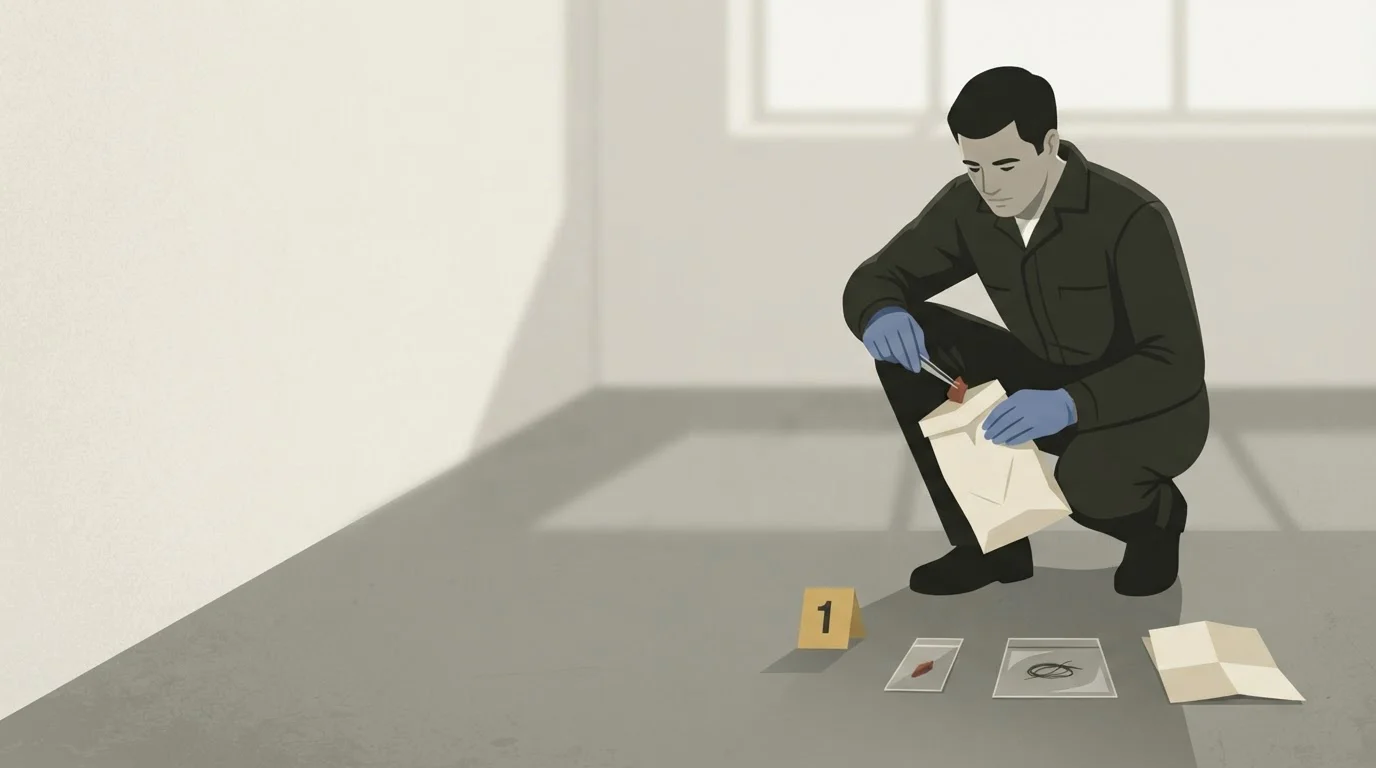
- Fragile or transient items first (our recommendation). Trace material is, by definition, small quantities transferred between surfaces, so it is the easiest to lose by walking, wiping or repacking. Photograph and secure it before you turn to stable items.
- Individual items next. One mishandled fingerprint or root-bearing hair cannot be replaced, and contamination can destroy the only link to one person.
- Class items as a set. A single fiber proves little. Its value comes from where it was found and how many like it were found there, so the location record matters more than the item.
How do you handle each type of physical evidence you receive?
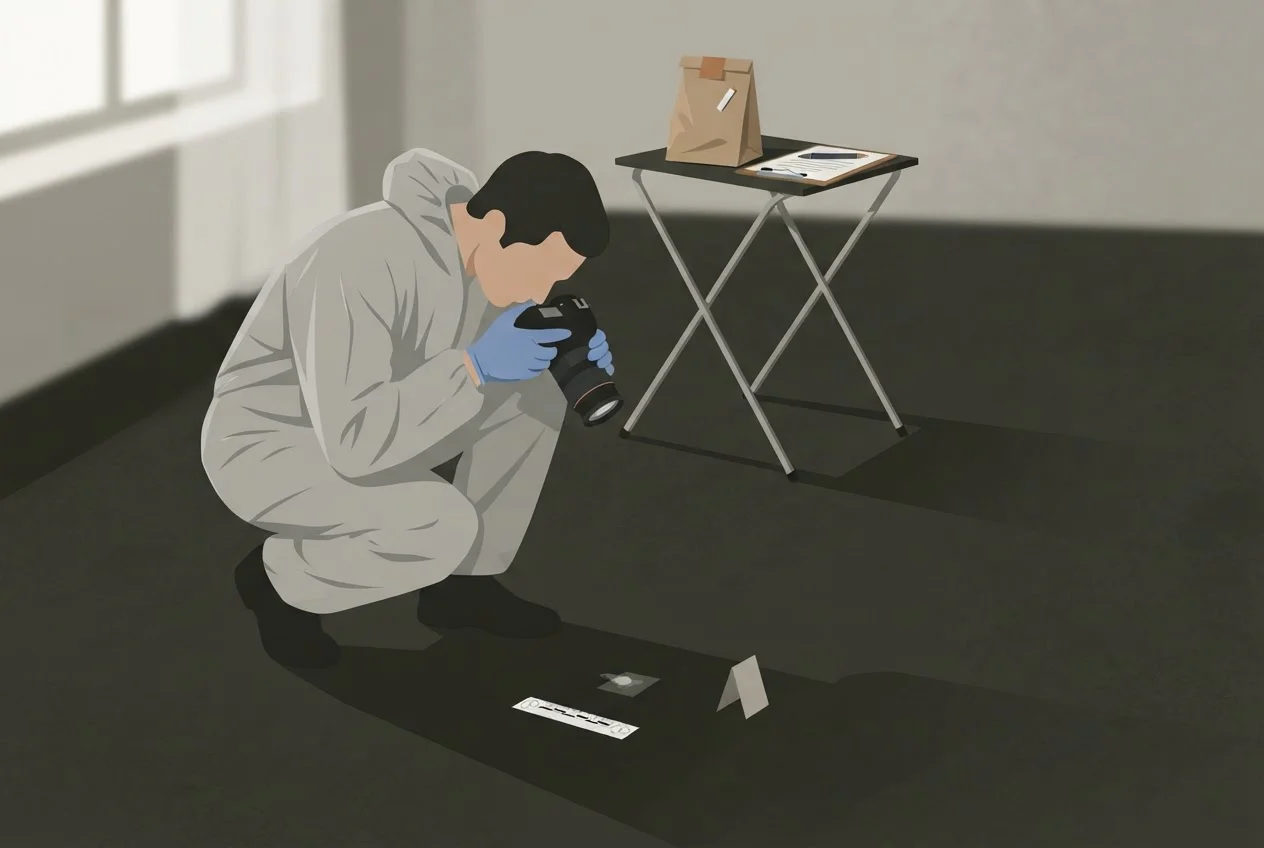
Use the table below for the first minutes with any item. The first three columns come from the sources above. The "What you do first" column is our recommendation, built on the steps our evidence collection course teaches: photograph, sketch and measure, mark and package, and document.
| Item | Group | Class or individual | What you do first | Who examines it |
|---|---|---|---|---|
| Fibers, glass fragments, paint chips, soil | Trace | Class for fibers and small glass fragments; paint chips and soil are usually class evidence too (our inference) | Photograph in place, record exactly where found, package each item separately, label, log | Laboratory examiner |
| Fingerprints | Fingerprint | Individual | Photograph in place with a scale; do not touch the surface | Fingerprint examiner |
| Hair with roots, other material that may carry DNA | Biological | Individual | Handle as little as possible, package separately, label, log | Laboratory examiner |
| Shoe print, tire track | Impression | Examiner decides | Photograph with a scale before anything else, then measure and sketch | Laboratory examiner |
| Letter, contract or other document | Documentary | Not applicable | Keep the original as received, work from a copy, log the receipt | Document examiner, if authenticity is in doubt |
Confirm who arranges laboratory submission before you collect anything. If an attorney or agency retained you, that decision is usually theirs, not yours.
When a client hands you an item, which four tests should your file pass?
Run these four tests the day you receive the item. Each is pass or fail.
- Prior custody. Pass: your file names every person who held the item before you, with dates. Fail: it says only "from the client."
- Condition. Pass: a timestamped photograph taken before you opened or touched the item shows its container, seals and markings. Fail: your first photograph comes after handling.
- Labeling. Pass: each item is in its own container, marked with case number, date, your initials and a short description. Fail: items share a container or carry no label.
- Transfer. Pass: for any item, your log accounts for every day since receipt, with the name and date of each release and receipt. Fail: any gap, or any unrecorded handover.
These tests follow NIJ's definition of chain of custody: a process that maintains and documents the chronological history of the evidence, including who collected it, each later custodian, the dates of transfers, the case number and a description of the item (NIJ glossary). Our page on chain of custody for investigators shows what to log and why.
How does a court decide an item of physical evidence is what you say it is?
A court requires the proponent of an item to produce "evidence sufficient to support a finding that the item is what the proponent claims it is" (Federal Rule of Evidence 901(a), U.S. Courts). The rule is a low, practical standard, and it lists examples of how to meet it.
Two examples matter most to an investigator. The first is testimony by a witness with knowledge "that an item is what it is claimed to be." The second is the item's "appearance, contents, substance, internal patterns, or other distinctive characteristics," taken together with all the circumstances.
You are usually the witness with knowledge. Your receipt photograph, label and custody log are what you would testify from, which is why the four tests above come first. Whether the item then comes in also depends on how it was obtained, and that varies by state and by case, so check with the attorney.
Two other kinds of evidence are easy to confuse with the item itself. Demonstrative evidence illustrates a witness's testimony and is not the thing involved in the case (FindLaw). A sketch you draw to explain your testimony is demonstrative. The shoe print it shows is physical.
Which of our courses covers collecting evidence, and which covers what a laboratory does?
We teach the two sides as separate self-paced courses. As of November 2026, prices are as shown below.
122. Collection and Preservation of Evidence costs $80 and takes 4 hours. It covers physical evidence defined, search preparation and methods, identifying physical evidence, incident scene photography, sketching and measuring, marking and packaging, documentation, forensic testing and jurisdiction. It has 30 lessons and 5 assessments with 78 questions.
116. Scientific Analysis of Physical Evidence costs $100 and takes 6 hours. It covers forensic services for examining physical evidence, the kinds of material that can be examined, and forensic methods and instruments. Its lessons include trace evidence (glass, tape, fibers, hair, paint), treadware impressions (impressions left by shoe or tire tread), serological analysis (blood and body fluid analysis), DNA analysis, ballistics, tool marks, fingerprints, questioned documents, drug examination and chain of custody. It has 54 lessons and 25 assessment questions, and issues a certificate of completion.
Neither course turns you into a laboratory examiner. They teach what an investigator collects and what a laboratory can tell you about it. Each course page lists the states where it is approved for continuing education credit, so check your state board's requirements before you enroll. For help choosing between them, see Training That Improves Evidence Collection for Private Investigators. To decide between physical and digital evidence training, read Physical or Digital Evidence Training for Private Investigators?.
To enroll or ask a question about either course, call (832) 922-1215 or (706) 268-2221.
Learn to collect and preserve physical evidence
Frequently asked questions
It depends on the list. Of the two eight-group lists we compared, Nikoui and Associates includes digital evidence as a group and ForensicSpot's eight groups do not. For training in either, read our page on physical or digital evidence training.
Sources
- 1.NIJ: Types of Evidence, Crime Scene and DNA Basics for Forensic Analysts, National Institute of Justice, U.S. Department of Justice, June 15, 2023
- 2.Glossary: Crime Scene Investigation Guides for Law Enforcement, National Institute of Justice (archived, no longer updated)
- 3.Federal Rules of Evidence, effective December 1, 2024, Rule 901, U.S. Courts
- 4.Real and Demonstrative Evidence, FindLaw, December 12, 2023
- 5.Physical Evidence unit, ACCESS Virtual Learning
- 6.122. Collection and Preservation of Evidence, Learningshopusa course page, prices as of November 2026
- 7.116. Scientific Analysis of Physical Evidence, Learningshopusa course page, prices as of November 2026
- 8.ForensicSpot, "Physical Evidence: Types and Classification", updated November 22, 2026; read November 23, 2026
- 9.Nikoui and Associates, "Understanding Physical Evidence at a Crime Scene", read November 23, 2026
- 10.Barefoot Professional Investigations, "The 6 Crucial Types of Evidence", read November 23, 2026