Process Server Training for First-Time Servers
Choose process server training for first-time servers with a weekend plan, state-rule checks, and affidavit and return guidance.

State requirements shape the training decision as much as the lessons themselves. Texas, for example, requires a Commission-approved 7-hour civil-process course before an initial application, along with a background check and a $200 first-time application fee under its current Texas requirements.
Process server training for first-time servers works best when it teaches lawful service, document review, safe attempts, contemporaneous field notes, and jurisdiction-specific proof of service. It can fit a weekend only when verified instructional hours and delivery fit two days, while exams, background checks, applications, and local approval remain separate steps.
We built this guide to help you compare course fit, plan a realistic weekend, understand proof documents, and check whether your state or local authority adds requirements after training.
Which Process Server Training for First-Time Servers Is Best?
The best beginner fit is not the course with the biggest promise. It is the course that matches where you will serve, teaches the full assignment workflow, gives you practice with records, and clearly distinguishes completion from legal authorization. Start by reviewing our course overview before you compare schedules, support, and state recognition.
| Course Option | Curriculum Depth | State Specificity | Price Check | Instructor Access | Practice And Assessment | Certificate Verification |
|---|---|---|---|---|---|---|
| State-Approved Initial Path | Must cover required state topics | Required where an authority approves providers | Confirm all training and filing costs | Confirm before enrolling | Look for required exercises and exam preparation | Course certificate plus agency process |
| Self-Paced Foundational Course | Should cover intake through proof of service | May be general rather than qualifying | Confirm price, access, and refund terms | Confirm support channel | Look for scenario and documentation practice | Completion record should be identifiable |
| Our Learningshopusa Training Selection | Match the current lesson plan to your service goal | Check the relevant jurisdiction before purchase | Confirm current listing details | Ask about available support | Choose practice that tests workflow decisions | Retain your completion evidence |
A strong course lets a first-time server explain what they received, what rule applies, what happened at each attempt, and what proof is due next. Georgia’s rules illustrate the depth that an initial path can demand: an approved course totals 12 hours and includes regulation, ethics, liabilities, state law, safety, and practical exercises under the Georgia curriculum.
What Should Beginner Training Teach Before a First Assignment?
Before we encourage anyone to accept papers, we want them to understand that service is a documented legal task, not simply a delivery errand. Good training gives new servers a sequence they can repeat under pressure, while making it clear that the issuing court’s rules and the client’s lawful instructions control.
Role, Purpose, and Document Identification
Start with the papers. A trainee should be able to locate the court, case number, named parties, document type, deadline, attached pleadings, address, and special instructions. That review prevents a common early error: planning an attempt before confirming who must be served and what the papers actually require.
Federal summons rules show why these details matter. A summons identifies the court and parties, directs the defendant to respond, and states the time to appear and defend under Federal Rule 4.
Lawful Methods, Boundaries, and Safety
Training should introduce personal service, service at a dwelling, service on authorized agents, and court-ordered alternative methods as separate, rule-dependent paths. It should also teach a beginner to stop and seek guidance when identity is uncertain, access is restricted, an encounter becomes unsafe, or an order is unclear.
Privacy and professionalism belong in this lesson, too. We expect servers to disclose only what is necessary for the assignment, avoid impersonation or false claims of authority, and leave when an interaction cannot proceed lawfully or safely.
Attempts and Contemporaneous Field Notes
A good beginner course makes documentation part of every attempt. Notes should capture the date, time, precise location, description of the person or location, observations, method attempted, and any fact relevant to later substituted or alternative service.
We recommend practicing this skill before working live assignments. Our discussion of practical investigation skills can help learners recognize why neutral, specific notes are more useful than conclusions or assumptions.
Proof, Quality Control, and Professional Readiness
The final lesson should connect fieldwork to the paperwork that allows a client and court to understand what happened. Learners need to compare their notes with the proof form, check every name and date, follow the required signature process, and retain supporting records.
That is the difference between finishing lessons and becoming ready to handle an assignment responsibly. A completion certificate matters, but it does not erase a local rule, court order, or registration requirement.
How Do You Complete a Service Assignment from Intake to Delivery?
Every assignment should follow the same core pattern: receive and review the papers, research the target and instructions, plan a lawful attempt, document each event, complete service only when authorized, prepare proof, and report completion. This workflow gives a first-time server a defensible checklist instead of a vague instruction to make the delivery.
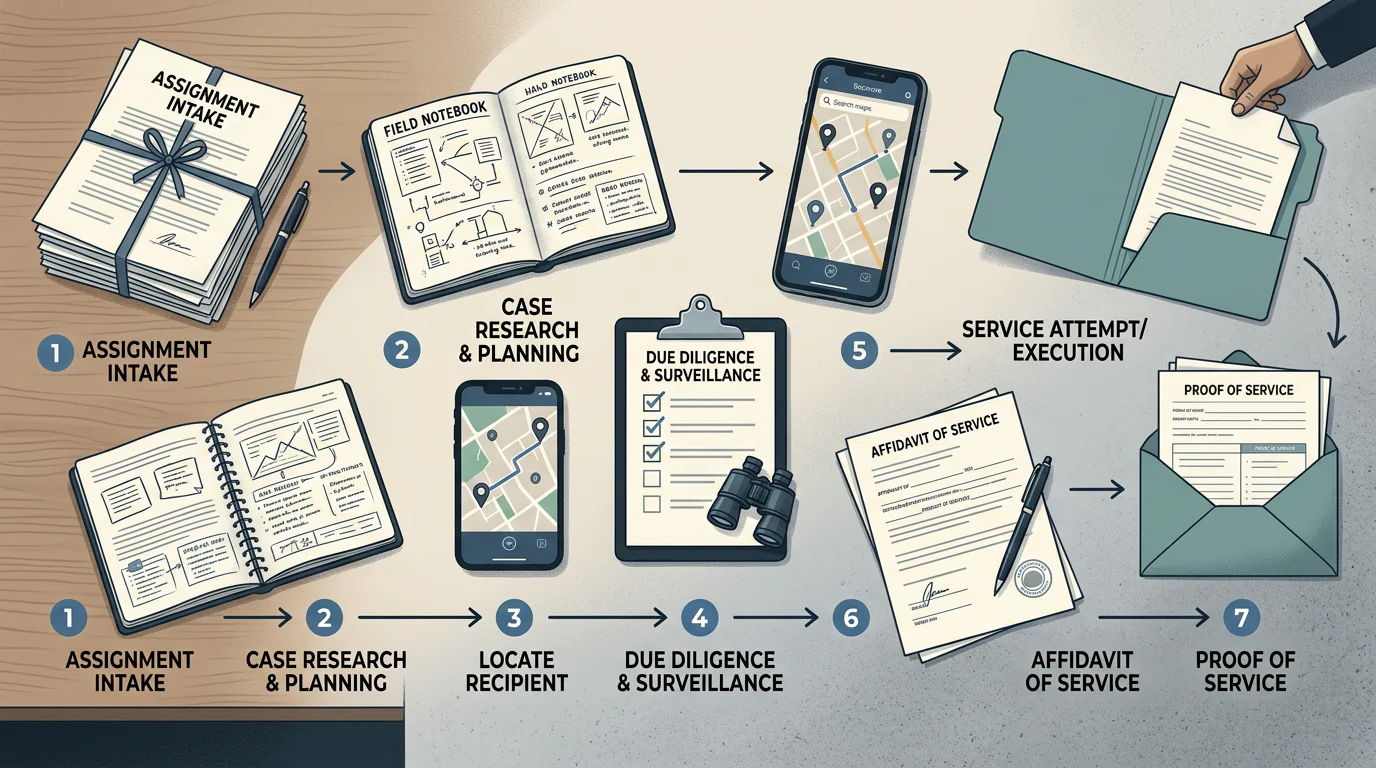
Receive Papers and Prepare the Assignment
At intake, confirm the caption, issuing court, case number, parties, target, deadline, documents enclosed, and any client instructions. Record the date received and resolve obvious mismatches before leaving for an address.
Then research only what is relevant to the assignment. Check whether the target is an individual or entity, whether an agent is named, and whether the instructions indicate a court order or special handling requirement.
Plan, Attempt, and Complete Service
Plan the service method by the governing rule, not by habit. A server should know the authorized method, the correct target, the expected location, and the point at which they need legal or client guidance rather than another improvised attempt.
Texas training materials emphasize that a return should state the date and time of each successful or unsuccessful attempt and exactly how delivery or attempted delivery occurred. They also stress that court-ordered alternative service must follow the order’s terms under the Texas curriculum.
Prepare Proof and Deliver the Result
After service or an unsuccessful sequence of attempts, compare the notes to the required proof form. Confirm the method, recipient details, time, place, documents, signature, and any supporting evidence before filing or returning the package as instructed.
| Workflow Stage | Required Record | Common Beginner Error |
|---|---|---|
| Receive Papers | Court, case number, parties, deadline, instructions | Ignoring a missing attachment |
| Research | Target match, address source, assignment notes | Confusing a similar name with the correct party |
| Plan | Authorized method and safety plan | Importing a rule from another jurisdiction |
| Attempt | Time, location, observations, result | Writing notes much later |
| Complete Service | Method, identity basis, recipient facts | Calling substituted service personal service |
| Prepare Proof | Complete return or affidavit, attachments, signature | Signing incomplete proof |
| Deliver Result | Filing or client confirmation, retained records | Closing an assignment before proof is accepted |
For jurisdiction-specific recordkeeping, review the New York law update alongside the live rules that govern your own assignment.
Can Process Server Training Fit into One Weekend?
A weekend is realistic only for the instruction portion when the provider’s verified hours and delivery format fit the available time. It is not a reliable promise of authorization, because a later exam, application review, fingerprint appointment, bond, county appointment, or agency decision can extend the timeline.
Georgia’s approved initial curriculum provides a useful, verified 12-hour model. It allocates 30 minutes to regulation, 1.5 hours to ethics, one hour to liabilities, six hours to law, one hour to personal safety, and two hours to practical exercises under the state’s training rules.
| Day | Verified Modules | Hours |
|---|---|---|
| Saturday | Regulation, ethics, liabilities, first half of state-law instruction | 6 |
| Sunday | Remaining law instruction, personal safety, practical exercises | 6 |
| Path | Verified Instructional Time | Delivery Check | Certificate Or Exam Timing | Post-Course Step |
|---|---|---|---|---|
| Georgia Initial Certification | 12 hours | Online or in-person training may be permitted through an authorized provider | Course completion is followed by an AOC testing process | Application, fingerprints, bond, and county requirements |
| Texas Certification | 7 hours | Confirm the provider’s format in writing | Complete the approved course before applying | Application and state and national background checks |
| New York City Individual Licensing | No course hours stated on the licensing page | Exam appointment availability controls timing | Applicants must complete the licensing process and pass the exam | Ongoing recordkeeping and GPS obligations |
We advise learners to leave margin for breaks, technical issues, document practice, and a final review rather than trying to compress every minute. Before buying, confirm access dates, any required live component, the certificate release timing, and every post-course step. Our course price guide helps separate tuition from the government and verification costs that can follow.
How Do State Rules, Affidavits, and Returns Affect Course Choice?
Course completion and authorization are different checks. We recommend verifying your state, county, city, court, and assignment type before relying on any training certificate, because recognition can be statewide, circuit-based, county-based, or limited to a particular licensing path.
| Jurisdiction | Training Approval | Registration Or Appointment | Exam | Background Check | Bond Or Insurance | Local Check |
|---|---|---|---|---|---|---|
| Georgia | AOC-approved 12-hour path | County certification process | AOC exam | Fingerprint-based | Commercial surety bond required | Certifying sheriff |
| Texas | JBCC-approved 7-hour course | Online certification application | Confirm current Commission rule | State and national checks | Confirm current Commission requirements | Approved provider status |
| Florida | Circuit or sheriff path varies | Circuit list or sheriff appointment | Required for special-server applicants | Required | Current bond and annual status | County or circuit rules |
| New York City | Licensing materials support required exam preparation | Individual license for frequent service | Required | Application requirements apply | Recheck current published requirement | Electronic records and GPS |
Florida demonstrates why local details matter. Its special process server route includes a background investigation, good-conduct evidence, an examination, and sheriff-controlled appointment requirements under Florida law. Use our course-fit guidance only after confirming the authority and service area that govern your work.
An affidavit is a sworn proof statement when the governing rule requires one. A return is the jurisdiction’s report of service or attempts, usually with prescribed fields and timing. In federal civil cases, proof of service is generally made by the server’s affidavit unless service is waived or made by a U.S. marshal or deputy under Rule 4 proof requirements.
| Item | Affidavit | Return Of Service |
|---|---|---|
| Purpose | Sworn proof of facts when required | Formal record of service or attempts |
| Typical Contents | Server identity, facts, date, manner, recipient, oath | Dates, times, method, recipient, documents, signature |
| Notarization | Depends on the governing rule and verification method | Depends on jurisdiction and permitted verification |
| Common Failure | Swearing to incomplete or unsupported facts | Missing a time, method, capacity, attachment, or signature |
| Correction | Follow the court’s amendment process | Follow the applicable rule and filing procedure |
Florida’s return rule, for example, requires the date and time received and served, manner of service, recipient, capacity when relevant, documents served, and server signature. It also allows amendment on application to the court under Florida return rules. Never pre-sign a form, leave blanks for later, or correct filed proof without following the appropriate process.
The right training gives you a disciplined way to prepare records, but it does not tell you to improvise when the rule is unclear. Revisit our process-server course details after you have confirmed whether your assignment calls for a return, affidavit, court order, or local credential.
Learningshopusa Process Server Training
At Learningshopusa, we built our process-server learning path for people who want a usable first assignment checklist, not vague career advice. We focus on the choices that determine whether a weekend course is practical: the rule set that governs the job, the hours you can realistically complete, and the records you must be ready to create. Before enrolling, compare your jurisdiction’s approval status, exam timing, fingerprint steps, local appointment process, and final certificate requirements. Then use the state matrix above to ask us precise questions. We can help you identify the right training scope, but we do not replace a court, licensing office, or attorney. That keeps your training decision tied to authorization rather than marketing claims. We want your first assignment to be orderly and lawful. Start with the current course details and contact route at Learningshopusa.
FAQs on Process Server Training for First-time Servers
These FAQs cover common issues. Check current local rules.
Can I Finish Process Server Training in One Weekend?
You can finish weekend-scheduled instruction when the verified hours and delivery format permit it, but exams, fingerprints, applications, background checks, and agency decisions may take longer.
Does a Completion Certificate Let Me Serve Immediately?
A completion certificate documents training, not automatic authority. Confirm every state, county, city, court, or agency requirement before accepting papers or representing yourself as authorized.
What Notes Belong in an Attempt Record?
Record the date, time, exact location, method attempted, identity observations, relevant contact facts, safety concerns, and any instruction that changed the next lawful step for you.
What Is the Difference Between an Affidavit and a Return?
An affidavit is a sworn proof statement when governing rules require it. A return records service or attempts in the jurisdiction’s prescribed form and timing.
How Should I Compare Beginner Process Server Courses?
Compare approval status, workflow coverage, price transparency, instructor access, practice exercises, assessment method, and certificate verification before deciding whether a course actually fits your jurisdiction.