Private Investigator Continuing-Education Alternatives: Which Fit Your Investigation Work?
Compare private investigator continuing-education alternatives by specialty, renewal credit, hands-on practice, cost, access, and credential value.

Private Investigator Continuing-Education Alternatives: Which Fit Your Investigation Work?
In Texas, the higher private-investigator renewal tier requires 18 CE hours. That makes a training comparison a compliance choice before it becomes a skills or price choice.
Private investigator continuing-education alternatives work best when you choose by casework and confirm credit separately. Public-sector criminal-investigation courses may be useful for method or agency recognition, while private and corporate assignments may need interviewing, surveillance, OSINT, fraud, or evidence skills. No certificate alone proves PI renewal eligibility.
We compare the practical differences that matter before enrollment, including audience, access, exercises, records, cost, and the type of recognition a course can honestly claim. We also show how to score an option against the work you actually perform.
How Does the Public-Sector Benchmark Fit PI Renewal?
The public-sector benchmark is useful as a comparison point, not a default renewal answer for private investigators. Its core criminal-investigation course appears in the Texas catalogue as a 40-hour law-enforcement course, which illustrates how public-safety curriculum can be much broader than a state renewal package.
At our last review, the online benchmark listed a 90-day completion period, a $107 tuition, no stated prerequisite, and a final examination with three attempts. It focuses on criminal casework, affidavits, warrants, interviewing, evidence, reports, and prosecution preparation. Those are useful subjects, but PI renewal credit still depends on your regulator and the exact school or provider approval.
| Provider Or Path | Specialty | Primary Audience | Prerequisites | Format | Hands-On Component | Verified Duration | Total Cost | Credential | CE Applicability | Source Date |
|---|---|---|---|---|---|---|---|---|---|---|
| Public-sector criminal-investigation benchmark | Criminal investigation, interviewing, evidence | Law enforcement and assigned investigative personnel | None stated | Online | Assignments, quizzes, final examination | 40 hours, 90 days to complete | $107 listed tuition | Completion certificate and public-safety credits | Not automatic PI renewal credit | September 14, 2026 |
| State-approved PI renewal route | Investigation, ethics, laws and rules | Licensed private investigators | License-class and state match required | Course-specific | Attendance and assessment controls vary | Course-specific | Course-specific | State-compliant completion certificate | May count only with documented approval | September 14, 2026 |
| Interviewing and surveillance skills route | Interviews, statements, observation, reporting | Working investigators | Varies | Live, virtual, or self-paced | Verify scenarios and instructor feedback | Varies | Varies | Completion certificate | Confirm separately | September 14, 2026 |
| OSINT and digital-evidence skills route | Online research, verification, preservation | PIs and specialist practitioners | Varies | Live, virtual, or self-paced | Verify applied exercises and source logs | Varies | Varies | Completion certificate or specialty credential | Confirm separately | September 14, 2026 |
| Fraud-investigation route | Fraud indicators, records, interviews | Corporate and financial investigators | Varies | Live, virtual, or self-paced | Case studies and assessments vary | Varies | Varies | Professional certificate or CPE | Not presumed to count for PI renewal | September 14, 2026 |
| Evidence-handling route | Preservation, chain of custody, reporting | PIs handling physical or digital material | Varies | Classroom, virtual, or blended | Verify practical documentation exercises | Varies | Varies | Completion certificate | Confirm separately | September 14, 2026 |
For Texas renewal planning, start with your own required hours and category splits, not with a broad criminal-investigation certificate. Our Texas CE requirements guide helps separate the renewal route from useful additional training.
Which Private Investigator Continuing-Education Alternatives Fit Each Specialty?
The strongest alternative is not the course with the broadest title. It is the route that improves the next type of assignment you want to accept, while leaving a clear record of whether it counts toward your current renewal obligation.
Criminal Investigation, Interviewing, and Surveillance
Criminal-investigation training can help private investigators organize leads, document decisions, prepare interviews, and write reports that a client or attorney can follow. For surveillance and interviewing, ask whether the course requires a plan, a written statement, a scenario decision, or instructor feedback. A completion certificate alone does not establish practical skill.
OSINT, Digital Evidence, and Evidence Handling
OSINT training should teach source evaluation, corroboration, collection notes, attribution awareness, and reporting. Digital-evidence training should also make boundaries clear: a short course may improve preservation and referral decisions, but it does not make a learner a forensic examiner. Our evidence training resource explains where collection, preservation, and specialist referral separate.
Fraud and Corporate Assignments
Fraud work often rewards careful records review, interview planning, document comparison, and clear findings. A fraud-focused course can be valuable for an investigator working with insurers, employers, or counsel, but professional CPE and a regulator-approved PI renewal course make different promises. Match the credential to the assignment, then match renewal credit to your license.
Who Can Enroll, and Which Credits Count?
Eligibility is where many comparisons break down. A course can be open to the public, useful for private casework, and still fail to meet a state’s rules for a private-investigator renewal.
Georgia is a clear example. Registered private-detective employees generally need 16 hours before renewal, divided among industry-related, ethics, and homeland-security topics. The Georgia rule also addresses facilitators, course records, certificates, and audit responsibilities, so a course title is never enough evidence by itself.
Before enrolling, confirm these points with the regulator or approved-school record:
- Your credential: Confirm that the course applies to your individual PI license or registration, not merely to a company, security credential, or law-enforcement role.
- The category split: Confirm that ethics, laws and rules, and investigation-related hours are allocated exactly as your jurisdiction requires.
- The delivery method: Confirm that online, self-paced, live virtual, or classroom delivery is allowed for the exact course.
- The certificate fields: Confirm that the provider records the learner, dates, course topic, credited hours, and required instructor or facilitator information.
Requirements do not travel neatly across state lines. Use our PI CE by state page for a state-first check before choosing a course or scheduling study time.
Which Options Offer Hands-On Practice?
Hands-on training should mean more than watching a video and passing a quiz. We look for evidence that a learner must apply a process, make a decision, produce work, or receive feedback that resembles the documentation expected in real investigations.
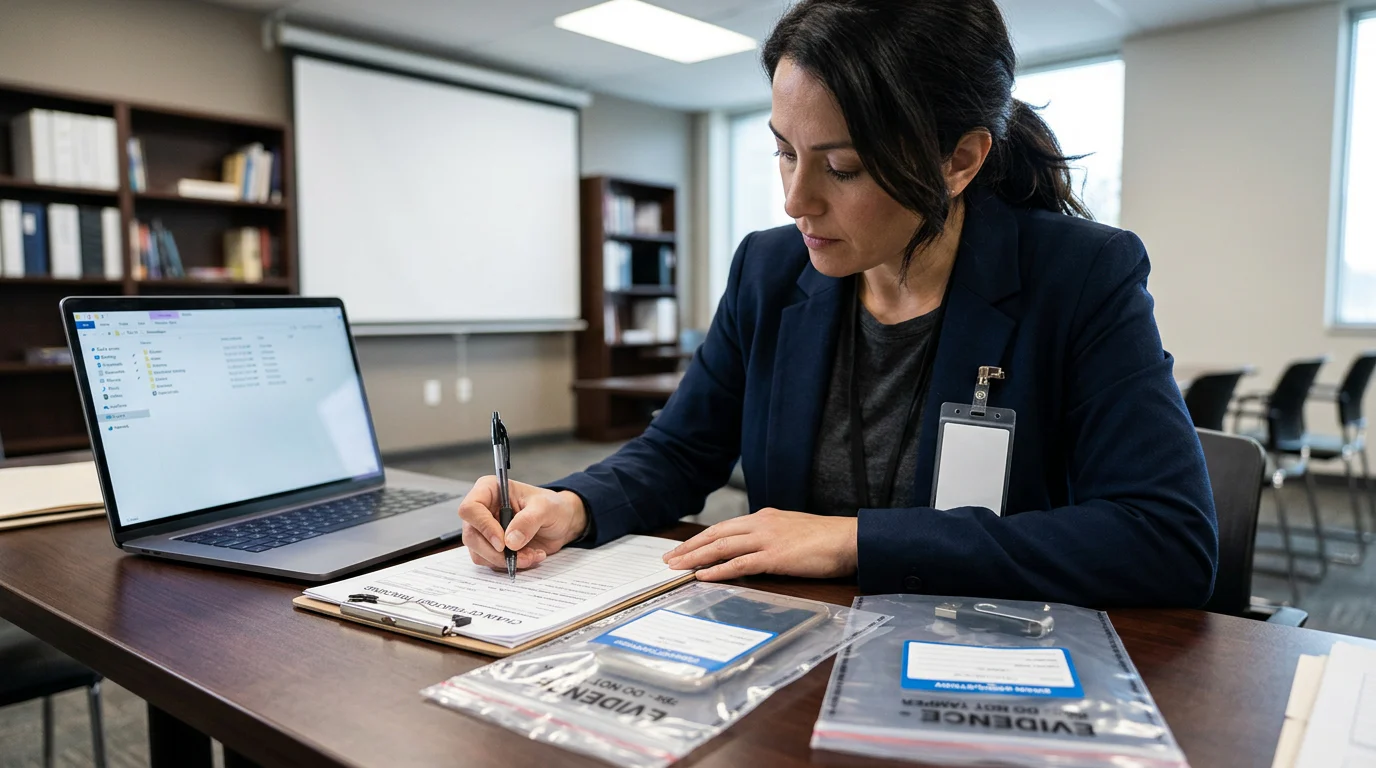
Use this scale when comparing course descriptions:
- Knowledge check: Short quizzes confirm recall, but do not show whether you can apply the material to a case.
- Mock analysis: A case study or guided scenario asks you to interpret facts, identify leads, or plan an interview.
- Documented exercise: A course requires a source log, surveillance plan, evidence record, interview outline, or report.
- Instructor feedback: An instructor reviews the work, identifies errors, and gives the learner a chance to improve.
- Observed practical: A trainer observes a lab, scenario, or field exercise against stated standards.
Ask the provider what the learner must submit, who reviews it, whether feedback is individualized, and whether a final assessment is proctored. Our next skills course guide can help you prioritize practical gaps instead of collecting unrelated certificates.
How Should You Compare Recognition, Cost, and Records?
Recognition is useful only when you state precisely what is recognized. Regulator approval, academic credit, association membership, professional CPE, and employer preference are different things, and they should never be presented as interchangeable.
Texas requires qualifying private-security continuing education through department-approved schools, and licensees must retain proof tied to renewal. The state’s training guidance is the right place to verify that compliance layer before comparing course marketing claims.
Cost deserves the same discipline. Compare listed tuition with every required fee, including an exam, proctoring, certificate issue, membership, travel, and renewal charge. A low starting price can be a poor value if the course does not provide the category of credit, access window, or documentation your renewal requires.
Keep a renewal file that includes the course description, approval evidence, receipt, attendance or progress record, dated certificate, and any confirmation from the regulator or school. Our Texas CE records checklist helps turn that file into something you can find during an audit.
Which Path Fits Your PI Casework and Deadline?
Your best choice changes with the assignment in front of you. A renewal deadline may make approval and certificate timing decisive, while a new fraud or digital-evidence assignment may justify skills training that sits outside your required CE package.

| PI Assignment Context | Best Starting Path | Non-Negotiable Check |
|---|---|---|
| Public-sector-connected assignment | Agency-recognized investigation training | Confirm agency eligibility and PI renewal status separately |
| Independent PI renewal | State-approved PI CE | Match the school, categories, hours, and certificate to your license |
| Corporate or fraud assignment | Fraud, interview, and document-review training | Do not assume professional CPE meets PI renewal rules |
| Specialist assignment | OSINT, surveillance, digital evidence, or evidence handling | Verify practical intensity and lawful scope before enrolling |
We recommend a weighted score after the approval gate is cleared:
| Criterion | Default Weight | Question To Score |
|---|---|---|
| Regulatory-credit fit | 5 | Does the exact course satisfy my state and credential category? |
| Casework relevance | 4 | Does it improve the assignments I expect to handle? |
| Practical intensity | 4 | Does it include assessed scenarios, exercises, or feedback? |
| Access and deadline | 3 | Can I complete it with my device, schedule, and available time? |
| Total cost | 2 | Does the final cost include every required fee? |
| Credential relevance | 2 | Is its recognition documented for my employer or specialty? |
Score each criterion from zero to four, multiply by your chosen weight, and compare totals only after removing options without verified approval. A course with uncertain renewal status is not a lower-ranked choice, it is an ineligible renewal choice.
Use the same score to plan the order of your approved learning, specialty training, and recordkeeping tasks. Our Texas PI CE planner can help turn that decision into a deadline-aware study plan.
Learningshopusa: Choose with Confidence
At Learningshopusa, we built this comparison for working private investigators who need more than an attractive certificate. We help you begin with your license type, renewal deadline, and actual assignments, then separate documented renewal credit from useful skills training. If you are in Texas, our planning resources help you check the appropriate CE route before you commit time. If you work elsewhere, we encourage the same disciplined process: confirm the regulator, course category, attendance evidence, final certificate, and total checkout cost. We also believe a schedule should fit surveillance shifts, client calls, and court deadlines, without pretending convenience creates credit. Use the matrix to shortlist options, save the proof behind your choice, and return whenever a new assignment changes the skills you need. Explore our broader investigator, security, and process-service training resources when you are ready to plan your next course at Learning Shop USA
FAQs on Private Investigator Continuing-education Alternatives
These answers address the most common comparison mistakes we see from working investigators. Use them alongside your regulator’s current rules and your provider’s written course record.
Can a Public-Safety Investigation Course Count Toward My Private-Investigator Renewal?
Only when your regulator accepts the exact school, course, delivery method, and hour categories. Public-safety credit or a completion certificate does not establish PI renewal eligibility.
What Evidence Shows a Course Includes Hands-On Practice?
Look for graded scenarios, written assignments, exercises, labs, instructor feedback, or observed performance. Quizzes test recall, but rarely demonstrate applied investigative judgment, decision-making, or documentation.
Why Does a Professional Credential Not Automatically Renew My License?
Professional credentials demonstrate subject knowledge, while renewal rules govern license compliance. Compare the credential’s assessment and recognition with your regulator’s provider, topic, attendance, and record requirements.
What Should I Save After Completing PI Continuing Education?
Save your receipt, course description, approval evidence, attendance or progress record, dated certificate, credited hours, and regulator communication. Keep retrievable digital copies for a future renewal audit.