Interview vs. Interrogation: Where the Legal Line Falls
Interview vs interrogation turns on custody and who is asking, not on tone. Miranda warnings apply only when police question a person in custody, meaning someone who is not free to leave.
By Sharon DeCet, Founder · Updated 25 Oct 2026

Key takeaways
- An interview gathers information, and an interrogation tests the account of someone suspected of involvement. The Miranda rule attaches to custody plus police questioning, not to either word.
- A private investigator has no authority to detain or compel testimony. Miranda addresses governmental coercion, so every private interview should be voluntary, and you should say so at the start.
- Information-gathering questioning produces more true confessions and fewer false ones than accusatorial questioning, according to a 2024 systematic review of 29 laboratory studies.
- Before any private interview, confirm six things: you identified yourself, the person is free to leave, you claimed no government authority, police did not direct you, you checked the state recording rule, and you wrote notes the same day.
In this article
- 1What is the difference between an interview and an interrogation?
- 2When does questioning legally become an interrogation?
- 3Which rules apply to which conversation?
- 4What does this mean for a private investigator or security officer?
- 5Why does the style of questioning matter more than the label?
- 6What should you check before any interview?
- 7Did you identify yourself?
- 8Can the person leave?
- 9Did you claim any government authority?
- 10Did police direct the interview?
- 11Is recording lawful in your state?
- 12Will your notes be written the same day?
- 13How do we teach interviewing and interrogation?
- 14Frequently asked questions
A detective can stay polite for three hours and still be running a custodial interrogation. A blunt, accusatory question from a private investigator is not covered by the rule most people mean by "reading someone their rights."
That gap is why the same conversation gets two names. A person asked to "come in and talk" calls it an interrogation, and the officer calls it an interview. Both can be right, because the words describe different things: purpose on one hand, legal status on the other.
For investigators, the consequence is practical. The rules change with who is asking and whether the person can leave, so identical questions carry different legal weight in a police station and in a private interview.
A private investigator has no power to detain or compel testimony. A security officer may have limited detention powers under state law, and a deputized or off-duty police officer working security is a government actor.
What is the difference between an interview and an interrogation?
An interview is questioning to learn what a person knows, saw or remembers. An interrogation is questioning aimed at a person suspected of involvement, usually to test their account or obtain an admission. Those are working definitions of purpose. The law draws its line elsewhere.
Researchers describe three styles of questioning suspects: accusatorial (confronting the person with the assumption of guilt), information-gathering (open questions to get an account), and direct questioning. The Campbell Collaboration review of 29 experimental studies (October 10, 2024) compares them. This matters because a single conversation can move between styles. It can start as a witness interview, turn into a suspect interrogation, and end with a signed statement. The label you used at the start does not follow it.
For field technique, our interview techniques guide for investigators covers the practice. This page covers the rules around it.
When does questioning legally become an interrogation?
Questioning becomes an interrogation under Miranda when two things are true: the person is in custody, and the state is asking. Custody means the person has been "taken into custody or otherwise deprived of his freedom of action in any significant way" (Miranda v. Arizona, 1966).
Interrogation is wider than direct questions. It covers "any words or actions on the part of the police (other than those normally attendant to arrest and custody) that the police should know are reasonably likely to elicit an incriminating response" (Rhode Island v. Innis, 1980). A pointed remark over a table can count even if no question mark appears.
When both conditions are met, police must warn the person of four things: the right to remain silent, that statements may be used as evidence, the right to an attorney, and that a lawyer will be appointed if the person cannot afford one.
When custody is missing, the rule does not apply. In Miranda v. Arizona, the Supreme Court wrote that "general on-the-scene questioning as to facts surrounding a crime or other general questioning of citizens in the fact-finding process is not affected by our holding," and that volunteered statements are not barred (Miranda v. Arizona, 1966).
Miranda covers questioning by government agents, not only police. Even without custody, an involuntary statement can be excluded, and after formal charges, deliberate questioning without a lawyer raises a separate Sixth Amendment problem (Massiah v. United States, 1964).
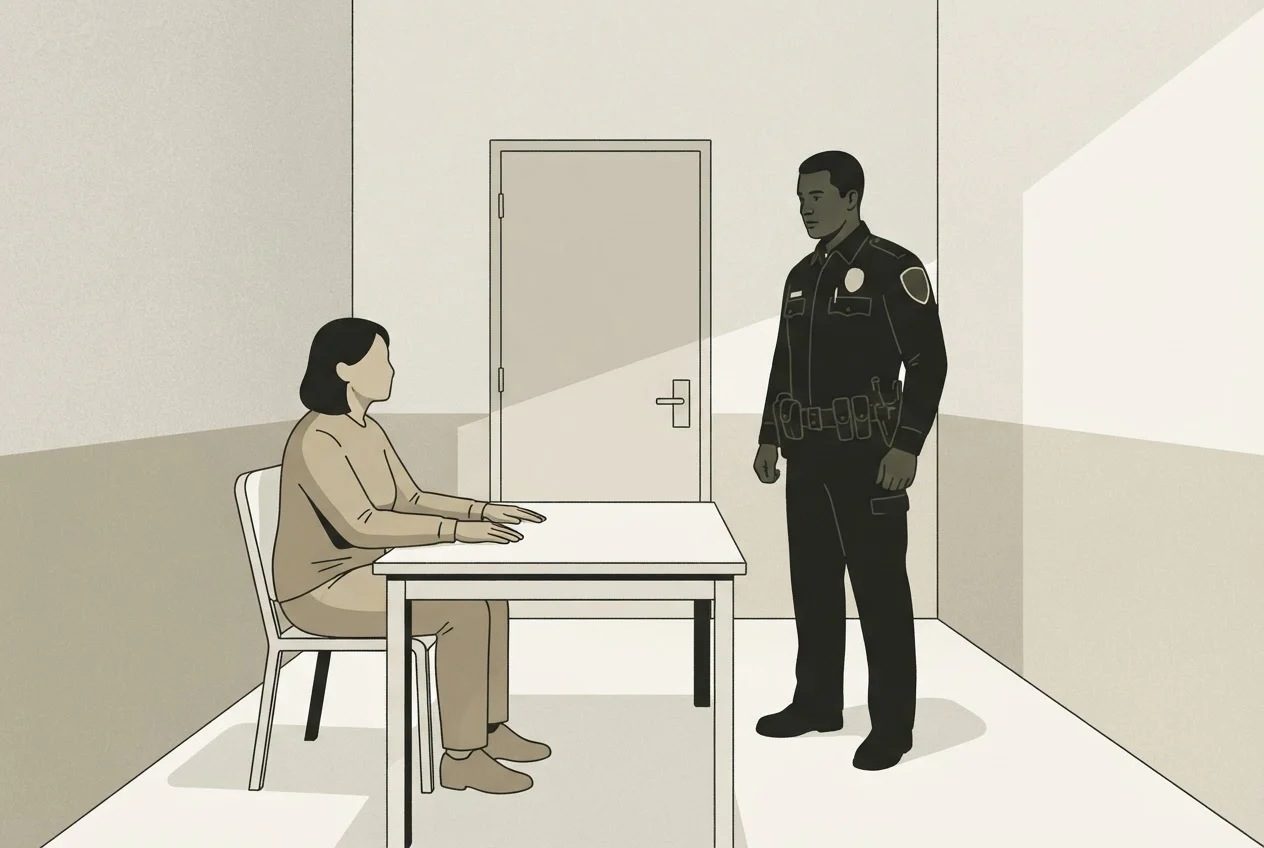
Which rules apply to which conversation?
The rule that applies depends on who is asking and whether the person is in custody. The table below sets out seven common situations, as of October 2026.
| Who is asking | Miranda warnings required? | What applies |
|---|---|---|
| Police, person is free to leave | No. Custody is missing. | Anyone in this position can ask whether they are free to leave, and can speak to a lawyer before answering. |
| Police, person is detained or arrested | Yes, before interrogation. | This is an interrogation in the legal sense. |
| Private investigator acting alone | No. Miranda addresses governmental coercion. | Keep the conversation voluntary. A private investigator has no authority to detain or compel testimony. |
| Security officer who is purely private staff | No. | Security officers may have limited detention powers under state merchant-detention or arrest statutes. State law limits how and how long they may hold someone. |
| Deputized or commissioned security officer, or off-duty police working security | Yes, if the person is in custody and being interrogated. | These officers are government actors. |
| Private investigator or security officer questioning at police request | May be, if the person is in custody. | Stop and consult counsel first. |
| Company lawyer interviewing employees in an internal investigation | Not a Miranda setting. | An Upjohn warning (a notice that the lawyer represents the company, not the employee, and that the privilege belongs to the company) applies instead (Upjohn Co. v. United States, 1981). |
The private investigator row rests on Colorado v. Connelly (1986): "The sole concern of the Fifth Amendment, on which Miranda was based, is governmental coercion" (Cornell LII).
Courts can treat a private person as a government agent when police direct or encourage the questioning. If the person is then in custody, warnings may be required and the statement can be challenged. Treat any police request to question a particular person as a stop point and consult counsel first.
What does this mean for a private investigator or security officer?
A private investigator's questioning is voluntary, because a private investigator cannot detain anyone or compel testimony (Working PI Magazine, September 16, 2026). The practical consequence is that the person you are questioning can walk away, say nothing, or call a lawyer, and nothing you do should suggest otherwise.
Two points follow from that, and both are our recommendations.
First, do not use the absence of Miranda warnings as permission to pressure someone. Miranda concerns the state, but your state's licensing rules govern how you may identify yourself and what you may imply. Read them before you rely on any of this. Our guide to what a private investigator license does and does not cover is the place to start.
Second, a polite, open interview is also the better tool. The next section explains why.

Why does the style of questioning matter more than the label?
The style matters because accusatorial questioning produces more false confessions, while information-gathering questioning produces more true ones. The Campbell review of 29 laboratory studies found that "information-gathering approaches produce more true confessions than both accusatorial and direct questioning," and that accusatorial approaches "produce more false confessions" than the other two (Campbell Collaboration, October 10, 2024).
Laboratory studies use mock suspects, so they show which approach works under controlled conditions. They do not show what happens in every real case. The cost of unreliable statements shows up in exoneration data. As of July 29, 2020, the Innocence Project counted false confessions or admissions in 29% of 375 DNA exonerations (Innocence Project). Our inference: these cases show why unreliable statements are costly, not that accusatorial questioning caused them.
Our recommendation follows from both: begin with open questions, let the person give a full account, and move to specific or challenging questions only when you can put a document, a date or a recording in front of them. Challenging an account is legitimate. Building the conclusion into the question is where a statement stops being reliable.
What should you check before any interview?
Before any interview, confirm six things: you identified yourself and said you are not law enforcement, the person may leave, you claimed no government authority, no officer directed you, you checked your state's recording law, and you will write notes the same day. Each has a pass and a fail.
Did you identify yourself?
Pass: you stated your name, your role and who you work for, and said you are not law enforcement. Fail: any of those was left out or blurred.
Can the person leave?
Pass: you said they may leave, the exit is unblocked, and you hold none of their belongings. Fail: any of those is untrue. This test is for voluntary interviews; a security officer holding someone under a state detention statute is in a different position, set out in the table above.
Did you claim any government authority?
Pass: nothing you wore, carried or said suggested government authority. Fail: anything did.
Did police direct the interview?
Pass: no officer asked you to question this person. Fail: one did, so stop and get legal advice.
Is recording lawful in your state?
Pass: you checked your state's recording rule before pressing record, and you can point to the rule. Fail: you assumed.
Will your notes be written the same day?
Pass: notes written up the same day and any document or recording logged. Fail: anything left in your head or an unlabeled file. See how to write investigation reports that hold up and chain of custody for investigators.
A short opening statement covers the first three tests: "I'm [name], a licensed investigator working for [client]. I'm not law enforcement. You don't have to speak with me, you can stop at any time, and you can have anyone present you wish." Say it before the first question, then write down that you said it.
How do we teach interviewing and interrogation?
We teach it as two separate skills in self-paced online courses with a certificate of completion. As of October 2026, each course costs $80 (US dollars).
Our Interrogation course runs 4 hours, with 26 lessons and a final exam. It covers interrogating versus interviewing, suspect preparation and evaluation, direct and indirect questioning, nonverbal communication, documentation methods, statement recording and polygraph testing. Our Interviewing-Private Investigators course runs 4 hours, with 34 lessons and 4 assessments. It compares interviews with interrogations, and covers handling uncooperative subjects, obtaining factual information, and working with victims and witnesses.
A certificate of completion is not a license. What counts toward a license or renewal is set by your state board. The Interrogation course page lists approvals in Georgia, South Carolina, North Carolina, Oklahoma, Kansas, Iowa, Oregon, Kentucky, Minnesota, Tennessee, New Mexico and Texas. Confirm with your board before you enroll.
If you want to talk through which course fits your role, call (832) 922-1215 or (706) 268-2221.
Train in interviewing and interrogation online
Frequently asked questions
It turns when the person is no longer free to leave and the police are trying to get an incriminating answer. Tone, length and location do not decide it. Custody plus police questioning does, under Miranda v. Arizona.
Sources
- 1.Miranda v. Arizona, 384 U.S. 436 (1966), Cornell LII
- 2.Rhode Island v. Innis, 446 U.S. 291 (1980), Cornell LII
- 3.Colorado v. Connelly, 479 U.S. 157 (1986), Cornell LII
- 4.Massiah v. United States, 377 U.S. 201 (1964), Cornell LII
- 5.Upjohn Co. v. United States, 449 U.S. 383 (1981), Cornell LII
- 6.Interview and interrogation methods and their effects on true and false confessions: a systematic review update and extension, Campbell Collaboration (October 10, 2024)
- 7.DNA Exonerations in the United States, Innocence Project
- 8.Interview and Interrogation Techniques for Private Investigators, Working PI Magazine (September 16, 2026)