Can a Private Investigator Use a Drone for Surveillance?
Yes, a private investigator can use a drone for surveillance with a federal Part 107 remote pilot certificate and lawful recording under state privacy law. An investigator license replaces neither.
By Sharon DeCet, Founder · Updated 10 Nov 2026
Key takeaways
- An investigator needs two things to fly a camera drone on a case: a federal Part 107 remote pilot certificate, and a lawful basis under state law to record what the camera sees.
- In the four state statutes reviewed (Texas, Florida, Idaho, Oregon), the route to lawful footage runs through the property owner's written consent or a listed use, not through an investigator license.
- Run the six checks below before every flight, and log each flight so the footage can be tied to it.
In this article
- 1Is drone surveillance legal for a private investigator?
- 2What does a Part 107 certificate allow, and what does it cost?
- 3What do state drone privacy laws add that the certificate does not?
- 4Does a private investigator license authorize drone recording?
- 5What six checks should an investigator run before a drone flight?
- 6How does our training fit an investigator who wants to use drones?
- 7Frequently asked questions
A Part 107 certificate answers whether an investigator may fly a drone. It does not answer whether the investigator may record what the camera sees. The first has a test, a fee and a written rule. State law answers that second question, and the two answers can come out differently.
The gap matters more to an investigator than to a hobbyist. A drone clears the fence that blocks the street view, and a camera that clears the fence records exactly what several state statutes protect. The footage is the work product, so the legality of the recording is the legality of the job.
This page is for working and aspiring investigators and security professionals. The state statutes covered below turn on the property owner's consent, not on the investigator's license, and the federal certificate has its own costs and limits. Homeowners worried about a drone over their yard will find their answer in the FAQ.
Is drone surveillance legal for a private investigator?
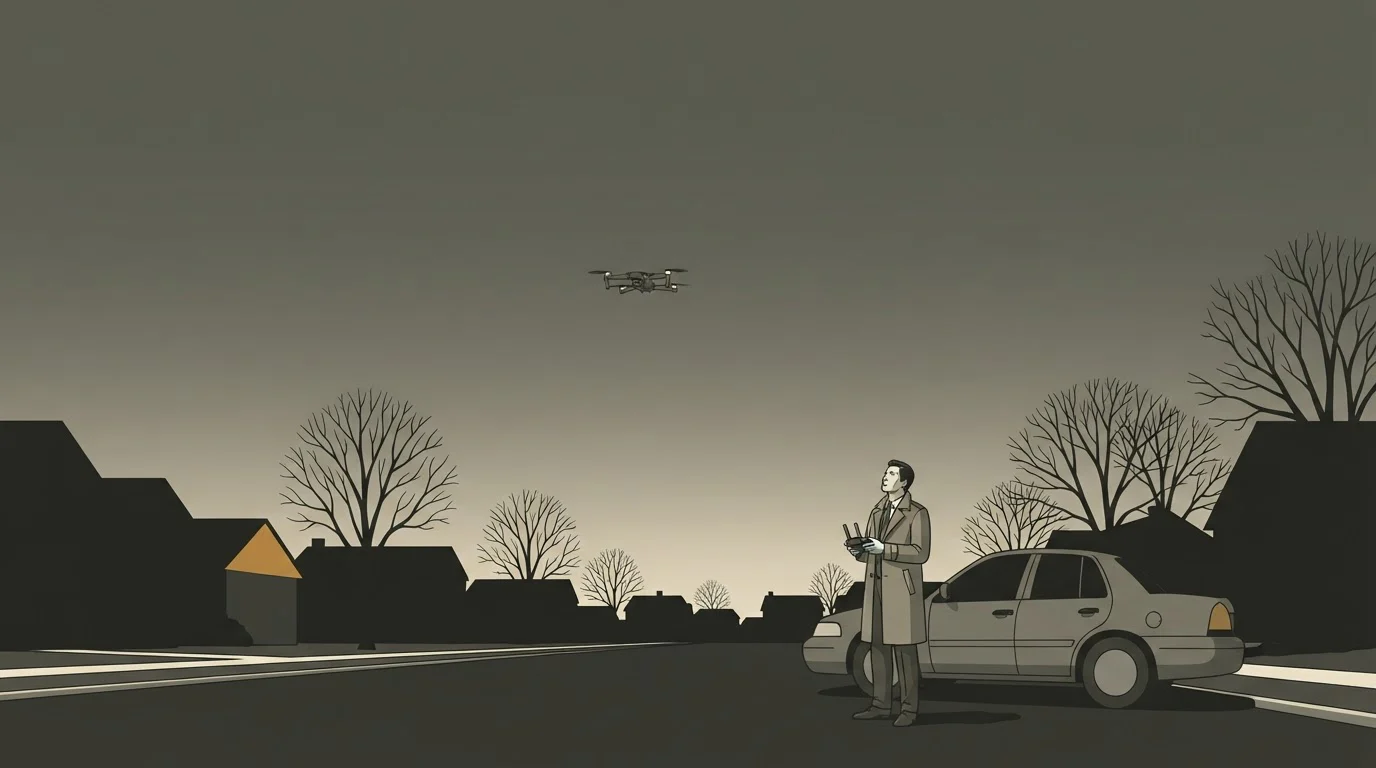
A private investigator may use a drone only if two separate tests pass. The first is federal: the person at the controls holds a remote pilot certificate under Part 107, the Federal Aviation Administration's (FAA) rule for small drones flown for anything other than recreation. The second is state law: the recording itself must be lawful where you are flying. Passing the first never satisfies the second.
Under Title 14 of the Code of Federal Regulations (14 CFR) § 107.12, no person may manipulate the flight controls of a small unmanned aircraft system unless they hold a remote pilot certificate or are under the direct supervision of a certificate holder who can immediately take control. The rule applies to a person, not to a profession. An investigator license does not appear in it.
The state test is where cases go wrong. For the broader picture of surveillance methods and the law behind each, see our guide to types of surveillance investigators use. The rest of this page covers the drone.
What does a Part 107 certificate allow, and what does it cost?
A Part 107 certificate allows you to fly commercially within set physical limits. The FAA's Aeronautical Information Manual requires it for any operation that is not recreational, and applicants must be at least 16 and able to speak and understand English.
The flight limits sit in Part 107 itself:
- The pilot, and any visual observer, must be able to see the aircraft throughout the flight (§ 107.31).
- Altitude is capped at 400 feet above ground level (§ 107.51).
- Night flight requires anti-collision lighting visible for at least 3 statute miles (§ 107.29).
- Flight over people is restricted unless an exception applies (§ 107.39).
Two of these limits matter for surveillance. Our inference: the line-of-sight rule keeps the aircraft near the pilot, so it is close and audible. The lighting rule means a night flight is a lit aircraft, which is not covert.
Remote ID and renewal. Since March 2024, drones that require registration must broadcast Remote ID (14 CFR Part 89), which includes the drone's location, to anyone nearby (FAA). Our inference: that is a second reason a drone flight is not covert. The pilot must also complete FAA recurrent training every 24 calendar months (FAA).
Cost. As of November 2026, the knowledge test costs $175 per attempt, and a retake is possible after a 14-day wait (FAA, Become a Drone Pilot). Registering each drone adds $5 for 3 years (FAA, drone registration). Our model: one pilot and one drone is $175 + $5 = $180 in fees, and each further test attempt adds $175.
Equipment. On December 22, 2025, the Federal Communications Commission (FCC) added foreign-made drones and critical components to its Covered List, which stops new models from receiving equipment authorization. The FCC stated that the decision does not affect drones already purchased or models previously authorized. Check a model's authorization status before you buy.
What do state drone privacy laws add that the certificate does not?
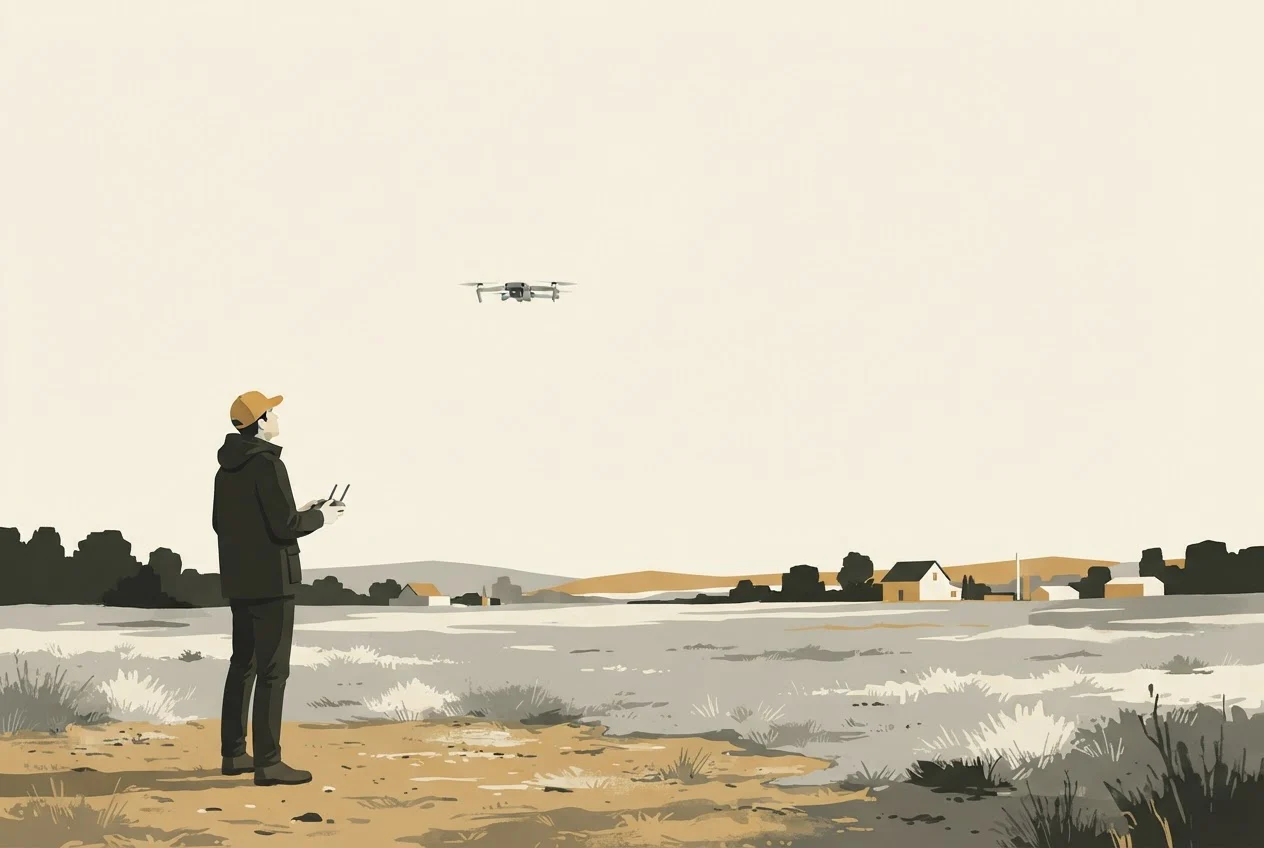
State statutes decide whether the footage is lawful, and they are written around the property owner's consent. None of the four statutes turns on holding an investigator license. Florida, Idaho, Oregon and Texas are the states covered here; the table shows each statute's text as of November 2026.
| State | What it bars | What makes it lawful | Remedy |
|---|---|---|---|
| A drone with an imaging device recording privately owned property or its occupants where privacy is expected. Privacy is presumed if the person cannot be observed from ground level by those with a legal right to be there. | Written consent. Listed exceptions include property appraisers, utilities, communications providers, aerial mapping and cargo delivery. | Civil action for compensatory damages, punitive damages, injunction and attorney fees. | |
| Surveillance or recording of an individual or their dwelling, farm, ranch or commercial property. | Written consent. | The greater of $1,000 or actual and general damages, plus fees. | |
| Flying over land after an earlier flight and notice that flights are unwanted. | The section excludes commercial flights in compliance with authorization granted by the FAA. | Treble damages for trespass, an injunction, and attorney fees where the claim is $10,000 or less. Other privacy claims remain available (ORS 30.831). | |
| Using a drone to capture an image of a person or private property with intent to conduct surveillance, outside the lawful uses in § 423.002. | Listed uses include owner consent, warrants, law enforcement work, licensed surveyors and engineers, and utility inspection. | Class C misdemeanor under § 423.003; civil remedies in § 423.006. |
In Oregon, our reading is that a commercial flight under Part 107 qualifies for the exclusion; confirm with counsel. In Florida, Idaho and Texas, the certificate gives no cover.
What six checks should an investigator run before a drone flight?
Run these six checks in order before every flight. Any fail means the drone stays on the ground.
- Is the person at the controls certificated or directly supervised?Pass: the pilot holds a current remote pilot certificate, with recurrent training completed every 24 calendar months, or is under the direct supervision of a certificate holder who can immediately take control; the drone is registered and broadcasts Remote ID. Fail: the person at the controls has no certificate and no certificated pilot directly supervising.
- Is the flight inside the physical limits?Pass: the aircraft stays in visual line of sight, under 400 feet, with anti-collision lighting if flown at night. Fail: the plan needs the aircraft farther away than the pilot can see.
- What will the camera capture?Pass: you have consent, or a statutory exception in your state covers the job, and the camera is not targeting a person or private property in a state (Idaho, Texas, Florida) that bars targeted drone surveillance without consent. Fail: the camera targets a person or private property in one of those states with no consent and no exception covering the job.
- Does your state statute name your work?Pass: you have read your state's drone statute and can point to the exception that covers the job, or you hold written consent. Fail: your authority is the investigator license.
- Can the footage be tied to the flight?
Pass: each flight has a log entry and the files can be traced to it, as in our guide to what to log for chain of custody. Fail: footage whose flight, time or location you cannot document.
- Is the client's purpose written down before the flight?
Pass: the client's purpose is recorded in a signed engagement letter before the flight and names a lawful investigative objective. Fail: no written purpose. Our guide to investigator ethics covers the requests to refuse.
How does our training fit an investigator who wants to use drones?
Our Surveillance course covers surveillance fundamentals, techniques and specialized methods including aerial surveillance, which is the part of the work that touches drones. It does not replace the FAA test, which you book and pass separately. As of November 2026, it costs $80.
Surveillance (course 123) is self-paced, runs 4 hours, and has rolling access. It has 32 lessons across 6 chapters and a final exam. It covers photographic and electronic approaches, target identification and professional techniques, and Chapter 3, on specialized methods, includes aerial surveillance content. You receive a certificate of completion on passing. The course page lists approvals in Georgia, South Carolina, Oklahoma, Kansas, Iowa, Oregon, Kentucky, Minnesota, North Carolina, Tennessee, New Mexico, Arizona and Texas, and lists 4 continuing education units for the states named; confirm with your own licensing board.
If your concern is the rules of evidence, Legal Aspects of Private Investigation (course 115) costs $120 as of November 2026. It covers criminal law, defenses, types of evidence, hearsay, the exclusionary rule and rules of evidence. For how a license sets the boundaries of the work, read what a private investigator license does and doesn't cover.
Add aerial surveillance to your investigator training
Frequently asked questions
Sources
- 1.14 CFR Part 107, small unmanned aircraft systems (CFR 2024 edition), U.S. Government Publishing Office
- 2.FAA, Become a Drone Pilot (knowledge test fee and retake wait)
- 3.FAA, Register Your Drone (registration fee)
- 4.FAA, Remote ID
- 5.FAA, Recurrent Training Courses for Drone Pilots Available Online
- 6.FAA Aeronautical Information Manual, Chapter 11, Section 5: UAS Pilot Testing, Certification and Responsibilities
- 7.Florida Statutes § 934.50, Florida Legislature
- 8.Idaho Code § 21-213, Idaho Legislature
- 9.Oregon Revised Statutes 837.380, Oregon Legislature
- 10.Texas Government Code § 423.002, Texas Legislature
- 11.Texas Government Code § 423.003, Texas Legislature
- 12.Texas Government Code § 423.006, Texas Legislature
- 13.FCC fact sheet: FCC updates Covered List to add certain UAS and UAS components, December 22, 2025, Federal Communications Commission
- 14.Surveillance (course 123), Learningshopusa
- 15.Legal Aspects of Private Investigation (course 115), Learningshopusa