How to Start a Process Server Business: Do the Per-Serve Math
To start a process server business, price your routine serve from local competitors, subtract mileage and repeat attempts, and train before taking work. Margin per serve decides whether the business pays.
By Sharon DeCet, Founder · Updated 31 Oct 2026

Key takeaways
- A process server business pays when the fee for a serve covers the miles and repeat attempts behind it. Work that out for your own counties before you spend on anything else.
- As of October 2026, four providers' own price pages show routine fees from $55 to $125. Check how many attempts each fee includes before comparing them.
- Our recommendation: keep the worst-case mileage for one serve at or below half the fee, and charge for extra attempts separately.
- Finish serving-mechanics training before the first paid serve, and check your state's own requirements first.
In this article
- 1How much should a new process server business charge per serve?
- 2What does a process server business actually keep from each serve?
- 3Why do repeat attempts decide whether process serving pays?
- 4What goes on a process server fee sheet?
- 5What do you need to buy and register before your first client?
- 6Which process server training should you finish before taking work?
- 7How do you win your first process server clients?
- 8What must be true before you accept your first serve?
- 9Start with the serving skill
- 10Frequently asked questions
Four process serving firms publish routine fees of $125, $75 to $95, $55 to $75 and $60 to $85. Those are the prices a new server competes against. What a server keeps from each depends on costs a fee sheet does not show.
Three of the four include up to three delivery attempts in the base fee (All Pro's page does not state how many attempts its fee covers). At a $75 fee, three 20-mile attempts use $45.60 in mileage alone at the IRS business mileage rate. That is 61% of the fee.
The first decision in a process server business is the fee sheet, because your service area, your clients and your hours all follow from what one serve nets you.
Below are the fees, a worksheet and break-even table to run the math, a short training route, and a launch checklist where every item can be passed or failed.
How much should a new process server business charge per serve?
Charge what local competitors charge for a routine serve, then price extra attempts, rush work and distance separately. A serve is one delivery of court papers to a named person, with proof filed afterward. As of October 2026, four providers' own price pages show routine fees from $55 to $125.
| Provider and market | Routine fee | What the fee covers or adds |
|---|---|---|
Famous Legal Services, Los Angeles area | $125 (rush $175, same day $225) | Up to 3 attempts included; page states no hidden fees |
Reliant, Atlanta | $75 to $95 base | Up to 3 attempts included; $65 for a non-serve attempt report |
All Pro Legal Services, Salt Lake City | $55 to $75 | $2 a mile in its extended areas; $50 an hour wait time |
Just Legal Solutions, Oklahoma | $60 to $85 standard, up to 3 attempts included | $35 for a single-attempt service; $25 for each attempt beyond three |
The ranges cannot be compared until you read the last column. Famous, Reliant and Just Legal bundle three attempts into one fee, and Just Legal charges $25 for each one beyond three. A national average tells you little. The price pages for your own counties tell you more.
What does a process server business actually keep from each serve?
A serve nets the fee minus the mileage for every attempt, before insurance, software and your time. Here is the worksheet, which is our model rather than an official figure. Fill it in for each fee on your sheet.
- Write the routine fee you plan to charge.
- Write the attempts that fee covers.
- Estimate round-trip miles for one attempt in your core area.
- Mileage cost = miles × attempts × the IRS business rate. As of 31 October 2026 the IRS business rate is 76 cents a mile through 31 December 2026; the 2027 rate will replace it. It was 72.5 cents for January 1 to June 30, 2026, per the IRS.
- Margin before other costs = fee minus mileage cost.
- Break-even miles = fee ÷ the rate. This is the total mileage at which driving alone uses the whole fee.
Break-even miles at the 2026 second-half rate (76 cents a mile), rounded down to whole miles:
| Routine fee | Break-even miles |
|---|---|
| $55 | 72 |
| $60 | 78 |
| $75 | 98 |
| $95 | 125 |
| $125 | 164 |
The IRS figure is the rate you may deduct for business driving, not a measure of your own vehicle costs. Use it to plan, then replace it with your tracked cost per mile once you have a few weeks of data. Re-run the break-even column when the 2027 rate is published.
Why do repeat attempts decide whether process serving pays?
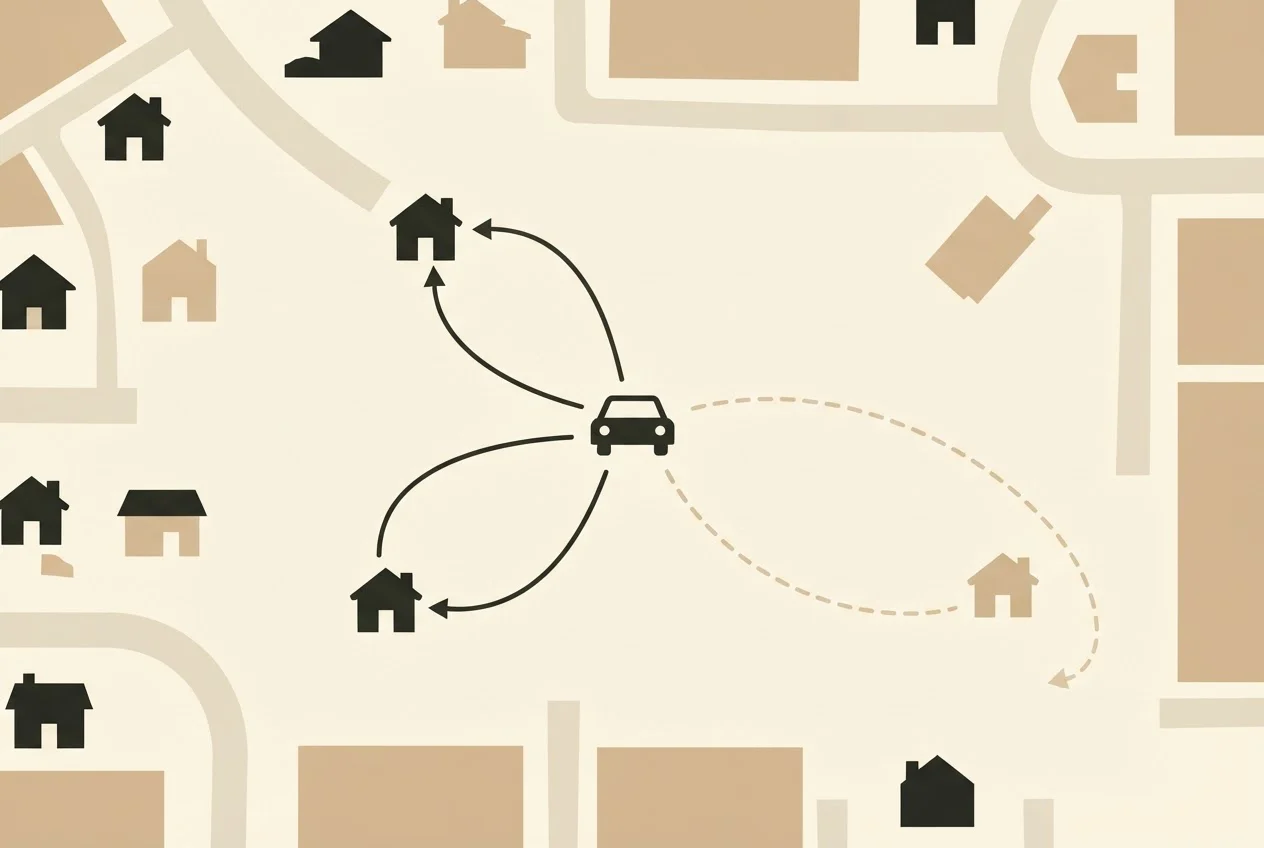
Repeat attempts decide it because each failed trip is unpaid driving when the fee covers several attempts. Take a $75 fee and a 20-mile round trip. One attempt costs $15.20 in mileage (20 × $0.76), leaving $59.80. Three attempts cost $45.60 (60 × $0.76), leaving $29.40. Mileage is then 61% of the fee.
Our recommendation is a rule of thumb, not a published standard: keep worst-case mileage at or below half the fee. At $75, half is $37.50, which is about 49 miles at the 2026 second-half rate. Three attempts must then average about 16 miles or less each (49 ÷ 3 = 16.4).
If your area cannot meet that, change the fee structure rather than hoping for easy serves. Offer a single-attempt price and a bundled three-attempt price, as Just Legal does ($35 for one attempt, $60 to $85 for up to three), and charge for attempts beyond the bundle, as Just Legal does at $25 each. Or add a per-mile charge outside a core zone, as All Pro does at $2 a mile. Or concentrate on a tight service area where routes stack.
What goes on a process server fee sheet?
A fee sheet lists every charge a client can face before the first attempt, so nothing is argued afterward. Build yours from the lines the published price pages use, and set each amount from your own worksheet.
- Routine serve, by type of person served. Reliant, for example, prices a substitute serve at a residence at $75 and a personal serve at $90.
- Attempts included in the routine fee.
- Each additional attempt.
- Rush and same-day serve.
- Non-serve attempt report, for when the person is not found.
- Additional person at the same address. All Pro charges $20 per person; Reliant charges $50.
- Wait time, per hour.
- Distance outside your core zone, per mile.
- Volume discount. Just Legal offers 5% for 10 to 25 serves a month, 10% for 26 to 50, and 15% for more than 50.
What do you need to buy and register before your first client?
Before your first client you need a dependable vehicle, a phone, insurance, and whatever your state or county requires to serve court papers. Requirements for registration, certification and bonds (a surety bond is a financial guarantee some states require) vary by state, so price them from your own court or sheriff's page. We set out the state routes in Your State Sets the Path to Becoming a Process Server.
On insurance, ask each insurer in writing whether the policy covers driving to serve papers and a claim that you served someone incorrectly. Do not assume your personal auto policy does either.

Which process server training should you finish before taking work?
Finish training in the mechanics of serving before the first paid serve, because a defective serve costs the client time and can cost you the account. Our Key Concepts in Civil Process course costs $80 as of October 2026. It is self-paced and takes 4 hours, with 33 lessons across 4 chapters and a final exam. You receive a certificate of completion after passing all assessments.
It covers who may serve process, service methods, document types, court orders, return of service (the record of how and when papers were served), depositions, discovery, criminal subpoenas and due diligence (the documented effort to find the person). The course page states it is approved by the Certification and Licensing Division of the Arizona Supreme Court. Whether any course counts toward your own state's requirement is set by your state. To compare options, see Which Online Process Server Certification Course Fits Working Adults? Turn off any VPN (virtual private network) before watching the course videos.
How do you win your first process server clients?
Win your first clients by sending a one-page fee sheet to paralegals and litigation staff at law offices that file civil cases in your counties, then proving reliability on small jobs. This is our recommendation.
- State your attempts policy and your turnaround in the first line.
- Offer a volume tier once a firm sends regular work.
- Complete one trial serve with a clean affidavit, the sworn statement that papers were delivered. See Affidavit of Service: What to Check Before You Sign.
- Chase a few steady accounts rather than many one-off jobs, because steady work makes routes dense.
What must be true before you accept your first serve?
Run these tests in order. Each has a pass and a fail.
- Competitor fees.Pass: you hold three price pages for the counties you will serve, each with the attempts it includes. Fail: you used a national average.
- Break-even miles.Pass: you calculated fee ÷ rate for every fee on your sheet. Fail: any fee has no figure.
- Half-the-fee rule.Pass: attempts × round-trip miles × rate is at most half the fee. Fail: it is more, as in the 61% example.
- Extra-attempt charge.Pass: a dollar amount is written on the fee sheet. Fail: it says "negotiable."
- State and county requirements.Pass: you can name the document your court or sheriff requires, or confirm in writing that none is needed. Fail: you assumed.
- Insurance.Pass: the insurer answered in writing on business driving and service errors. Fail: you have only a verbal answer.
- Training.Pass: you finished the course and can explain each service method you will use. Fail: you cannot.
- Trial serve.Pass: the affidavit shows date, time, address and who received the papers. Fail: any field is missing.
Start with the serving skill
We train the serving itself, self-paced, with a certificate of completion after you pass the assessments. Start with our courses, or call (832) 922-1215 or (706) 268-2221, Monday to Friday, 9:00 AM to 6:00 PM EST.
Learn the serving skill before your first paid serve
Frequently asked questions
Sources
- 1.IRS, Standard mileage rates (2026 business rates)
- 2.Famous Legal Services, process server pricing (accessed October 2026)
- 3.Reliant, Atlanta process server pricing (accessed October 2026)
- 4.All Pro Legal Services, Utah pricing (June 2026)
- 5.Just Legal Solutions, Oklahoma pricing (accessed October 2026)
- 6.Learningshopusa, Key Concepts in Civil Process course page