Your State Sets the Path to Becoming a Process Server
The first decision is jurisdiction. State and court rules determine whether you need certification, registration, appointment, or only baseline eligibility before you serve.
5 chapters · Updated Sep 27, 2026 · By Sharon DeCet
- 12 hours
- Georgia pre-certification training document listed with the application
- 7 hours
- Texas Commission-approved course required before initial application
- $5,000
- Florida statutory surety-bond amount for certified-server applicants
In brief
There is no universal U.S. process-server credential. Your route may involve statewide certification, county or circuit registration, city licensing, court appointment, or eligibility as a non-party adult. Start with the authority for the court and location where you plan to serve, then choose training that matches that route.
Start with the court and location, not a course
A process server delivers court papers, but the authority to do that work comes from the jurisdiction handling the case. There is no single U.S. certificate that authorises service everywhere. Federal civil cases follow Federal Rule 4, which generally permits service by a non-party adult aged 18 or older, while also allowing state-law methods in specified circumstances. The federal rule is therefore a starting point for federal cases, not a nationwide career licence.
For state-court work, identify the state, county or circuit, court type, and document type before spending money on training or business setup. A state may have a statewide certification program, a county registration system, a circuit list, a court-appointment route, or a general eligibility rule. A rule for a summons may also differ from a rule for an order requiring property seizure or arrest.
Takeaway: Choose your jurisdiction first, because the jurisdiction determines whether training is preparation, a formal prerequisite, or neither.
Five requirement patterns explain why generic advice fails
Statewide certification is one route. Arizona requires an applicant for private-process-server certification to pass an examination, apply in the county of residence, and submit an FBI fingerprint card. Texas requires a Commission-approved seven-hour course, online application, and state and national criminal-history checks. Arizona Judicial Branch requirements and Texas JBCC requirements make the difference concrete.
Other places use a narrower authority. California registration applies to compensated individuals making more than 10 services in a calendar year. Florida certification is maintained by judicial circuit and includes annual recertification and reappointment. New York City requires an individual licence for five or more processes in a one-year period. Illinois provides statewide forms to seek approval for an unlicensed special process server, while Arkansas publishes appointment and renewal materials.
A third pattern is general eligibility. Maryland, Michigan, and Minnesota each permit specified civil process by a non-party adult, subject to their rules and exceptions. Those examples show why a national promise of certification would be misleading.
Takeaway: A matrix should name the authority route first, then list the training, documentation, and renewal steps for that exact route.
Georgia turns training into one step of a longer route
Georgia is a detailed example of why a completion certificate is not the same thing as legal authority. The certified-server application materials call for a 12-hour pre-certification-training certificate, fingerprint-based criminal-background proof, certification-exam completion proof, and a commercial surety-bond copy, among other attachments. Georgia's rules also say a certified server must be a U.S. citizen, at least 18, not a party to the case, and free of an interest in its outcome. Georgia's application and certified-server rules set out those elements.
From training to filed return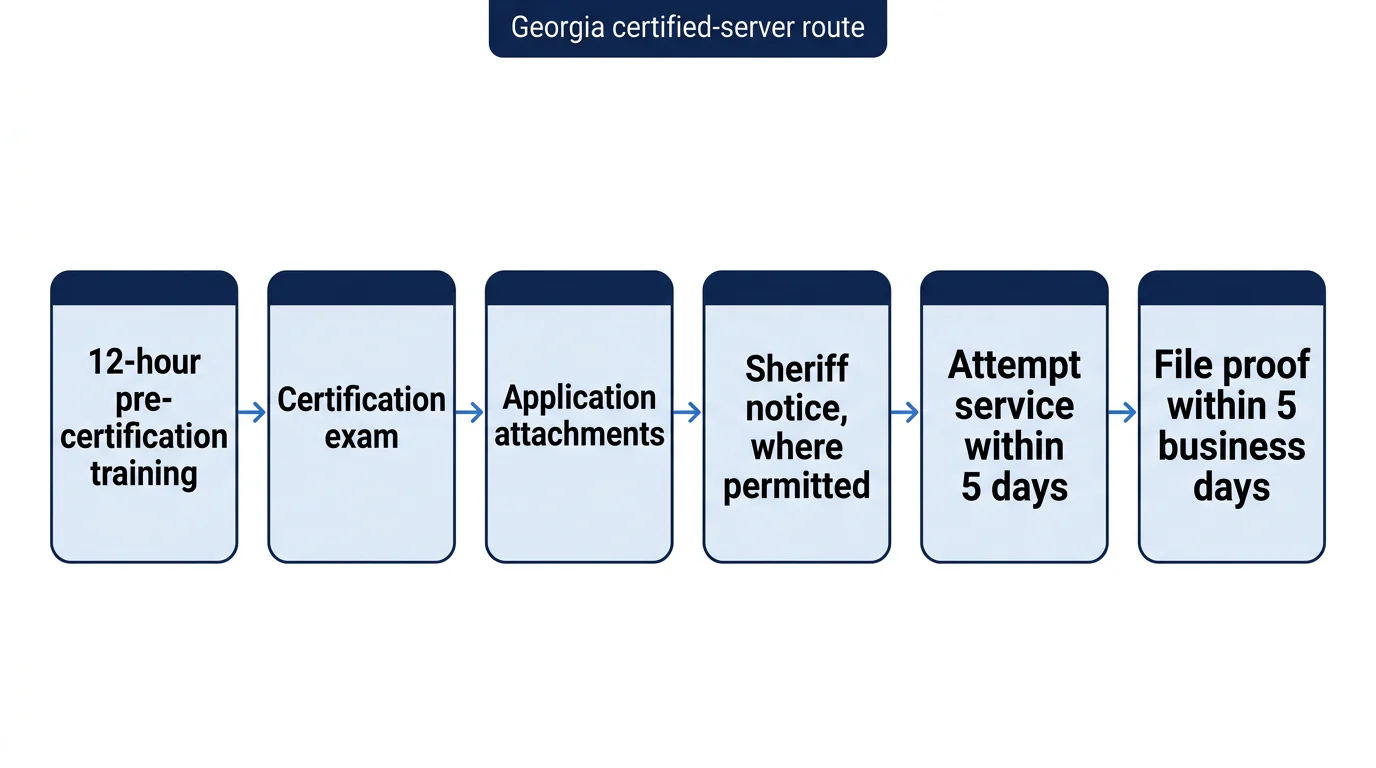
After certification, county practice still matters. Before first serving in a county, a certified server must file notice with the sheriff if that sheriff permits certified servers to serve there. Georgia also requires an attempt within five days of receiving a summons and complaint, filing proof within five business days after service, and five training hours each calendar year after initial certification.
We offer a self-paced Georgia pre-certification course with 12 hours of instruction, 57 lessons, six assessments, and a certificate of completion for $175. It prepares you for the training step, while the examination, application, sheriff process, and any local requirements remain separate.
Takeaway: In Georgia, plan for training, examination, application, local notice where applicable, documented service, and annual training.
Build a service workflow around proof, deadlines, and limits
A reliable process-server workflow starts with the court's rule and ends with valid proof of service. Confirm who may serve, what documents must accompany the summons or process, the permitted method, any local appointment or notice condition, and the return deadline. Keep the case documents, service record, dates, location, method, and proof together so the return can match what actually occurred.
Georgia provides a concrete documentation standard. Its rules require a certified server to file proof within five business days of service, have the proof signed before a notary, and avoid signing it in blank. Alaska likewise requires a non-peace-officer server to make written affidavit proof that states the manner, place, and date of service. Alaska Civil Rule 4 shows that proof requirements can be as important as the initial eligibility rule.
This path is not a shortcut for work involving special court orders, property seizure, arrest, or jurisdictions with appointment, licensing, or certification conditions. Those assignments require the authority stated in the governing rule.
Takeaway: Treat the proof of service as part of the assignment from the first attempt, not as paperwork to reconstruct afterward.
Go deeper
Frequently asked
Not everywhere. Arizona, Georgia, and Texas have statewide certification paths, while California uses county registration for compensated servers over its threshold and Florida uses circuit-based certification. Maryland, Michigan, and Minnesota also show that some civil process may be served by a qualified non-party adult.
Georgia's certified-server route includes qualifying requirements, a 12-hour pre-certification-training certificate, fingerprint-based background-check proof, a certification-exam completion certificate, a surety-bond copy, and an application to the sheriff of the county where you seek registration. County notice may also be required before first service.
Course completion and legal authority are separate steps. Texas requires an approved seven-hour course before application, while Georgia's application materials list training and exam-completion certificates among several required attachments. Check the applicable court or regulator before accepting an assignment.
Georgia rules require a certified server to attempt service within five days after receiving a summons and complaint, make diligent efforts if unsuccessful, and file a notarized proof of service within five business days after service. The rules also require five hours of relevant training each calendar year after initial certification.
Prepare for Georgia's initial certification route
Our self-paced Georgia pre-certification course covers 12 hours of instruction before the separate certification steps.
Explore Georgia training