7 companies compared
How to Become a Process Server in Texas: Steps and Costs
To become a process server in Texas, complete a 7-hour approved course, apply online, complete fingerprinting, show work authorization, and pay the $200 fee.
By Sharon DeCet, Founder · Updated 7 Nov 2026
On this page
- 01The shortlist
- 02How we ranked them
- 03The companies in detail
- 04How to choose
- 05Key takeaways
- 06How do you become a process server in Texas?
- 07Do you need to be a certified process server to serve papers in Texas?
- 08What does it cost to become a certified process server in Texas?
- 09Will the proposed Texas process server exam change these steps?
- 10How do you stay certified once you have the card?
- 11Method and sources
- 12Frequently asked
The short answer
Texas certifies process servers through the JBCC after an approved 7-hour course, an online application, proof of work authorization, fingerprinting and a $200 fee. The course certificate counts only if you apply within one year. Using six providers' own course prices, the first-year total is $315 to $390.
The shortlist
- 1Learning Shop USAOur companyFor renewal-ready Texas training
- 2Texas Process Servers AcademyFor the lowest first-year total
- 3SLDP.netFor starting whenever you want
- 4Quinn EducationFor live regional classes
- 5Codex Educational & Legal ServicesFor self-paced study with retakes
- 6Texas School of Legal SupportFor a live Zoom class
- 7Texas Process Servers AssociationFor a single-day live webinar
How we ranked them
- Approved by the JBCC as an orientation course provider
- Course price published on the provider's own page
- Format and schedule stated by the provider
- Course meets the 7-hour Texas orientation requirement
The companies in detail
Learning Shop USA
Online approved provider with an $85 renewal course
- Format
- Online
- Course price
- On request: 832-922-1215
- First-year total
- Course price plus $240
- Notes
- Also offers the $85 CE course for renewal
Learning Shop USA is an approved online provider, and it also offers the continuing education course you will need to renew. The orientation course price is quoted on request at 832-922-1215.
Strengths
- Approved online orientation course provider
- Offers the $85, 8-hour continuing education course for renewal
- Renewal course is self-paced, with 81 lessons and 13 assessments
Texas Process Servers Academy
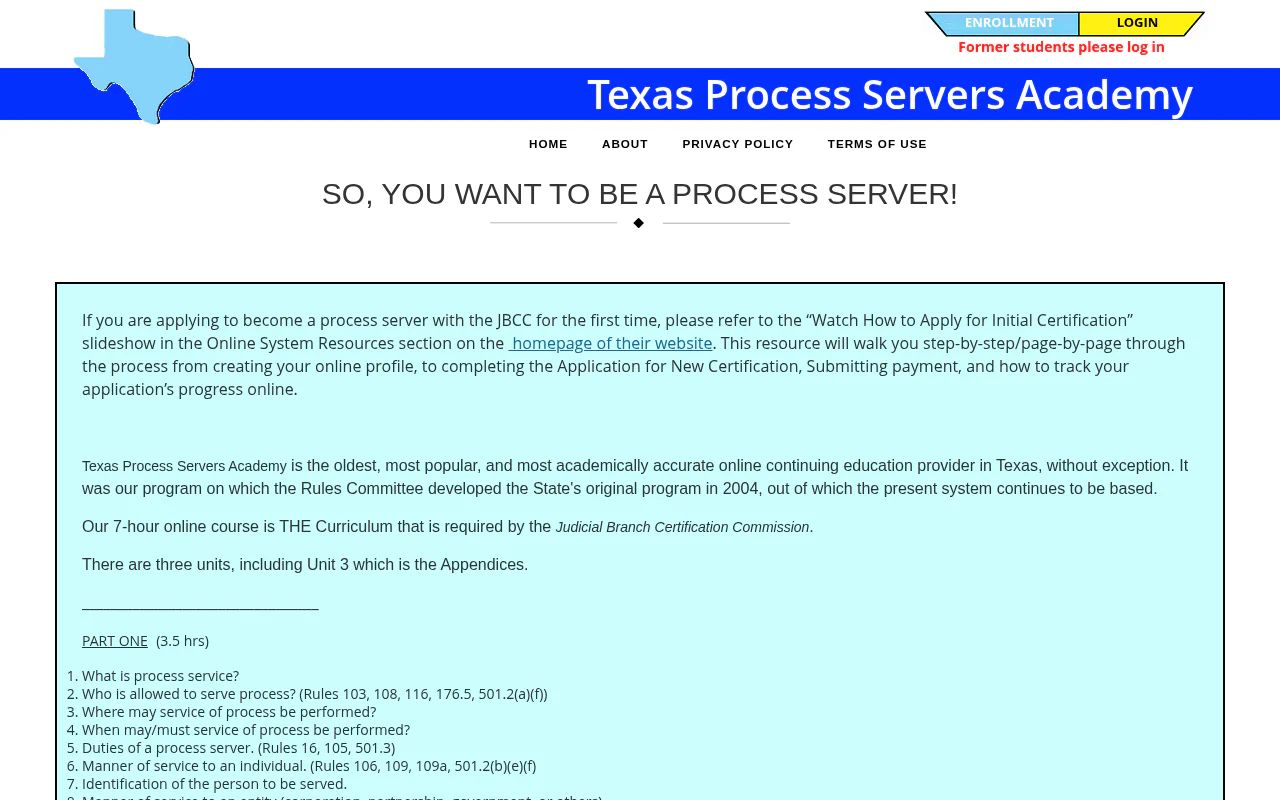
Online orientation course at $75
- Format
- Online
- Course price
- $75
- First-year total
- $315
- Notes
- Finish within 90 days
Texas Process Servers Academy has the lowest course price in this comparison, giving a first-year total of $315 in our model. The course must be finished within 90 days.
Strengths
- $75 course price is the lowest
- First-year total of $315 in our model
- Online format
Limitations
- Course must be finished within 90 days, so a slow pace risks running out of time
- Online only, with no live class option
SLDP.net
Online-only course you can start any day
- Format
- Online only
- Course price
- $89.99
- First-year total
- $330
- Notes
- Finish within 90 days; 7+ hours logged in
SLDP.net is an online-only course at $89.99 that you can start whenever you want. It must be finished within 90 days, with 7 or more hours of logged-in time.
Strengths
- Start whenever you want
- $89.99 course price
- First-year total of $330 in our model
Limitations
- Must be finished within 90 days, so the window is fixed
- Requires 7 or more hours of logged-in time
Quinn Education
Live quarterly classes in four Texas regions, or online

- Format
- Live quarterly classes or online
- Course price
- $125
- First-year total
- $365
- Notes
- $40 background check fee
Quinn Education offers live classes in four Texas regions as well as an online option, at $125. Its $40 background check fee is the basis for our fingerprinting allowance.
Strengths
- Live classes in four Texas regions
- Online option also offered
- $40 background check fee
Limitations
- Live classes run quarterly, so you may wait for a date
- Runs an 8-hour class while the JBCC course requirement is 7 hours
Codex Educational & Legal Services
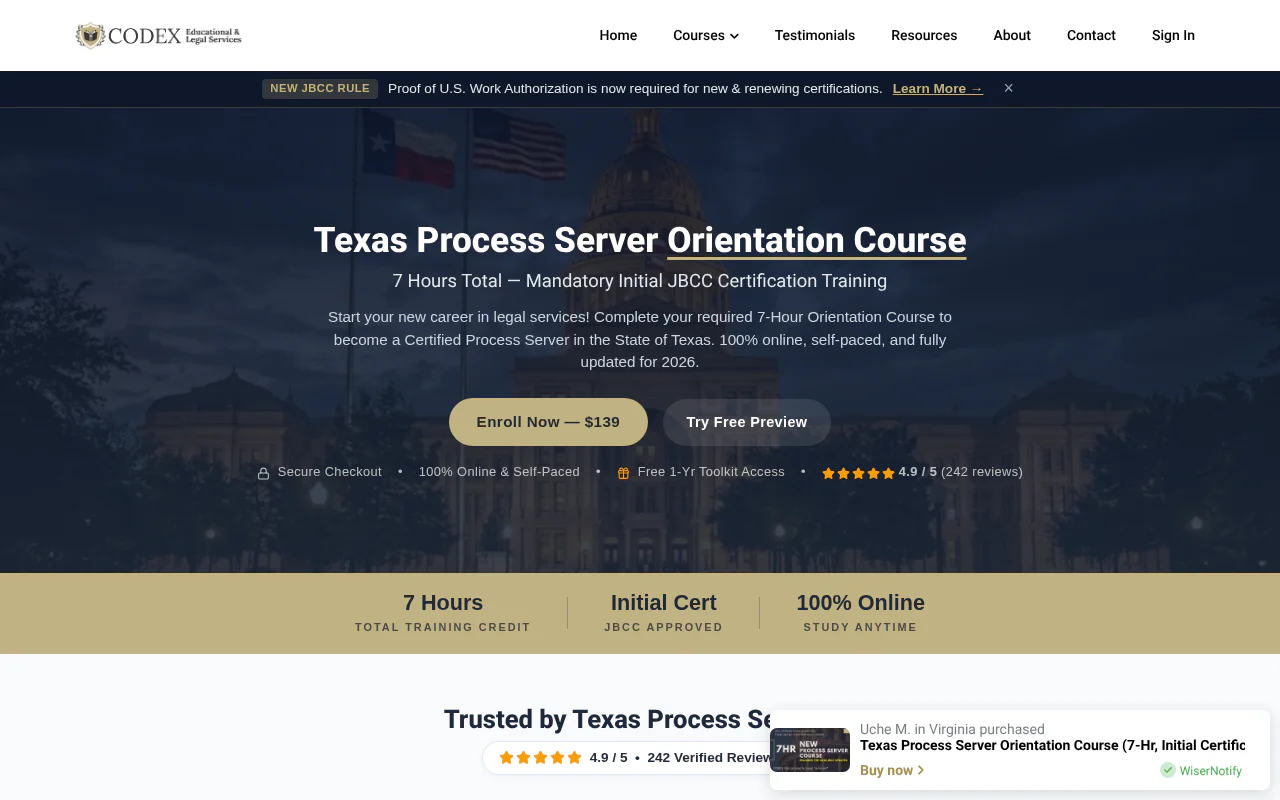
100% online, self-paced course with unlimited retakes
- Format
- 100% online, self-paced
- Course price
- $139
- First-year total
- $379
- Notes
- Unlimited exam retakes
Codex is a fully online, self-paced course at $139. It allows unlimited exam retakes with a 60-minute review between attempts.
Strengths
- 100% online and self-paced
- Unlimited exam retakes
- 60-minute review between attempts
Limitations
- At $139 it costs more than the $75 and $89.99 online options
- No live class option
Texas School of Legal Support
Live Zoom certification orientation
- Format
- Live on Zoom, 9am to 5pm Central
- Course price
- $149.95
- First-year total
- $390
- Notes
- Can reschedule to a later class date
Texas School of Legal Support runs a live Zoom class from 9am to 5pm Central at $149.95. Payments are non-refundable, but you can reschedule to a later class date.
Strengths
- Live instructor-led Zoom class
- Can reschedule to a later class date
- First-year total of $390 in our model
Limitations
- Payments are non-refundable
- Fixed class day, and it runs an 8-hour class while the JBCC requirement is 7 hours
Texas Process Servers Association
Single-day, instructor-led live online webinar
- Format
- Live online webinar
- Course price
- $150 registration fee
- First-year total
- $390
- Notes
- Single day, 8am to 5pm Central
The Texas Process Servers Association offers a live online webinar from 8am to 5pm Central for a $150 registration fee. It is the highest course price in this comparison.
Strengths
- Single-day, instructor-led session
- Live online, with no travel
- Association-run webinar for new process servers
Limitations
- $150 registration fee is the highest course price
- Fixed 8am to 5pm Central day, so you must clear a full day
How to choose
- 1
Confirm the provider is approved
Find the provider name on the JBCC's approved orientation course page, which lists 16 providers plus four law enforcement academies approved by the Texas Commission on Law Enforcement. - 2
Check that you can file within a year
Your course completion date and filing date must be less than one year apart, or the certificate no longer counts. - 3
Match the format to your calendar
A live session date or a completion window (such as 90 days) must work for you. - 4
Get the all-in price in writing
Collect the course price, any added fees, and the retake or reschedule policy in writing. - 5
Add the state's costs
Add the $200 JBCC first-time fee and a fingerprinting allowance (we use $40) to the course price; all JBCC fees are non-refundable. - 6
Check for an exam before you file
If you file on or after January 1, 2027, plan on the $125 exam if the JBCC requirements page then lists it.
Key takeaways
- Texas certifies process servers through the JBCC. The steps are an approved 7-hour course, an online application, proof of work authorization, a fingerprint background check, and a $200 first-time fee.
- Certification is not required in every case, because trial courts may authorize service by other means. Ask the court handling your papers.
- The JBCC issues a certification card, not a badge.
- Staying certified takes 8 hours of continuing education every two years, including 2 hours of ethics. We offer that course for $85. Using six other providers' course prices, the first-year total is $315 to $390.
How do you become a process server in Texas?
You become a certified process server by completing a Commission-approved 7-hour course, applying through the JBCC's online licensing system, providing proof of lawful work authorization, and passing a state and national fingerprint background check. The first-time application fee is $200, per the JBCC's requirements and fees page, updated 10/07/2026.
Run each step as a test with a pass or fail result:
- Age. Pass: you are at least 18. Texas Rule of Civil Procedure 103 allows service by persons "not less than eighteen years of age," as the JBCC FAQ quotes it.
- Work authorization. Pass: you can document that you are lawfully authorized to work in the United States. This has been a requirement for all applicants since October 1, 2026, per the process server certification page.
- Criminal history. Pass: you have either no criminal history or a written criminal history evaluation letter from the JBCC, which you can request before you apply. The standard for denial is that your history indicates you lack "the honesty, trustworthiness, or integrity to hold the certification." Fail: you pay the fee with an unchecked record.
- Course. Pass: the provider is on the JBCC's approved list and you finish within one year before filing the application.
- Application. Pass: you apply under your full legal name (preferred names are not allowed) and upload the course certificate.
- Fingerprinting. Pass: you are fingerprinted using the JBCC's service code and upload the receipt to your application.
- Exam check. Pass: no exam is listed on the JBCC requirements page, or one is listed and you have booked it. Fail: you file without reading the page.
The JBCC processes applications "in the order in which they are received," so there is no way to jump the line. Complete every step in one sitting where you can.
Do you need to be a certified process server to serve papers in Texas?
Not always. A certified process server is a person certified by the JBCC to serve process statewide. Certification is not required in every case, because trial courts may authorize service by other means; if you are uncertain, "check with your local court."
Our recommendation is to treat certification as the working standard for anyone planning to serve papers for a living, because it is the only credential that covers service statewide. If you only need to serve one set of papers, ask the court that issued them what it allows before you pay for a course.
The JBCC does not issue badges. It states: "We do not issue badges. We issue certification cards to certified process servers upon initial certification; and upon renewal of certification." A certification card is not a law enforcement credential, so do not present it as one.
What does it cost to become a certified process server in Texas?
Expect to spend about $315 to $390 to get certified, based on six providers' own course prices plus the state's $200 fee. This is our model: the course price, plus the $200 JBCC first-time application fee, plus a $40 fingerprinting allowance.
Course prices are as of November 2026, each from the provider's own page. Totals are rounded to the nearest dollar. The $40 is our allowance as of November 2026, based on Quinn Education's $40 background check fee; confirm the amount when you book fingerprinting. Our course price is available on request at 832-922-1215; add it to the $200 fee and the $40 allowance the same way. All JBCC fees are non-refundable and payable by credit or debit card only.
If the proposed exam (below) is adopted as posted, add its $125 fee: $440 for the lowest row to $515 for the highest.
- Provider
- Texas Process Servers Academy
- Course price
- $75
- JBCC fee
- $200
- Fingerprinting allowance
- $40
- Total
- $315
- Provider
- SLDP.net
- Course price
- $89.99
- JBCC fee
- $200
- Fingerprinting allowance
- $40
- Total
- $330
- Provider
- Quinn Education
- Course price
- $125
- JBCC fee
- $200
- Fingerprinting allowance
- $40
- Total
- $365
- Provider
- Codex Educational & Legal Services
- Course price
- $139
- JBCC fee
- $200
- Fingerprinting allowance
- $40
- Total
- $379
- Provider
- Texas School of Legal Support
- Course price
- $149.95
- JBCC fee
- $200
- Fingerprinting allowance
- $40
- Total
- $390
- Provider
- Texas Process Servers Association
- Course price
- $150
- JBCC fee
- $200
- Fingerprinting allowance
- $40
- Total
- $390
Will the proposed Texas process server exam change these steps?
It could, but as of November 2026 it is a proposal. No exam is required today. The exam appears in the Commission's public postings of proposed rule changes and proposed fee changes, and the currently published JBCC Rules contain no exam in the initial certification rule.
If adopted as posted:
- You would need a minimum score of 75 on a Commission-approved exam covering Texas law and procedure on service of process.
- It would apply to applications submitted on or after January 1, 2027.
- You would have two hours to complete it.
- After three failed attempts, you would have to petition the Commission for permission to retake it.
- People already certified would have to pass it before their next renewal or be suspended.
- The exam fee would be $125 for an initial attempt or a retake, paid separately from other fees.
Until the exam is adopted, it remains a proposal.
How do you stay certified once you have the card?
You stay certified by completing 8 hours of continuing education (CE) every two-year certification period, including 2 hours of ethics, per the JBCC's continuing education page (updated 04/01/2026). You may carry forward up to 4 non-ethics hours to the next period; ethics hours cannot be carried forward.
The JBCC's proposed fee posting includes a $200 renewal fee, a proposed figure as of November 2026. On that figure, our arithmetic is $200 for renewal plus the $85 CE course described next, which comes to $285 per two-year cycle.
We offer the Texas Process Server Continuing Education Course with Ethics for $85. It is 8 hours, online and self-paced, approved by the Texas Judicial Branch Certification Commission, and built from procedures for process service, return of service procedures, and a 2-hour ethics module. It contains 81 lessons and 13 assessments with 103 questions, and you earn a certificate of completion. It is a continuing education course for people who already hold certification.
What should you do after you are certified?
After certification, learn the return of service, then choose between working for a firm or on your own. A served paper needs a correct return of service, so read what to check before you sign an affidavit of service. Then decide how you will earn: the duties and pay of the job and the per-serve math for starting a business show whether working for a firm or on your own fits you. If you are weighing a membership, read NAPPS certification for process servers, which explains why it is a membership and not a license. For other states, see how each state sets the path to becoming a process server.
How we built this list
We considered the course providers on the JBCC's approved orientation course page and included those with a published price, format and schedule on their own pages. Providers are ordered by course price from lowest to highest, after Learningshopusa. Prices and rules are as of November 2026. Learningshopusa is one of the companies listed.
This page is published by Learning Shop USA. If anything here is out of date, tell us and we will correct it.
Sources
- 1.JBCC: Certification requirements and fees, Texas Judicial Branch Certification Commission, 10/07/2026
- 2.JBCC: Process server certification, Texas Judicial Branch Certification Commission, 09/30/2026
- 3.JBCC: Frequently asked questions, Texas Judicial Branch Certification Commission
- 4.JBCC: Approved orientation courses, Texas Judicial Branch Certification Commission, 10/01/2026
- 5.JBCC: Continuing education, Texas Judicial Branch Certification Commission, 04/01/2026
- 6.JBCC Rules
- 7.JBCC: Proposed rule changes, public posting
- 8.JBCC: Proposed fee changes, public posting
- 9.Quinn Education
- 10.Codex course page, Codex Educational & Legal Services
- 11.Texas Process Servers Academy
- 12.Texas Process Servers Academy: new professionals page
- 13.Texas Process Servers Association webinar page
- 14.Texas School of Legal Support
- 15.SLDP.net
- 16.Texas Process Server Continuing Education Course with Ethics, Learning Shop USA