Workers' Compensation Fraud Investigation: Prove Four Elements
Under California's training guidelines, a workers' compensation fraud investigation must prove four things: a false statement, made knowingly, to gain or deny a benefit, that was material. Surveillance only points to them.
By Sharon DeCet, Founder · Updated 4 Nov 2026

Key takeaways
- A workers' compensation fraud case needs four elements: a lie, knowledge, intent to obtain or deny a benefit, and materiality. Without all four, the claim may be abuse, not fraud.
- Surveillance can show that activity contradicts a medical restriction. It cannot show what the person said, knew or intended; other records must supply that.
- California's Fraud Division reported 2,932 suspected cases identified and 291 new cases assigned in fiscal year 2023-24. These are one-year counts, not a conversion rate.
- Intentional misstatements about age, height or weight that change no benefit fail materiality, so they are not fraud.
In this article
- 1What does a workers' compensation fraud investigation have to prove?
- 2Why is surveillance of a claimant not enough to prove workers' comp fraud?
- 3When is it fraud, when is it abuse, and when is it neither?
- 4What are the steps in a workers' compensation fraud investigation?
- 5What do California's fiscal 2023-24 workers' comp fraud statistics show?
- 6What should a contract investigator check before taking a workers' compensation assignment?
- 7What goes into a workers' compensation fraud referral file?
- 8Do you need a license to work as a workers' compensation fraud investigator?
- 9What training fits workers' compensation fraud work at Learningshopusa?
- 10Frequently asked questions
The people who do this work need a file that shows a crime, not just a mismatch. Video of a claimant carrying groceries is a lead. It is not yet a case.
California's Department of Insurance publishes training for the special investigative units (SIUs) that insurers run. It separates fraud, a provable lie, from abuse, and names four elements that must be established. That distinction decides what you photograph, what you ask, and what you write down.
This page is written for working and aspiring investigators, claims staff, and contract surveillance investigators. It gives the four elements, a worksheet that maps evidence to each one, a table for cases that look like fraud but are not, the sequence of investigative steps, the statistics California publishes, and a checklist for contract assignments. To report a suspected fraud, go to your state's fraud unit; the FAQ gives the California, New York and Illinois routes.
What does a workers' compensation fraud investigation have to prove?
A workers' compensation fraud investigation has to prove four elements: a false representation, made knowingly, to obtain a benefit not due (or to deny one that is due), and material to the claim. The California Department of Insurance's SIU guidelines list these as the four elements of fraud. A missing element is a missing case.
Use this worksheet to map every piece of evidence to the element it supports:
| Element | The question to answer | Evidence that can answer it | The element fails when |
|---|---|---|---|
| The lie | Is there a specific false statement or act, not just an omission? | Claim form, recorded statement, history given to a doctor, or "assertive behavior" such as limping at the doctor's office and nowhere else | The statement is ambiguous or has a reasonable second meaning |
| Knowledge | Did the person know it was false when they said it? | Timing and circumstance, for example claiming not to have been out of bed for three months but filmed on a ski slope three days earlier | The misstatement was inadvertent or unintentional |
| Intent | Was it made to get a benefit not due, deny one that is due, or buy coverage at too low a rate? | A direct link between the statement and a payment, benefit decision or premium | The lie served a different purpose, or the person did not know the procedure |
| Materiality | If the truth had been told, would anything have been done differently? | Benefit and payment records showing what changed because of the statement | The lie did not affect benefits, such as a wrong age, weight or height |
Source: California Department of Insurance, Workers' Compensation Insurance SIU Guidelines & Protocols, March 2011. The manual is voluntary training material written for California insurers, so check your state's current rules before applying it.
New York's statute is built from the same parts. New York Workers' Compensation Law section 114-a disqualifies a claimant who "knowingly makes a false statement or representation as to a material fact" to obtain compensation. It is an administrative sanction; criminal workers' comp fraud is charged under the Penal Law.
Why is surveillance of a claimant not enough to prove workers' comp fraud?
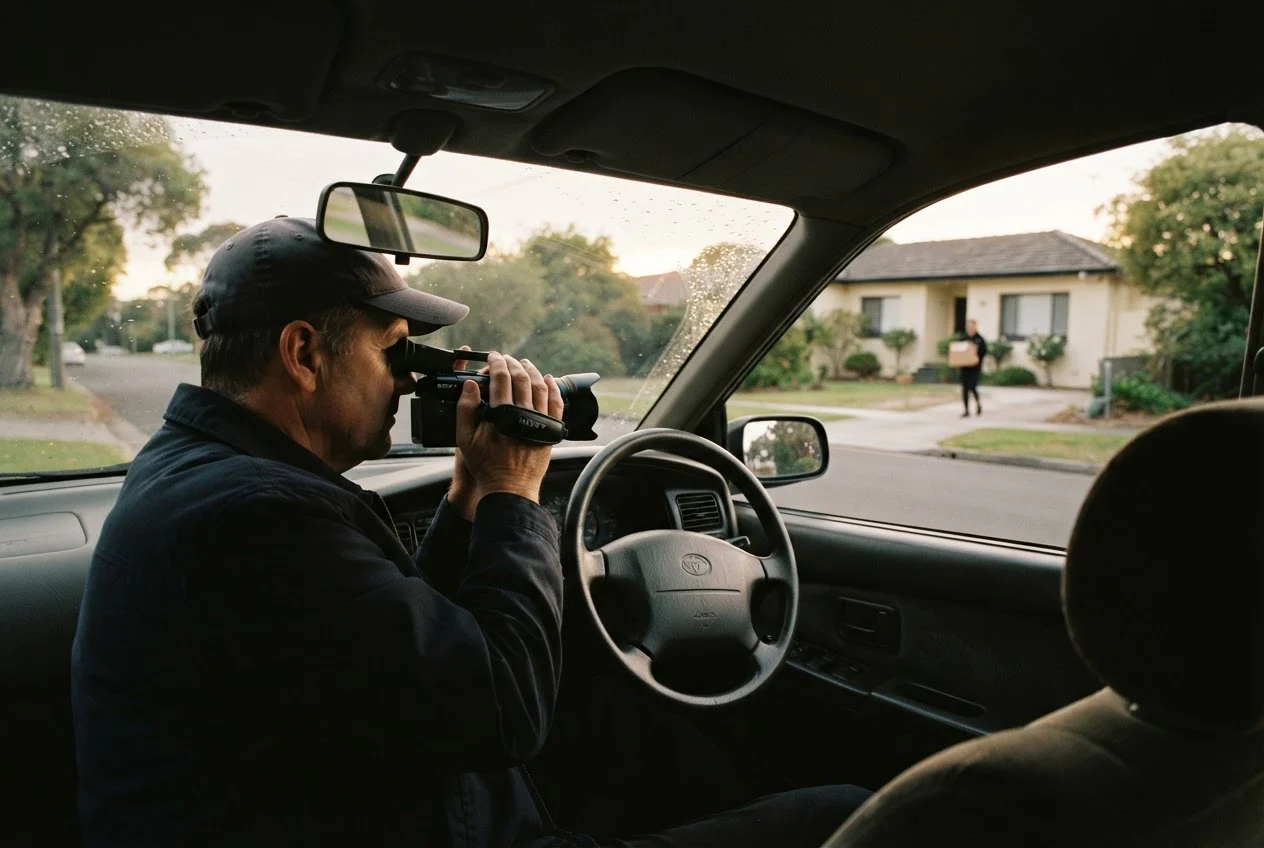
Surveillance shows what a person did on the days you watched. It does not show what they said, what they knew, or why. Footage that contradicts a medical restriction supplies the contradiction; the false statement, the knowledge and the materiality must come from other records.
The California SIU guidelines' claimant red-flag list has 63 numbered items. Only two mention surveillance: item 38, surveillance inconsistent with the physical limitations in medical reports, and item 39, surveillance or a tip showing a totally disabled worker is employed elsewhere. The rest are circumstantial, such as a new hire, an injury just before a layoff, or a claimant who cannot be reached at home during working hours. Item 29 lists a "well-tanned" claimant with "callused hands" as a sign of active work. Our inference: red flags give you a reason to look, and none of them is a lie you can prove. An investigator who treats an appearance as evidence builds a file that fails the first element.
California's workers' compensation SIU guidelines also set a threshold before surveillance starts. Surveillance must be supported by "an articulable suspicion" of illegal activity, whether the investigator is in-house or under contract, and the guidelines point investigators to California Civil Code section 1708.8(f) and its privacy implications. For the main surveillance methods and the law behind each, see types of surveillance.
When is it fraud, when is it abuse, and when is it neither?
It is fraud only when a provable lie meets the other three elements; abuse covers conduct that misuses the system without one. California's SIU guidelines define abuse as any practice contrary to the intended purpose of the system or law, and call criminal abuse "fraud". Use this table before you write anything that implies fraud:
| What you found | Call | Why |
|---|---|---|
| Exaggerated complaints, no false statement | Abuse at most | The manual lists "magnification of complaints or disability that falls short of an outright lie" as abuse |
| Claimant works while receiving temporary disability (wage-replacement) payments | Depends | The manual says it might be permissible, might be abuse, or might be fraud |
| Video shows activity beyond a medical restriction | A lead | Fraud still needs a false statement tied to it, with knowledge, intent and materiality |
| Wrong answer given by mistake | Not fraud | An inadvertent or unintentional misstatement is not fraud |
| Intentional lie about age, height or weight that changes no benefit | Not fraud | It fails materiality |
| A doctor's $4,000 bill with no false statement behind it | Abuse | "Outrageous", but no lie |
| The same bill, justified by a claim of 15 hours with the patient that did not happen | Fraud | The false statement supplies the lie |
Source: the same California Department of Insurance manual. The manual adds that abuse can be handled through claims handling, underwriting or the Workers' Compensation Appeals Board (the California body that decides disputed claims).
What are the steps in a workers' compensation fraud investigation?
A workers' compensation fraud investigation runs in five steps, in this order: a triggering fact, record review against the four elements, a recorded statement or deposition, surveillance only on an articulable suspicion, and the referral file.
- Triggering factA red flag or a tip gives a reason to look, not a finding (the guidelines' red-flag list).
- Record reviewAsk whether the claim is fraud or abuse, then whether fraud can be proven, mapping each record to the worksheet above (the guidelines' modules on fraud versus abuse and the four elements).
- Recorded statement or depositionInterview reports, recorded statements and deposition transcripts go into the referral, and the guidelines' module "The Deposition" covers preparing and conducting a deposition.
- SurveillanceStart it only once an articulable suspicion of illegal activity exists (the guidelines' module on outside investigators).
- Referral fileAssemble it as the chapter "The Documented Referral" describes, covered below.
What do California's fiscal 2023-24 workers' comp fraud statistics show?
They show the scale of California's anti-fraud effort in one year, not how often suspicion ends in a prosecution. In fiscal year 2023-24 the California Department of Insurance's Fraud Division reported 2,932 suspected fraud cases identified, 291 new cases assigned, 128 arrests and 156 referrals to prosecution. County district attorney programs reported 1,313 investigations, 336 arrests, 1,041 prosecuted cases and 260 convictions.
Our working, from those published figures:
- New cases assigned divided by suspected cases identified: 291 ÷ 2,932 = 9.9%.
- Restitution collected divided by restitution ordered: $11,682,851 ÷ $31,543,396 = 37.0%.
These are one-year counts for one state, and the Fraud Division and district attorney figures count different things, so they are not conversion rates and do not show how many suspected cases end in prosecution. Our inference, about scale only: in that year the Fraud Division assigned roughly one new case for every ten suspected cases it identified, and restitution collected was 37.0% of restitution ordered.
Penalties differ by state. Under New York law, the claimant is disqualified from compensation tied to the false statement and faces a further penalty up to the amount of compensation involved. Illinois states that violations "range from a misdemeanor to a Class 1 felony."
What should a contract investigator check before taking a workers' compensation assignment?
Check eight things before you start, because an insurer that hires you remains responsible for the case, and your work becomes part of its file. The California manual describes a contract investigator as anyone from a single-task hire to a firm acting as the insurer's designated SIU. Sub rosa work (covert surveillance) is one of the tasks.
The first six rows come from the manual's questions for vetting an outside investigator. The pass and fail tests are our recommendation:
| Check | Pass | Fail |
|---|---|---|
| License | Your license number matches the state licensing record for where you work | No number, or a lapsed one. In California, private investigators are licensed by the Bureau of Security and Investigative Services under the Private Investigator's Act |
| Insurance | Certificates show workers' compensation and errors and omissions (E&O) cover, with the client named as additional insured on E&O | Either policy missing |
| Qualified manager | The firm names the person responsible for quality assurance (a California requirement) | No named manager |
| Basis for surveillance | The assignment states the specific fact that raised suspicion | "Check on the claimant" with no reason |
| Scope | A written task list, and you stay within it | You are asked to do work beyond why you were hired |
| Represented claimants | Written authorization before any phone or in-person contact | Contact with a claimant who has an attorney, without authorization |
| Original video | Original files kept unaltered, with a custody log | Only edited clips survive. Our chain of custody guide shows what to log |
| Report format | Format, turnaround, who signs, and whether opinions are wanted all agreed in writing | You find out after the field work |
The insurer's clock runs separately. Within 60 days after the insurer determines, following its SIU investigation, that it reasonably suspects fraud, it must report to the Department of Insurance Fraud Division and the district attorney (California Insurance Code section 1872.4). Send your reports promptly and write them to be read by a prosecutor: how to write investigation reports covers the format.
What goes into a workers' compensation fraud referral file?
A referral file holds every record that supports one of the four elements, labeled by source. The California manual lists these items for a claimant-fraud referral:
- The suspected-fraud report form and the employee's claim form
- The employer's and doctor's first reports of injury
- Medical reports on the current condition and past history
- The claimant's own supporting documents
- Deposition transcripts
- Reports of interviews and recorded statements
- Photographs or video with the investigative reports
- Claims database information
- Substantiation of employment while disabled
- Substantiation of prior claims from other insurers
The manual says not to send attorney-client privileged communications. Test your file against the worksheet above: each item should be tied to a lie, knowledge, intent or materiality, and any element with no item is a gap.

Do you need a license to work as a workers' compensation fraud investigator?
For contract investigation, usually yes. The Bureau of Labor Statistics (BLS) states that most states require private detectives and investigators to be licensed. It reports a 2025 median pay of $51,220 a year, 39,500 jobs, and 5% projected growth from 2025 to 2035. Median pay in finance and insurance was $72,740 and in government $75,810 in May 2025 (all private detectives and investigators). Our insurance fraud investigator guide compares the routes into this work.
What training fits workers' compensation fraud work at Learningshopusa?
Start with our Insurance Fraud course (course 129). As of November 2026 it costs $80 and runs 4 hours. It includes a dedicated chapter on workers' compensation fraud: a four-page reading, a two-page list of indicators, a three-minute video, and the Russell case study with review. It is approved for 4 continuing education units (CEUs) in GA, SC, NC, OK, KS, IA, OR, KY, MN, TN, NM and TX.
When the assignment is watching a claimant, our Surveillance course (course 123) is also $80 and 4 hours. It has 6 chapters and 32 lessons on photographic and electronic surveillance, planning, and court testimony preparation. It is approved for 4 CEUs in GA, SC, OK, KS, IA, OR, KY, MN, NC, TN, NM, AZ and TX. Check that your state board accepts a course before you rely on its credit. Course completion is not a license.
Questions about which course fits your state: call (832) 922-1215 or (706) 268-2221, Monday to Friday, 9:00 AM to 6:00 PM Eastern, or email sharondecet@yahoo.com.
Train for workers' comp fraud work with Learningshopusa
Frequently asked questions
It depends on what was said and what was paid. California's SIU guidelines say working while receiving temporary disability might be permissible, abuse, or fraud, and California has made workers' compensation fraud a felony. In New York, a proven false statement disqualifies the related benefits and adds a penalty up to the compensation involved, an administrative sanction.
Report it to your state's workers' compensation fraud unit. In California, report to the Department of Insurance Fraud Division hotline, (800) 927-4357, and to the county district attorney; the Department's workers' compensation fraud page explains the program. In New York, the Workers' Compensation Fraud Inspector General investigates violations of workers' compensation law. In Illinois, call 877-923-8648 or email DOI.WorkCompFraud@illinois.gov; the unit needs enough specific information, including your name and contact details, to open an investigation, and an intentionally false report is a Class A misdemeanor, with up to 12 months in prison and a $2,500 fine.
In California, an insurer must report to the Department of Insurance Fraud Division and the district attorney within 60 days after it determines, following its SIU investigation, that it reasonably suspects fraud (Insurance Code section 1872.4); that deadline is for the report, not for the whole investigation.
Sources
- 1.Workers' Compensation Insurance SIU Guidelines & Protocols (PDF), March 2011, California Department of Insurance
- 2.Workers' Compensation Fraud, fiscal year 2023-24 statistics, California Department of Insurance
- 3.Insurance Code section 1872.4, California Legislative Information
- 4.Business and Professions Code, Division 3, Chapter 11.3 (Private Investigator's Act), California Legislative Information
- 5.Workers' Compensation Law section 114-a, New York State Senate
- 6.Office page, New York State Workers' Compensation Fraud Inspector General
- 7.Workers' Compensation Fraud Unit, Illinois Department of Insurance
- 8.Private Detectives and Investigators, Occupational Outlook Handbook, U.S. Bureau of Labor Statistics
- 9.Insurance Fraud course, Learningshopusa
- 10.Surveillance course, Learningshopusa