What Is Civil Process? Who Serves Papers and What Sheriffs Charge
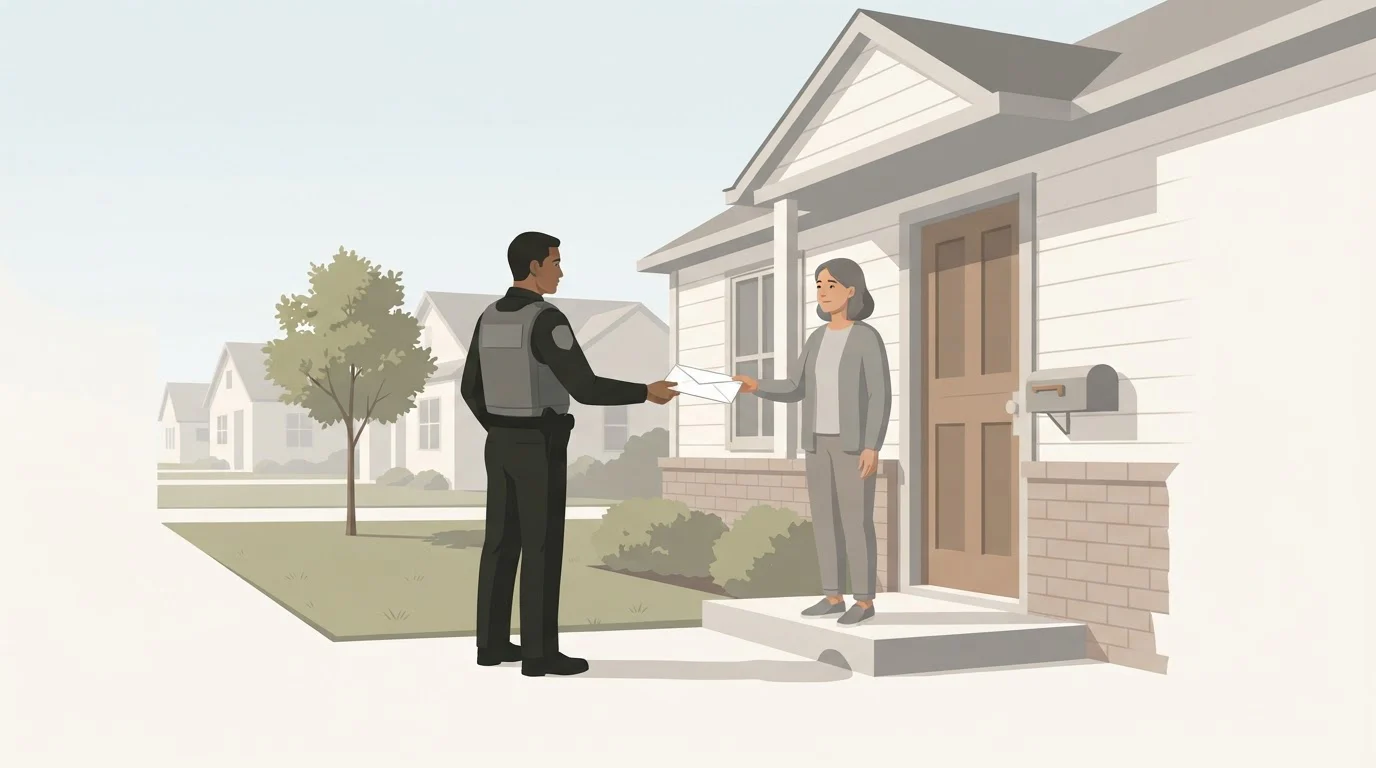
Civil process is the delivery of court papers, such as a summons, to the people named in a civil case. State rules set who may serve, and many allow private process servers.
By Sharon DeCet, Founder · Updated 15 Nov 2026
Key takeaways
- Civil process is the delivery of legal and court documents in a civil case. It is one step of a lawsuit, not the lawsuit itself.
- As of November 2026, the six sheriff's offices we compared list service fees from $15 to $100 before mileage and extra charges, and in our view a private server's natural price anchor is the local sheriff's fee.
- In federal cases the plaintiff must have the summons served, and any non-party adult 18 or older may do it. State courts set their own rules.
- A serve passes or fails on seven checks: the paper, the address, the server, the method, the deadline, the attempt log and the price.
In this article
- 1What is civil process, and how is it different from a civil case?
- 2Which papers does civil process cover?
- 3Who is allowed to deliver civil process?
- 4What does a sheriff charge for civil process?
- 5How do you check a civil serve before you accept it?
- 6What training covers civil process for process-serving work?
- 7Frequently asked questions
Civil process is one narrow step in a lawsuit: the moment a court paper reaches the person it is aimed at. The complaint, the document that starts the lawsuit and states the claim, comes before it, and the evidence and the verdict come after. In federal court, a case can be dismissed against a defendant who is never served in time.
That narrow step is also a line of work. Federal rules put the duty of having a summons, the court's notice that a case exists, delivered on the plaintiff, so delivery is work that someone is paid to do.
This page defines the term, lists what gets delivered, sets out who may deliver it, compares what sheriffs charge, and ends with a seven-check test to run before accepting a serve. It is written for people weighing process serving as work. Anyone who was handed papers should ask the court named on them what they mean.
What is civil process, and how is it different from a civil case?
Civil process is the delivery of legal and court documents in a civil case, as the Hennepin County Sheriff's Office puts it: "Civil process is the delivery of legal and court documents by the sheriff's office."
A civil case is the whole dispute. A civil action begins when a party to a dispute files a complaint and pays a filing fee required by statute. The plaintiff, the party bringing the case, then serves a copy on the defendant, the party being sued. Serving the paper is civil process. The person who delivers it is a process server.
The phrase is used three ways: for the delivery, for the sheriff's civil division, and loosely for the lawsuit. That is why the results mix definitions. For work purposes, the delivery is what matters.
Which papers does civil process cover?
Civil process covers papers that a court has filed or that a government agency has issued: summonses, subpoenas, notices, orders, small claims papers, writs of execution and garnishment, and at some offices evictions, protective orders, orders to appear, guardianship papers and restraining orders (Lane County Sheriff's Office, DeKalb County Sheriff's Office). A sheriff such as Lane County's does not serve letters or sealed envelopes.
A summons is the court's notice that a case exists. A subpoena orders a person to appear or produce records. A writ is a written court order directing an official to act. A writ of garnishment, for example, directs that money be taken from wages or an account to pay a debt. A writ of execution is an order to seize property to satisfy a judgment, the court's final decision in a case.
The summons and complaint come first in a case. Everything else follows once the court has acted.
Who is allowed to deliver civil process?
A sheriff's office may deliver civil process, and in federal cases so may any person who is at least 18 and not a party to the case. Under Federal Rule of Civil Procedure 4, the federal rule on summonses, the plaintiff is responsible for having the summons and complaint served.

Rule 4(e) allows service by following state law, or by one of three methods:
- Hand the papers to the person.
- Leave them at the person's dwelling or usual place of abode with someone of suitable age and discretion who lives there.
- Deliver them to an agent authorized by appointment or by law to receive service of process, the formal delivery of court papers.
Rule 4(m) sets the clock. If a defendant is not served within 90 days after the complaint is filed, the court must dismiss the case against that defendant without prejudice, or order that service be made within a specified time. "Without prejudice" means the plaintiff may file again. The court must extend the time if the plaintiff shows good cause, and the 90-day limit does not apply to service in a foreign country.
State courts set their own rules for who may serve and how. Check the state before taking a job. Our Arizona process server certification checks and costs page shows what one state asks.
What does a sheriff charge for civil process?
Listed service fees run from $15 to $100 across the six county sheriff's offices we compared, before mileage and extra charges such as Hennepin County's separate $50 processing fee. Calhoun County, South Carolina, lists the lowest and Hennepin County, Minnesota, the highest.
We read each office's fee page in November 2026. Only Hennepin states its date, January 1, 2026. Confirm any fee with the office before relying on it. The range excludes mileage charges.
| Sheriff's office | Fee for a basic serve | What the page adds |
|---|---|---|
| $15 | $25 for writs, judgments and executions | |
| $20 plus $2.50 per mile | $20 per person for multiple defendants | |
| $28 in state, $60 non-Indiana | Court-set fee under Indiana Code 33-37-5-15, paid to the clerk of courts, not to the sheriff | |
| $28 per location in state, $60 out of state | Personal service tried 3 times, then a copy is left at the address | |
| $50 | Prefers papers at least 30 days before a hearing | |
| $100 per person | $50 processing fee; $125 per hour for civil standby (an officer present to keep the peace while a party retrieves property) |
Two calculations from the table, both ours:
- Spread. $100 divided by $15 is about 6.7, so the highest listed fee is roughly 6.7 times the lowest.
- Mileage. Carbon County's formula is $20 plus $2.50 for every mile. A serve 10 miles from the office costs $20 + (10 × $2.50) = $45. At 30 miles it costs $20 + (30 × $2.50) = $95, nearly Hennepin's flat $100.
Six counties are a small sample. Fees vary by county and by type of paper: Calhoun charges $25 rather than $15 for writs, judgments and executions, and Carbon charges a $50 base rather than $20 for executions and writs of possession. Mileage can matter more than the base rate.
In our view, a private server pricing a job should start from the local sheriff's fee, since that is what the plaintiff would otherwise pay. Our process server business per-serve math page takes that into costs and margins.
How do you check a civil serve before you accept it?
Run seven checks before accepting a civil serve. Each has a pass and a fail, and a fail on any one is a reason to ask questions or decline. Checks 1 and 2 are sheriff intake requirements, checks 3 to 5 come from Federal Rule of Civil Procedure 4 (state courts may differ), and checks 6 and 7 are our recommendations.

- The paper
Sheriff intake test, as at Lane County. Pass: you hold a filed court paper or an agency-issued paper, such as a summons, subpoena, order or writ. Fail: a letter or sealed envelope. Lane County's sheriff does not serve those.
- The address
Sheriff intake test, as at DeKalb County. Pass: a complete street address. Fail: a post office box alone or a partial address. DeKalb County requires a physical address and does not refund papers returned "Not Found in Bailiwick", which means the person was not found within the sheriff's territory.
- The server
Pass: the person delivering is at least 18 and not a party to the case (Rule 4(c)(2)). Fail: a plaintiff, a defendant or anyone under 18.
- The methodPass: the method is one Rule 4(e) or the state's rule allows. Fail: a method that neither allows. Check the state's rule first.
- The deadlinePass: in federal court, you can deliver before day 90 after the complaint was filed (Rule 4(m)). Fail: the filing date is already near or past 90 days. State time limits differ.
- The attempt log
Our recommendation. Pass: you record the date, time, address and result of every attempt. Steuben County's sheriff tries personal service three times before leaving a copy at the address, which is a useful pattern for your own log. Fail: any attempt you cannot account for. The log feeds the sworn statement that proves service, covered in our affidavit of service checklist.
- The priceOur recommendation. Pass: your quote covers mileage, repeat attempts and the filing of the proof, and you have compared it with the local sheriff's fee. Fail: a flat price that a long drive or a third attempt turns into a loss.
What training covers civil process for process-serving work?
Our Key Concepts in Civil Process course covers this subject and costs $80 as of November 2026. It is a four-hour, self-paced course of 33 lessons in four chapters plus a final exam, with five assessments containing 40 questions in total.
The chapters are Terms, Summons, Personal Service Tips and Rules of Discovery. The course ends in a certificate of completion.
Check with the authority in your state whether any course is required before you enroll.
If you want to see where the work leads, our process server job description page covers duties, pay and requirements. Questions about the course can go to us by phone at (832) 922-1215 or (706) 268-2221, Monday to Friday, 9:00 AM to 6:00 PM EST. The full course list is at learningshopusa.online.
Learn civil process with a four-hour course
Frequently asked questions
Because the plaintiff, or the law for certain papers, sent them to the sheriff for delivery. Under federal rules the plaintiff must have the summons served. If you were served, the paper states a deadline to respond (21 days in federal court after service, under Rule 12; check the state's deadline). Missing it can lead to a default judgment, so contact the court or a lawyer promptly.
Sources
- 1.Hennepin County Sheriff's Office, Civil process services (fees as of January 1, 2026)
- 2.Orange County Sheriff's Department, Civil Process Services
- 3.Lane County Sheriff's Office, Civil Process Unit
- 4.Carbon County, Utah, Sheriff's civil processing fees
- 5.DeKalb County Sheriff's Office, Civil Process
- 6.Steuben County Sheriff's Office, Civil Process
- 7.Calhoun County Sheriff's Office, Civil Process Division
- 8.Indiana General Assembly, Indiana Code Title 33 (33-37-5-15)
- 9.Administrative Office of the U.S. Courts, Civil Cases
- 10.U.S. Government Publishing Office, Federal Rules of Civil Procedure, Rule 4, U.S. Code 2024 edition
- 11.U.S. Government Publishing Office, Federal Rules of Civil Procedure, Rule 12, U.S. Code 2024 edition
- 12.Learningshopusa, Key Concepts in Civil Process course page