License, CE, or Specialty Skills? Find Your PI Training Path
Choose the answer that best fits your next private-investigator training decision. Every option is worth 0 to 3 points, and higher scores mean that a state-specific compliance or eligibility check matters more before you choose training.
Question 1 of 5
Which state applies to the work you want to do?
Pick an answer to continue. Your result appears after question 5.
By Sharon DeCet, Founder · Reviewed 25 Sept 2026
In brief
A course certificate, state-required training, renewal CE, and a private-investigator license are different outcomes. This five-question assessment scores how much your next step depends on a state rule, current credential, experience, and work goal. Georgia rules, Minnesota rules, and Texas DPS set the examples used here.
What your score measures
This assessment measures regulatory and eligibility exposure, not investigative ability. Each answer is worth 0 to 3 points. Higher scores mean that state-specific training, CE, experience, or licence evidence is more likely to control the next step. Score bands are 0–3, 4–7, 8–11, and 12+.
Regulatory examples were checked in September 2026. Georgia requires private-detective applicants to complete at least 70 classroom hours, while Georgia’s official rules set 16 renewal CE hours for registered private-detective employees.
Four outcomes can sit behind the same search
Texas illustrates why a course title alone cannot diagnose the right path. Texas DPS rules require either 12 or 18 PI CE hours based on continued licensure, while a Texas investigations-company applicant needs three consecutive years of investigative-field experience under the Texas Occupations Code.
Where the requirement comes from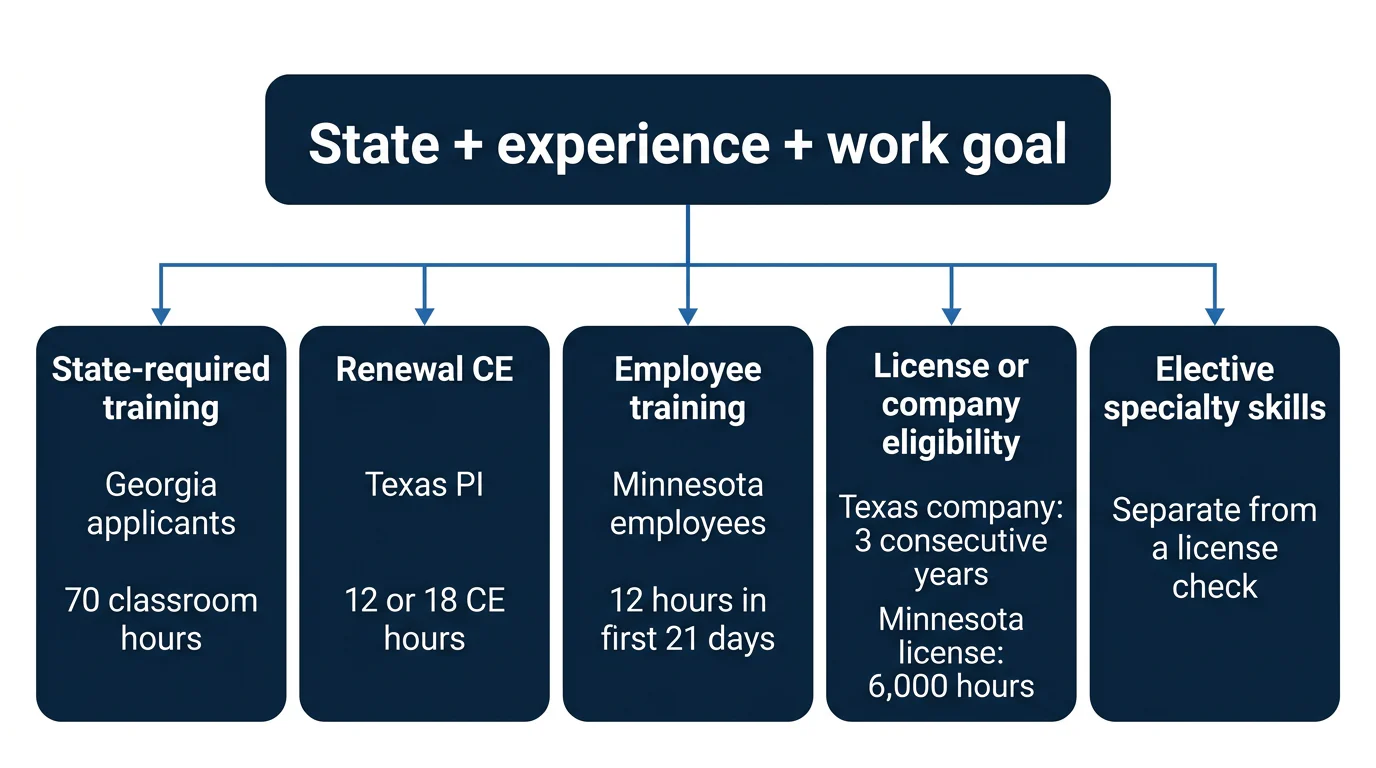
Minnesota makes a separate distinction between employee training and an individual licence. The Minnesota Revisor’s rules require 12 pre-assignment hours within an employee’s first 21 days, while its licensing statute requires 6,000 qualifying investigative hours for a private-detective licence applicant. A specialty course can build a defined skill, but it does not replace a state’s separate licence or experience requirement.
Read the result as a next-step check
A lower score points toward a defined skill goal and a higher score points toward documentation and eligibility checks before choosing training. The score does not determine personal eligibility, course approval, or whether a provider’s completion certificate will be accepted. Use the detailed result to identify the question to settle before enrolling.
What this assessment asks
5 questions. Each answer carries points; your total picks the result band below.
01Which state applies to the work you want to do?
- Georgia, Minnesota, or Texas, where I know a specific rule may apply
- Another state, and I have identified a regulator or licensing board
- Another state, but I have not checked its rules yet
- I am only exploring specialty skills and have not chosen a work state
02What is your current investigation experience?
- I am already licensed or registered and need to maintain that status
- I have substantial investigative experience and may pursue independent work
- I am new to the field and expect to work for a licensed business
- I am exploring a single investigative skill without a PI work role yet
03What work outcome are you aiming for?
- Renew or maintain a PI credential
- Work as a private-detective employee for a licensed business
- Operate or qualify an investigations company
- Build a specialty skill such as surveillance, reporting, or ethics
04What has the regulator or employer told you about training?
- Specific hours, CE, or application documentation are required
- My state or role has requirements, but I need to confirm which route applies
- An employer wants a course certificate, but no state-hour requirement is clear
- The course is elective professional development
05What proof do you need from training?
- Evidence for a licence application or renewal record
- A certificate requested by a current or prospective employer
- A completion record for my own files
- Practical skill-building without a required training record
How to read your score
| Score | Result | What it means |
|---|---|---|
| 0–3 | 0–3 points: Specialty-skills route | Your answers point to a defined professional skill goal rather than a documented licensing or renewal requirement. Choose a topic that matches the work you want to practise, while keeping any future state licence question separate from the course certificate. |
| 4–7 | 4–7 points: State-rule check first | Your answers show an unresolved jurisdiction or role question. Settle the applicable regulator, licence type, and work setting before treating any online course as a qualifying route. |
| 8–11 | 8–11 points: Documented training or CE match | Your next step is likely tied to a stated training, employee, or renewal requirement. Match the provider, credited hours, subject matter, and completion evidence to the credential and state that govern your work. |
| 12–15 | 12+ points: License or renewal route takes priority | Your answers indicate that compliance records, experience conditions, or a current credential are central to the decision. Confirm the state route before enrolment, because a course certificate may support a requirement without replacing the licence, company, or experience process. |
Keep reading


Frequently asked
No. A completion certificate documents that a course was finished, while a private-investigator license is issued under the applicable state process. Minnesota, for example, requires 6,000 qualifying investigative hours for an individual private-detective license applicant.
Renewal CE and initial training can have different audiences, hours, and evidence requirements. Texas DPS requires 12 or 18 PI CE hours based on continued licensure, while Georgia requires at least 70 classroom hours for private-detective applicants.
Company ownership can add an experience requirement that a course does not satisfy. Texas requires three consecutive years of investigative-field experience for an investigations-company applicant unless another Commission-set route applies, and Minnesota requires 6,000 qualifying hours for its individual licence route.
Yes. The assessment identifies when a state-rule check should come before course selection. The Bureau of Labor Statistics says most states require private detectives and investigators to be licensed, so the applicable state regulator remains the deciding source.