Kansas Private Investigator License: Steps, Fees and CE
A Kansas private investigator license comes from the Attorney General after a written exam and oral interview, with no experience hours required. Renewal every two years needs 8 hours of continuing education.
By Sharon DeCet, Founder · Updated 8 Nov 2026

Key takeaways
- A Kansas private detective license requires being 21 or older, a U.S. citizen of good moral character, and a high school graduate or General Educational Development (GED) certificate holder. You must also pass a written exam and an oral interview with the Attorney General. Experience hours are not a condition.
- You need $100,000 in bond, insurance or deposit unless a licensee employs you. As of November 2026, the statutory fee ceilings are $250 to apply and $175 to renew.
- Renewal needs 8 hours of continuing education (CE) in each two-year period. 22 of the 34 course pages we opened from our Private Investigator listing list Kansas. The cheapest single course covering 8 hours is $120.
- Our courses serve renewal and job skills. They do not replace the exam, interview, references, fingerprints or bond, and you should confirm with the Attorney General that a specific course counts before you enroll.
In this article
- 1What does a Kansas private investigator license require?
- 2What are the Kansas private detective license steps, in order?
- 3How do renewal and continuing education work for a Kansas private detective?
- 4Which of our courses list Kansas among their states, and what do they cost?
- 5Do our courses replace any Kansas licensing step?
- 6Frequently asked questions
Most of the effort in getting a Kansas license comes before the exam. You need five or more reference certificates dated inside a four-month window. Fingerprints must be taken by a law enforcement agency. Unless a licensed agency employs you, you also need a $100,000 bond or insurance policy.
The Attorney General's office controls all of it, and no city can add its own license. Kansas law calls a private investigator a "private detective," and this page uses "private detective" for the person who holds the license. The steps are short to list, and each one below ends in a pass test you can run before you apply.
This page sets out the steps in the order the state requires them, with the law behind each one. It then covers renewal, which is where training enters. Finally it shows which of our courses list Kansas, what each costs per hour, and what none of them replaces.
What does a Kansas private investigator license require?
A Kansas private investigator license is a private detective license from the Attorney General, required to do detective business for consideration. Applicants must be at least 21, be U.S. citizens of good moral character, and hold a high school diploma or GED. They must pass a written examination and sit an oral interview (Kansas Statutes Annotated (K.S.A.) 75-7b02, 75-7b04, 75-7b20, Kansas Administrative Regulations (K.A.R.) 16-3-3).
Detective business covers investigating crime, personal information, lost or stolen property and the cause of losses or damage. It also covers collecting evidence (K.S.A. 75-7b01). Law enforcement officers and anyone holding a special commission from a law enforcement agency cannot be licensed (K.S.A. 75-7b02).
Investigative experience hours appear in neither K.S.A. 75-7b04 nor 75-7b20. Instead, the Attorney General investigates each applicant's background. The Attorney General holds exclusive jurisdiction, and cities may not license or regulate private detectives (K.S.A. 75-7b18).
What are the Kansas private detective license steps, in order?
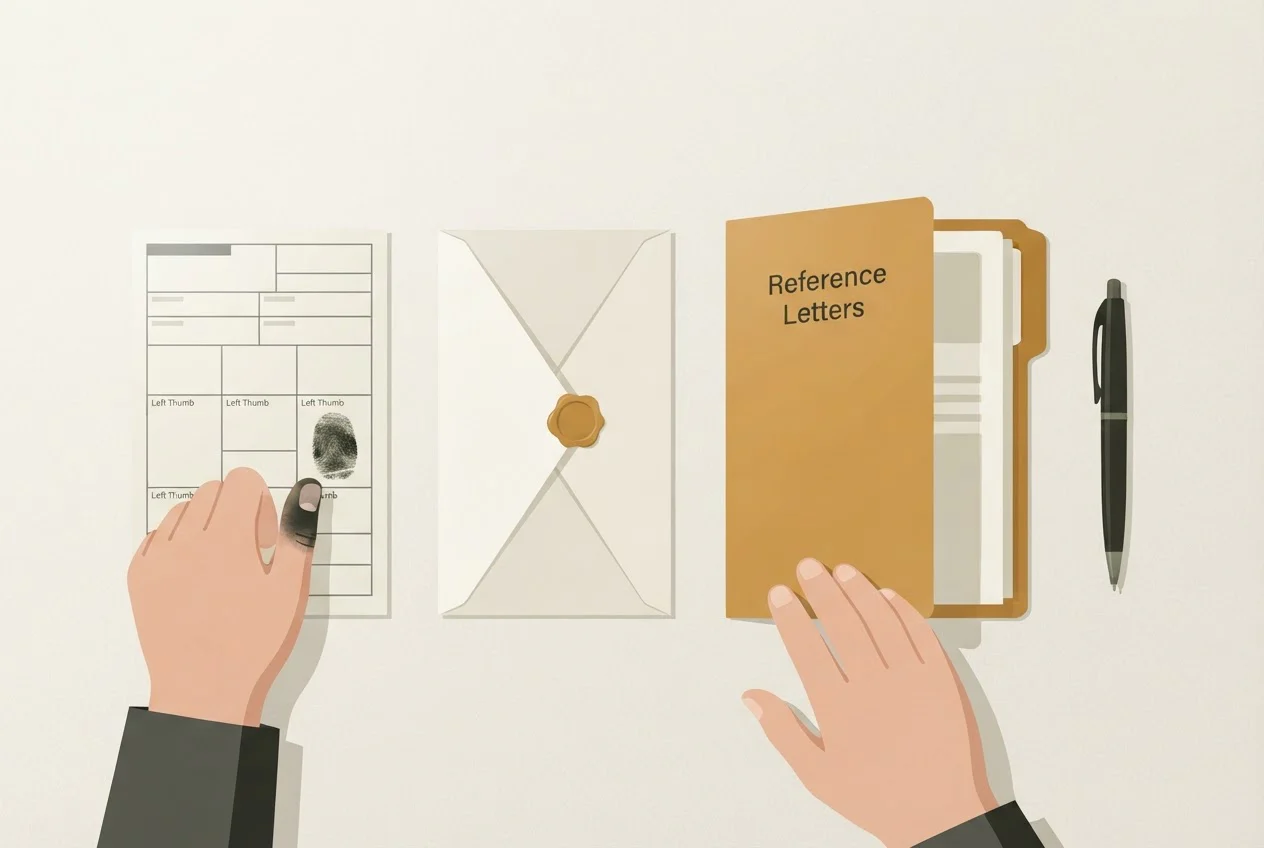
There are seven steps: confirm eligibility, clear the denial grounds, collect references, get fingerprinted, secure the $100,000 protection, file the application with its fee, then pass the exam and interview. Each step has a pass test, and a fail on any one stops the application.
- Eligibility
Pass: you are 21 or older, a U.S. citizen, a high school graduate or GED holder, and not a law enforcement officer or specially commissioned. Fail: any one is missing. See our private investigator age requirement page for how Kansas's 21 compares with other states.
- Denial grounds
Pass: none of these applies to you.
- A felony, or a conviction for a crime involving moral turpitude, dishonesty, vehicular homicide, assault or battery, within the statute's 10-year look-back.
- Fraud or dishonesty.
- Bad moral character or a bad reputation for truth, honesty and integrity.
- A refusal, suspension or revocation of a license in Kansas or elsewhere.
- A false statement on the application (K.S.A. 75-7b04).
- Current addiction to, dependence on or abuse of alcohol or a controlled substance, or an impairing mental condition (K.A.R. 16-3-3).
The statute says the Attorney General "may" deny, so if something here applies, ask the office before paying fees. Our guide on felons and private investigator licensing covers records in more depth.
- References
Pass: five or more reputable persons who have known you at least five years each supply a certificate, and every certificate is dated within four months of the day the Attorney General receives your application (K.S.A. 75-7b04, K.A.R. 16-3-1). The Attorney General may shorten the five-year period for honorably discharged military veterans (K.S.A. 75-7b04). Fail: any certificate is older. Collect these last, after the bond and fingerprints are ready, so the window does not run out.
- Fingerprints
Pass: an officer or employee of a law enforcement agency takes them, and the form names both the agency and the person (K.A.R. 16-3-1). Fail: either name is blank.
- The $100,000 protection
Pass: you hold one of three things, each worth $100,000 or more.
- A corporate surety bond.
- A general liability insurance certificate covering bodily injury or property damage caused by negligence and errors or omissions.
- A cash deposit with the state treasurer.
Alternatively, you are or will be employed by a licensee, who exempts you from this step (K.S.A. 75-7b11). Employment removes the bond, not the license, because the person doing the detective work still needs one. Our part-time private investigator page explains starting under an agency's license.
- Application and fee
Pass: you file the Attorney General's forms and pay the amount the office charges. The statute caps the application at $250. Officers, directors, partners or associates of an organization apply separately, at up to $100 each (K.S.A. 75-7b05, 75-7b22). As of November 2026 these are statutory ceilings, and the Attorney General sets the amounts charged within them (see the Attorney General's private detective licensing page).
- Exam and interview
Pass: you pass the written exam in no more than three attempts and complete the oral interview at the time and place the Attorney General designates. Fail: after three unsuccessful attempts the license is denied, and you cannot reapply within 12 months of the denial (K.A.R. 16-3-1).
State fees through the first renewal come to up to $425 (up to $250 for the application plus up to $175 for the renewal), and up to $545 with one 8-hour CE course at $120. This is our arithmetic. The totals are maximums built on the statutory ceilings, not on the amounts the Attorney General charges, so the actual cost may be lower. The bond or insurance premium and fingerprinting costs come on top.
How do renewal and continuing education work for a Kansas private detective?
A Kansas private detective renews on a two-year cycle and must complete 8 hours of Attorney General-approved continuing education (CE) in each period. The renewal also needs proof of the $100,000 bond, insurance or deposit. CE counts 50 minutes as one hour, and you submit your completion documents with the renewal application (K.S.A. 75-7b07, K.A.R. 16-3-2, 16-4-2).
The CE must be obtained within the renewal period. Each completion document must show five things (K.A.R. 16-4-4):
- The sponsor.
- The location.
- The program title.
- The dates.
- The minutes you participated.
A self-study program qualifies when it has a qualified sponsor, registration, and a final exam passed at 70% or higher. It must also issue a certificate of completion. Credit is one hour per 50 minutes and cannot exceed the sponsor's recommended hours (K.A.R. 16-4-3).
Our recommendation is to keep every certificate and check that the minutes field is filled in. Count credit by recorded minutes, not by course title.

Which of our courses list Kansas among their states, and what do they cost?
22 of the 34 course pages we opened from our Private Investigator listing include Kansas (KS) in their listed states. Our Legal Aspects of Private Investigation course also lists it, for 23 course pages in all. Hours run from 2 to 16, and the 8-hour courses cost $120 each as of November 2026. Listing Kansas is not Attorney General approval.
We counted on 8 November 2026 by opening each course page, linked in the table, and reading its hours, price and states line. We publish this page, and the table covers our own courses only.
| Hours | Price | Cost per hour | Courses listing Kansas |
|---|---|---|---|
| 2 | $40 | $20.00 | |
| 4 | $80 | $20.00 | Background Investigation (120), Pre-Employment Screening (121), Collection and Preservation of Evidence (122), Surveillance (123), Interviewing-Private Investigators (124), Interrogation (125), Note Taking (126), Report Writing (127), Testifying (128), Insurance Fraud (129), White-Collar Crime (130), Executive Protection (131) |
| 6 | $100 | $16.67 | |
| 6 | $110 | $18.33 | |
| 8 | $120 | $15.00 | |
| 16 | $175 | $10.94 |
The table has 3 + 12 + 2 + 1 + 3 + 1 = 22 courses. Cost per hour is price divided by hours. The cheapest ways to reach 8 hours are:
- One 8-hour course: $120.
- A 6-hour course plus a 2-hour course: $140 ($100 + $40), or $150 with Undercover Operations.
- Two 4-hour courses, or one 4-hour plus two 2-hour courses: $160.
Course 111 has the lowest price per hour, but Kansas counts 8 hours per period. For a single period, an $120 course costs less than the $175 one.
Our Legal Aspects of Private Investigation course (115) covers criminal law, evidence and court procedures in 49 lessons for $120. It ends with a final exam and a certificate of completion. See Legal Aspects of Private Investigation. Confirm with the Attorney General how many CE hours it earns before counting it toward 8, because credit follows your recorded minutes.
Our course pages list the states for each course. Whether a given course counts for your renewal is the Attorney General's decision under K.S.A. 75-7b07. Send the office the course title and hours before you enroll. Our guide on whether a private investigator course counts in your state shows how to run that check.
Do our courses replace any Kansas licensing step?
No. Our courses do not replace the written exam, oral interview, reference certificates, fingerprints, background investigation, age and citizenship tests, or the $100,000 protection. Those conditions come from K.S.A. 75-7b04 and 75-7b20, and no course stands in for them.
Our courses are self-paced and issue a certificate of completion. They serve the renewal requirement and the skills you use on the job.
To see the Kansas-listed courses, browse our Private Investigator courses, or call us at (832) 922-1215.
Find Kansas-listed private investigator courses
Frequently asked questions
The Attorney General may deny a license on the grounds listed in K.S.A. 75-7b04, such as a felony or other listed conviction, dishonesty or fraud, or a prior license refusal, suspension or revocation.
Not while holding that status. K.S.A. 75-7b02 bars law enforcement officers and persons with a special commission from a law enforcement agency from licensure. If you are retiring or separating, ask the licensing office how it treats your situation.
After three unsuccessful attempts the Attorney General must deny the license, and you cannot reapply within 12 months of the denial (K.A.R. 16-3-1).
Yes, self-study programs can qualify if they have a qualified sponsor, registration, a final exam passed at 70% or higher, and a certificate of completion (K.A.R. 16-4-3). The Attorney General approves programs, so confirm a specific course counts before you pay.
No. K.S.A. 75-7b18 gives the Attorney General exclusive jurisdiction and bars cities from licensing or regulating private detectives.
Sources
- 1.Kansas Attorney General, Private Detective Licensing
- 2.K.S.A. 75-7b01, definitions, Kansas Legislature
- 3.K.S.A. 75-7b02, licensure required, Kansas Legislature
- 4.K.S.A. 75-7b04, qualifications and denial grounds, Kansas Legislature
- 5.K.S.A. 75-7b04, Kansas Office of the Revisor of Statutes
- 6.K.S.A. 75-7b05, license fee, Kansas Office of the Revisor of Statutes
- 7.K.S.A. 75-7b07, renewal and continuing education, Kansas Office of the Revisor of Statutes
- 8.K.S.A. 75-7b11, bond, insurance or deposit, Kansas Office of the Revisor of Statutes
- 9.K.S.A. 75-7b18, exclusive jurisdiction, Kansas Legislature
- 10.K.S.A. 75-7b20, examination and interview, Kansas Legislature
- 11.K.S.A. 75-7b22, fee ceilings, Kansas Office of the Revisor of Statutes
- 12.K.A.R. 16-3-1, procedure, Kansas Secretary of State
- 13.K.A.R. 16-3-2, renewal, Kansas Secretary of State
- 14.K.A.R. 16-3-3, additional qualifications, Kansas Secretary of State
- 15.K.A.R. 16-4-2, CE requirements, Kansas Secretary of State
- 16.K.A.R. 16-4-3, CE program requirements, Kansas Secretary of State
- 17.K.A.R. 16-4-4, CE documentation, Kansas Secretary of State
- 18.Learningshopusa Private Investigator courses, course listing
- 19.Learningshopusa course pages linked in the table above, hours, prices and states lines as read on 8 November 2026
- 20.Learningshopusa, Legal Aspects of Private Investigation