Glossary
Private Investigator Continuing Education
By Sharon DeCet, Founder · Reviewed 25 Sept 2026
Also called PI CE or private detective continuing education
What is a Private Investigator Continuing Education?
Private investigator continuing education, or CE, is post-licensure professional learning that a jurisdiction may require or accept when a private investigator renews a license or registration. It is different from initial qualification training. Required hours, subjects, delivery methods, providers, records, and first-renewal treatment vary by state.
Key takeaways
- Match a CE course to the exact state, license or registration type, renewal cycle, and required subjects.
- An online course can be convenient, but online delivery alone does not establish renewal eligibility.
- Keep completion records because state regulators, employers, or renewal systems may require proof.
- Initial training and renewal CE should be checked separately before enrollment.
Why CE is not a universal course category
Private investigator CE is governed by state-level rules rather than one national hour total. A course can be useful professional learning without satisfying the renewal rule that applies to a particular investigator.
A worked Texas renewal decision
A Texas PI with fewer than 15 years of licensure needs 18 hours every two years: 14 investigation-related hours, 2 ethics hours, and 2 hours reviewing the Act and rules. An 18-hour course fits that hour total only if its topics and completion record meet the current Texas requirements.
When initial training matters instead
A person seeking a first private-detective credential may need basic training rather than CE. In Georgia, the basic-training requirement for private-detective applicants is at least 70 classroom hours, which is a different question from the 16-hour renewal CE requirement for registered private-detective employees.
Initial training and renewal CE answer different questions
Georgia makes the distinction concrete. A private-detective applicant needs at least 70 hours of basic classroom training, while a registered private-detective employee needs 16 continuing-education hours for renewal every two years. The first Georgia renewal after initial licensure is exempt from CE. Georgia’s Private Detective and Security Agency FAQ and Rule 509-3 set out those separate requirements.
A course certificate can document completed training, but a certificate is not itself a license or registration. Check the rule for the exact license class and renewal period before choosing a course.
Four official examples show why a national hour total would mislead
The comparison below reflects regulator materials consulted in September 2026. Texas separates investigators by years of licensure, Georgia specifies subject categories, and Oregon permits several delivery modes. Texas DPS, the Georgia Board, and Oregon DPSST provide the underlying rules.
Renewal requirements in four jurisdictions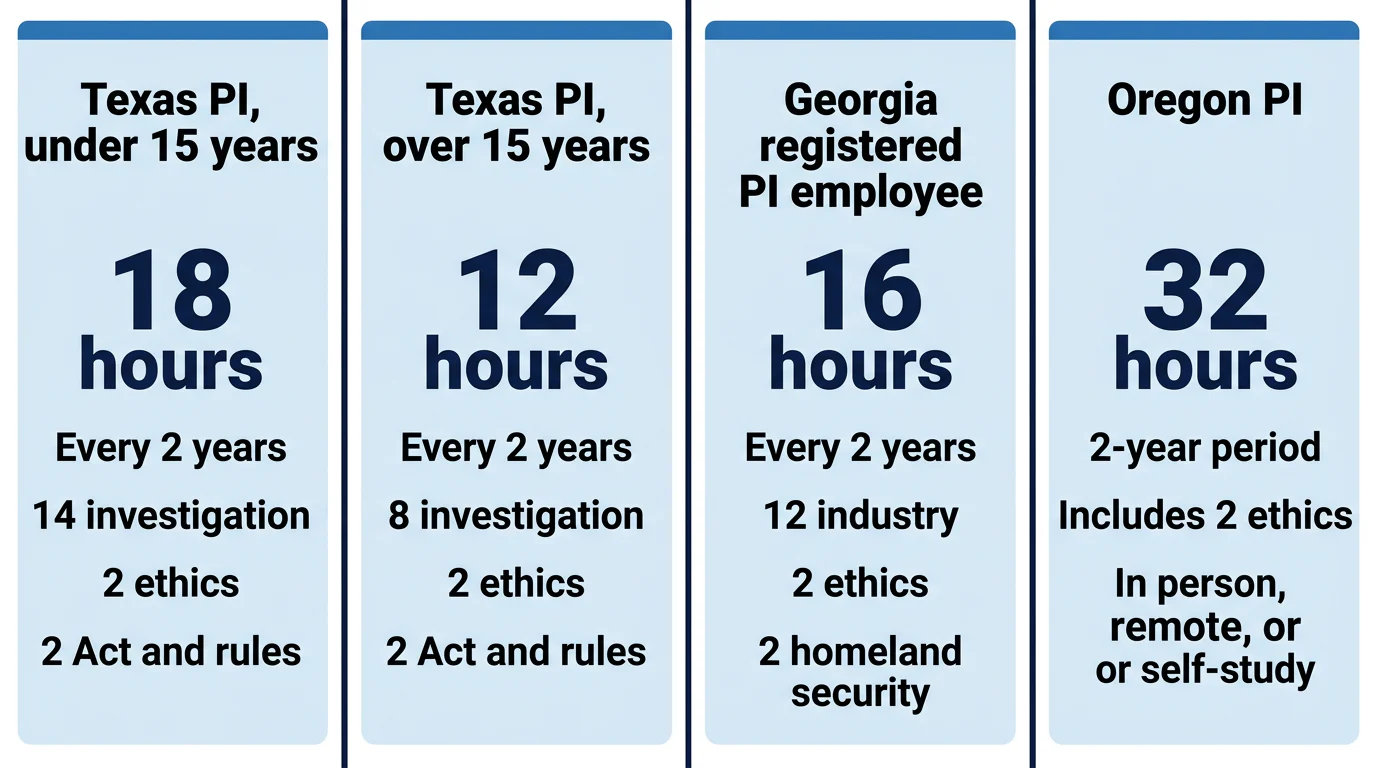
What “online CE” can and cannot tell you
Online delivery is only one part of eligibility. Oregon says PI CE may be completed in person, remotely, or through self-study. Georgia’s rules allow electronic signatures for distance learning, while also requiring for-profit CE providers to keep attendance or roster records and a written agenda or lesson plan. Oregon’s CE guidelines and Georgia Rule 509-3 show why a course being online does not, by itself, answer whether it fits a particular renewal.
Online CE is not a good fit for a learner who needs initial basic training, a separate firearms qualification, or a state-specific provider approval that the course does not meet.
Use the renewal rule before buying a course
- Identify the state, license or registration type, and expiration cycle.
- Match the required hour total and mandatory subjects to the course record.
- Confirm the state’s rules for provider, delivery method, and documentation.
- Keep the completion record for the period the regulator requires.
Texas requires attendees and companies to retain completion certificates for two years, while Georgia requires CE reporting and proof of completion through CE Broker. Texas DPS’s CE chart and Georgia’s FAQ explain those recordkeeping expectations.
Example
Example: A Texas PI with fewer than 15 years of licensure should look for a two-year CE package totaling 18 hours, including 14 investigation-related hours, 2 ethics hours, and 2 hours on the Act and rules. A general skills course without the required subject mix may not solve that renewal requirement.
Frequently asked
An online private investigator CE course can count only when it fits the current rules for the investigator’s state, license type, required subject matter, provider, completion date, and documentation. Oregon permits remote and self-study CE, but that Oregon rule does not establish acceptance in another jurisdiction.
Private investigator CE and initial licensing training are different requirements. Georgia requires at least 70 hours of basic training for private-detective applicants, while registered private-detective employees generally need 16 CE hours for a later renewal cycle.
The required total depends on the jurisdiction and the investigator’s status. Texas requires 18 hours every two years for PIs with fewer than 15 years of licensure and 12 hours for those with more than 15 years, while Georgia requires 16 hours for registered private-detective employees.
Yes. Completion records may be needed for renewal or an audit. Texas requires attendees and companies to keep CE completion certificates for two years, and Georgia requires licensees to report CE coursework and submit proof through CE Broker.
Match renewal education to your license rule
Start with your state, license class, required subjects, and renewal deadline.
Explore PI renewal education