4 companies compared
Executive Protection Courses Online, Ranked by Format and State Fit
Ranked for learning scope, delivery format, publicly stated price, assessments and how clearly each option fits a state-regulated path. A course completion certificate does not itself confer a licence or registration.
By Sharon DeCet, Founder · Reviewed 26 Sept 2026
The short answer
The best online executive protection course depends on the job you are preparing for. Choose a short, self-paced course for foundational knowledge, a live-online option for scheduled instruction, or a specialist course for advance work, then check your state’s separate training and registration rules before paying.
The shortlist
- 1Learning Shop USA 131. Executive ProtectionOur companyBest budget foundation
- 2ASIS International Essentials of Executive Protection Certificate ProgramBest for organisational risk overview
- 3Phalanx Training Academy Executive Protection Certification CourseBest for live-online instruction
- 4EP Access Executive Protection Advances MasterclassBest for advance-work specialisation
How we ranked them
- Published course price
- Online or live-online format
- Learning scope and stated outcomes
- Assessments and completion credential
- Fit with separate state training and registration requirements
The companies in detail
Learning Shop USA 131. Executive Protection
A self-paced introduction to protection planning, risk and team roles.
- Format
- Self-paced, all levels
- Duration
- 4 hours
- Completion
- Certificate of completion
- Assessments
- 7 assessments, 86 questions
Our own course wins for learners who want a low-cost, four-hour foundation before deciding whether a longer state-specific or practical route is necessary.
Strengths
- Four-hour self-paced format
- 36 lessons, seven assessments and 86 questions
- Covers risk surveys, event protection, team roles, operational planning and after-action reporting
- Certificate of completion after required work and assessments
Limitations
- A four-hour online course cannot by itself meet state routes that require longer training or practical exercises
- It is not a licence, registration or firearms credential
ASIS International Essentials of Executive Protection Certificate Program
A short online overview of executive-protection function, threat assessment and advance activities.
- Access
- 6 months
- Professional credit
- 3.5 CPE
- Completion
- Certificate of competency after assessment
- Source
- ASIS International product page, 2026
ASIS International wins for security professionals who want a compact organisational overview and CPE credit rather than a longer practical-training route.
Strengths
- Self-paced online format
- Six-month access period
- Covers threat and vulnerability assessment, protective intelligence and advance activities
- Includes 3.5 CPE
Limitations
- Its overview format is not designed to replace state practical-training requirements
- The nonmember price is higher than a short foundation course
Phalanx Training Academy Executive Protection Certification Course
A scheduled three-day live-online executive protection course.
- Format
- 3-day live online
- Completion
- Certified Certificate of Training
- Source
- Phalanx Training Academy course page, 2026
Phalanx Training Academy wins for learners who prefer a scheduled live-online class over self-paced study and accept a higher course price.
Strengths
- Three-day live-online format
- Includes a training certificate for successful graduates
- Structured dates may suit learners who want a fixed class schedule
Limitations
- The price is substantially higher than short self-paced options
- A training certificate does not itself establish a state licence or registration
EP Access Executive Protection Advances Masterclass
A specialist online course focused on executive-protection advances.
- Format
- Online
- Duration
- 12 hours
- Course structure
- 77 lessons, 7 assessments
- Source
- EP Access course catalogue, 2026
EP Access wins for a learner who already knows the basics and specifically wants a 12-hour online masterclass on advance work.
Strengths
- Twelve hours of online instruction
- 77 lessons and seven assessments
- Narrow focus on advance work rather than a broad introduction
Limitations
- Its specialist scope is not the strongest starting point for a complete beginner
- It does not replace a state route requiring practical work or registration
How to choose
- 1
Start with the role, not the course title
Decide whether you need introductory knowledge, advance-work training, live instruction or a regulated work credential. Similar course titles can serve different purposes.
- 2
Check the state pathway
Look for required hours, practical exercises, first aid, firearms training, applications and registration rules before you buy a course.
- 3
Match scope to the gap you need to fill
A four-hour foundation course and a 12-hour advance-work masterclass are not substitutes for each other, and neither is automatically a licensing programme.
- 4
Keep the completion record
Retain your completion certificate and assessment record, then provide the documents your regulator or employer requires for the applicable route.
State requirements can be much longer than an online introduction
North Carolina’s route for applicants without qualifying experience calls for 40 hours, including 26 hours of fundamentals and 12 hours of practical exercises, plus first-aid, CPR and AED credentials. Virginia’s entry-level personal-protection course is 60 hours, with extra firearms training for armed work. North Carolina’s approved-course notice also says the applicant remains responsible for showing that a course meets the required criteria.
- Jurisdiction
- North Carolina
- Training requirement
- 40 hours, including 12 practical hours
- Additional condition
- First aid, CPR and AED credentials
- Jurisdiction
- Virginia
- Training requirement
- 60 entry-level hours
- Additional condition
- Current registration required to work
- Jurisdiction
- Texas
- Training requirement
- Level II, III and IV certificates for Personal Protection Officers
- Additional condition
- Application and fingerprint process
Price tracks format and specialisation, not a universal credential
The four choices span self-paced foundations, an organisational overview, live-online instruction and a specialist advance-work masterclass. Compare what the course actually teaches before comparing prices, because a certificate after an online assessment is different from a state route that requires field exercises or registration.
Completion proves course work, not permission to work
Virginia states that a personal protection specialist must complete required training and have a current registration before working in that category. Texas requires Personal Protection Officer applicants to submit multiple training certificates, so a course certificate is one document in a larger process, not the process itself. Virginia’s current registration guidance makes that distinction explicit.
A course certificate and a work credential are separate steps
North Carolina requires a 40-hour close-personal-protection route for applicants without qualifying experience, including 12 hours of practical exercises. Virginia requires 60 hours of entry-level personal-protection training, and armed work adds firearms training. Those examples show why an online completion certificate should not be treated as a licence or registration. North Carolina’s current approved-course notice and Virginia’s personal-protection requirements set separate conditions for their jurisdictions.
Put the regulator check before the purchase
Start with the state and role you intend to work in, then compare course scope against that route. Texas, for example, requires Personal Protection Officer applicants to submit Level II, III and IV training certificates as part of an application process that also includes other requirements. Texas DPS explains the individual licence process.
Where online training fits in a state pathway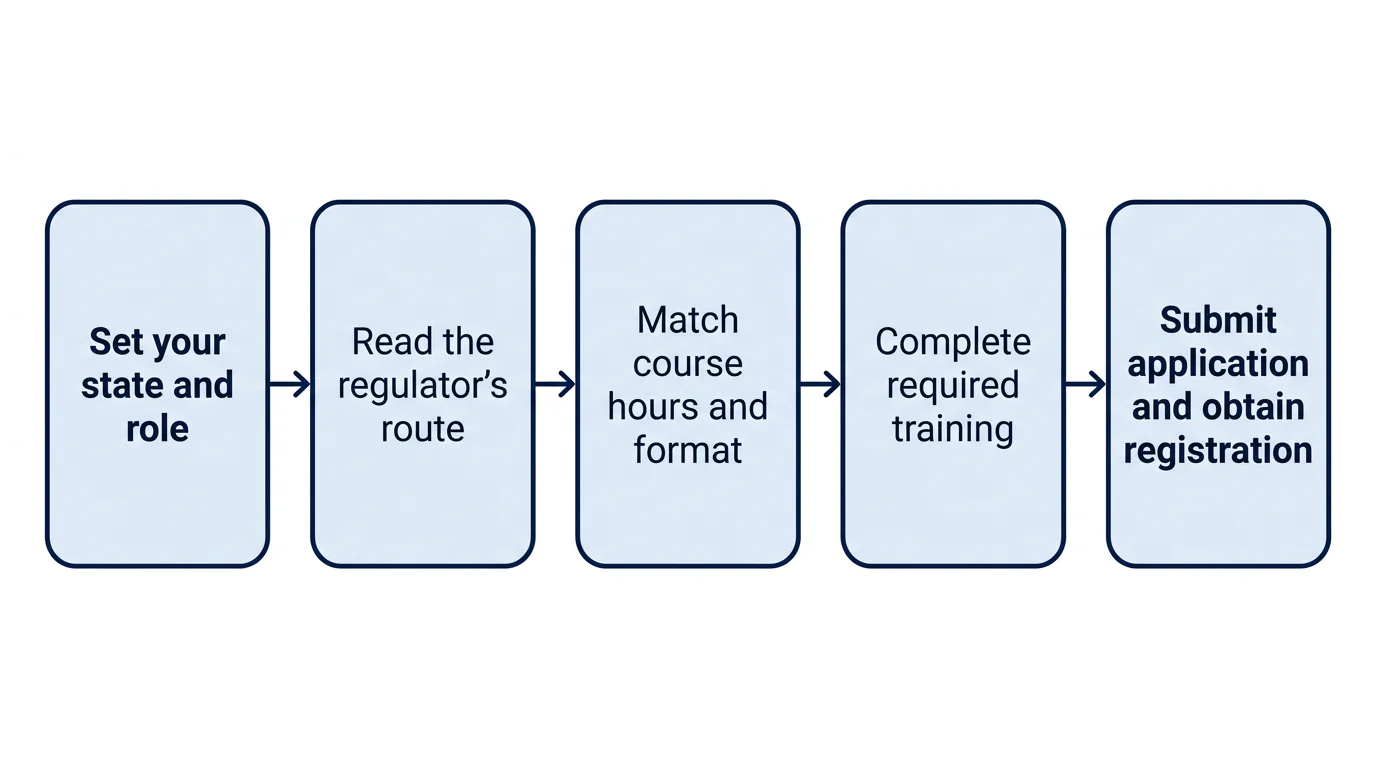
Use a course card to compare learning outcomes and delivery format, then use the state regulator to confirm whether its hours, practical work and documentation fit your path. For broader state-fit questions, read which online guard training meets state rules or take the security guard training readiness quiz.
What the four prices actually buy
Our own course is the budget choice for a four-hour foundation in executive-protection planning and team roles. ASIS International’s Essentials programme is a shorter organisational overview, Phalanx provides scheduled live-online instruction, and EP Access’s masterclass is specifically for advance work. Prices and course details are as of September 2026: ASIS International’s product page, Phalanx Training Academy’s course page and EP Access’s course catalogue provide the third-party details below.
A four-hour introduction is not a substitute for a route that requires practical exercises, medical credentials, firearms qualifications or a state registration. Choose the format that matches the skill you want to build, then confirm the legal route separately.
How we built this list
The ranking compares four live course offers with publicly stated prices. Each award identifies a different use case, rather than claiming that one programme is best for every state or role. State requirements are assessed separately because training completion and authority to work are different steps.
This page is published by Learning Shop USA. If anything here is out of date, tell us and we will correct it.
Sources
- 1.Approved Close Personal Protection Courses, North Carolina Department of Public Safety, 2026
- 2.Personal Protection Specialist, Virginia Department of Criminal Justice Services, 2026
- 3.Individual License Questions, Texas Department of Public Safety, 2020
Related pages
Frequently asked
No online course completion certificate should be treated as a licence by itself. State routes can require defined training hours, practical exercises, medical credentials, firearms qualifications, applications or current registration before a person may work in a regulated role.
A beginner who wants a low-cost introduction should choose a short foundation course that explains protection planning, risk and team roles. A beginner seeking regulated executive-protection work should first check the requirements of the state and role they plan to enter.
Practical training matters when the state pathway or intended work calls for it. North Carolina’s close-personal-protection route includes 12 hours of practical exercises, while Virginia’s entry-level curriculum includes practical exercises and performance evaluation.
Compare the course’s hours, delivery format, stated learning outcomes, assessments, certificate type and whether it covers the regulator’s required subjects. Check whether your intended role is armed or unarmed, because that can add separate training and credential requirements.
Start with a four-hour executive protection foundation
Our self-paced Executive Protection course covers planning, risk, team roles and after-action reporting.
Enrol in Executive Protection